The Fountain of Youth: The Factual Fiction

ponceExactly 500 years ago, give or take a day or two (they used a different calendar back then) Juan Ponce de Leon and a couple of hundred conquistador buddies were sailing off the coast of what he called Florida.  Although this wasn’t exactly the world’s first all-inclusive Caribbean cruise, it was the first time European tourists had shown up in the Sunshine State in any serious numbers.  Legend has it (and some people still believe) that Juan was an idiot, out searching for the Fountain of Youth.  Serious historians pooh-pooh this interpretation; mainly because nobody connected to the expedition mentioned anything about it at the time.  In fact, the Fountain of Youth story only shows up, ironically, more than ten years after Ponce de Leon died.  However, Ponce de Leon will forever be connected to The Fountain of Youth — credible history or not.

The problem with Ponce de Leon is his historical fact has gotten tangled up with his historical fiction, and now a lot of people can’t tell the difference.  Let me help.

First, a quick and dirty run at the facts.  Juan Ponce De Leon was a soldier.  He made his bones fighting with Ferdinand and Isabella against the Moors i the Reconquista of Spain.  When that was over (circa 1492) rather than take early retirement (the guy was 18 or 19) he decided to try his conquistadoring luck in the New World, and like most folks who get into a good thing early and stick with it, he did quite well for himself.  He signed on with Christopher Columbus, on his second voyage to the Americas, and ended up in Hispaniola.  Conquistadoring was booming at the time.  Apparently, less than 10 years into this “We Discovered America” business, the locals were already fed up with the illegal immigrants from Iberia who were wandering around as if they owned the place.  They wanted them to go home — at spear point, if necessary.  Unfortunately, Ponce de Leon was not the guy to mess with on this one.   In fact, he was so good at beating up the natives he was made the governor of a province.  As a kick-ass soldier and competent administrator, he was earmarked to explore and settle Puerto Rico when the guy who was supposed to do it didn’t.  He went there around 1508, and when he discovered gold, he was made governor of the new colony he’d established there.  This is where it gets complicated.  Suffice it to say there was a problem between Christopher Columbus’ son, Diego Colon, and Ferdinand of Spain.  Ferdinand needed to curtail Colon’s power, and so he gave all the rumoured lands north of Puerto Rico — notably “the islands of Benimy” — to Ponce de Leon, as long as he explored and settled them.  In 1512, Juan headed north to see what he could do, and six months later, he and his bros were doing Spring Break in Fort Lauderdale.ponce2

So how did we get from straightforward Spanish Imperial history to a Captain Jack Sparrow/Penelope Cruz Fountain of Youth adventure?  Easy!  Bad information and bad interpretation!

Stories about a Fountain of Youth are as old as the Pharaohs’ search for immorality in their Pyramid tombs.  Herodotus, the first historian, talked about it as an old tale.  Arab scholars, who kept his and other ancient texts alive during the European Dark Ages, wrote about it up to medieval times, and it was certainly know to the Spanish who’d been going through the Moors’ abandoned libraries, burning everything they didn’t understand.  To the early Spanish explorers, therefore, the Fountain of Youth was as real as El Dorado and the lost Christian Kingdom of Prester John.  These things were all findable.

Meanwhile, in the Caribbean, the natives were telling tall tales about a land just over the horizon.  This place was the second coming of Eden — where the waters held the key to everlasting youth.  Obviously, the Spanish were interested.  However, since none of the locals had actually been there, they were probably giving a garbled version of the Mayan civilization.  The Mayans, in order to please their gods and make it rain, had a nasty habit of rounding up scores of youthful virgins and offering them immortality. The only catch was the virgins had to have their throats cut — usually while standing over a fresh water sinkhole called a cenote.  The stories the Spanish got were heavy on the immortality and the water and seriously light on the throat cutting.  Anyway, the locals called this “wonderful” place Bimini.  (Sound familiar?)

Decades later, when Spanish scholars were writing the histories, they came across the native accounts of Bimini and Ferdinand’s offer of “the islands of Benimy.”  They put dos a dos together and came up with cinco: Ponce de Leon had been looking for the Fountain of Youth all along.  From there, all it took was 500 years of repetition to utterly erase the line between fact and fiction.ponce1
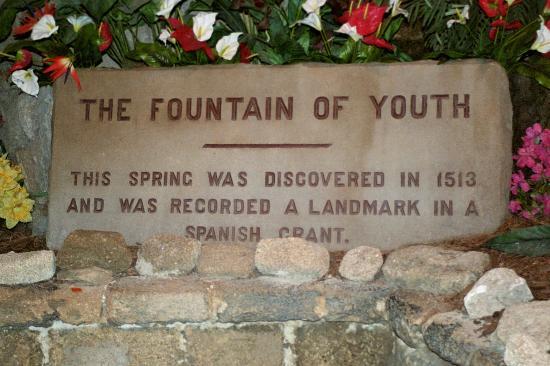
History has a way of sorting things out, though.  These days, when you look around the great retirement communities of Florida, you’d swear the search for the Fountain of Youth is still going on.

North Korea: Time to Get Serious

korea3Could we just hit “Pause” for a second and think about this thing?  Maybe stand down the Stealth Bombers, unlock the lock and load and tone down the rhetoric?  I realize that when a punk like Kim Jong whatever-he’s-calling-himself-this-week is kicking sand in your face, it’s difficult to calm down – but let’s give it a try.  We need to remember a few things before somebody forgets what we’re dealing with and all hell breaks loose.

Okay, folks!  All aboard the reality train.

First of all, don’t let the tough talk fool you.  Ever since Dougie MacArthur, Truman’s ten-star general, threatened to turn Pyongyang into a mud puddle, the Kim boys of North Korea have been yipping a good fight without ever throwing down.  That’s not to say they won’t, but history has shown us that, like the elementary school bully, these guys are professional bum biters.  They pick their spots and never do anything serious enough to risk major retaliation.  They might talk like hard men and take a few cheap shots, but grandfather, father and now son are smart enough to know just how far they can push it.  They realize that if they ever did take a real run at the United States or any of her allies, they’d be out of a job by close of business Tuesday.  Cold War stalemates may have been all the rage in the 50s, but they’re pretty much passé these days.

Secondly, anybody who thinks Kim Jong-un is running the show north of the 38th parallel has got another think coming.  Yes, he’s the current Glorious Leader and latest member of the Kim dynasty that Stalin put on the throne back in the 40s — but that doesn’t mean much.  There’s an entrenched state apparatus in North Korea that’s been calling the shots for over sixty years.  These folks are the descendents of Kim il-Sung’s (Un’s grandpa) original band of gangsters revolutionaries.  They keep everything that’s worth controlling firmly in their grasp, and they’re not about to lighten up on that grip of steel any time soon.  In short, Kims may come and Kims may go but the high-end folks of The Hermit Kingdom have a pretty good gig, and they’re not going to jeopardize it by taking a flyer on this kid’s nuclear adventuring.

Finally, and most importantly, North Korea is a “sovereign state” in name only.  In theory, it might have a flag and a nationalModels of a North Korean Scud-B missile and South Korean missiles are displayed at the Korean War Memorial Museum in Seoul anthem, but in practical terms, it’s about as independent as Nebraska.   I doubt very much if the powers that be in Pyongyang go to the toilet without telling Beijing what they’re up to.  Unless you flunked history, economics and current events in high school, you realize that North Korea is China’s surrogate.  It is North Korea’s only serious trading partner, and, as such controls over 70% of its economy – such as it is.  Besides, it’s not even close to plausible that the Chinese would allow a nuclear arsenal within spitting distance of The Dragon Throne if they didn’t have it on a leash.  And speaking of nuclear weapons, how does a “nation” without enough hard currency to buy a Happy Meal™ get its mitts on weapons-grade plutonium, never mind build the facilities it takes to make it work?  It’s obvious that China is pulling the strings south of the Yalu River.  This latest bit of sabre rattling may be nothing more than a no consequence test of American resolve in the area.  Personally, I think it’s more than that (remember: China just launched its first aircraft carrier into the South China Sea.)  But then I’m not getting the big bucks from the State Department for my opinion.

However, if I was, I’d mention that this new kid in the Petty Little Dictator Club is trying to impress the neighbours and make a name for himself with the locals.  He’s talking a good fight, but like his daddy, he isn’t likely to launch anything more than his mouth — if he does, China spank.  We need to let him know, in no uncertain terms, he should back off before somebody (mostly he) gets hurt.  However, we also need to take our fingers off the trigger just in case somebody gets twitchy and this whole thing blows up – by accident.

The Lost Easter Eggs

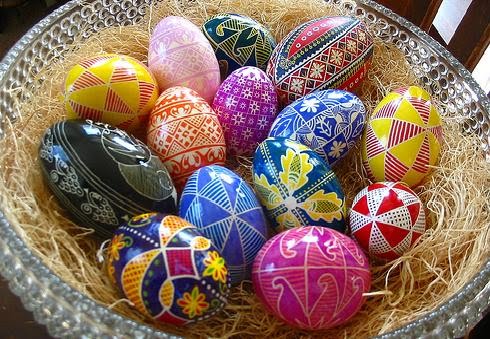
easter2I know I’m a day late and probably a few rubles short, but I want to talk about eggs.  No, not the ones that the bunny left yesterday or the ones that show up in your McMuffins, but real, honest-to-God Easter eggs that retail for 8 to 10 million dollars.  These are the Romanov Eggs, incredible treasures left over from the days of Imperial Russia.

Just a quick review.  The Romanovs were the boys (no girls allowed — except Catherine the Great) who ran the show in Imperial Russia for three hundred years.  At the peak of their power, in the 19th century, their writ ran from the North Pole to the Himalayas and from the Vistula River to the Pacific Ocean.  It’s hard to understand these days, but as absolute autocrats, they literally owned everything within those borders— down to the last babushka, and, more importantly, the grandma who was wearing it.  When a Romanov said jump, you didn’t waste his time asking how high; you got your ass into the air.  It’s no accident that the Russian word czar is derived from the Latin Caesar and that’s how the Romanovs thought of themselves.  Unfortunately, that’s what eventually got them into trouble, but that story’s for a different time.

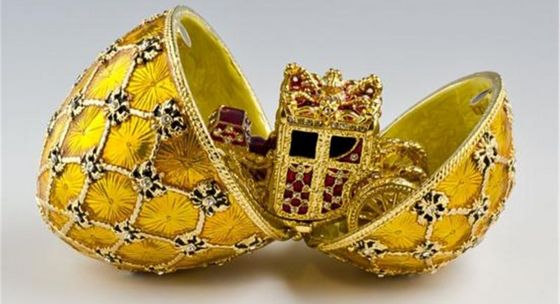
It was Czar Alexander III who came up with the idea of an Imperial Easter Egg.  Somewhere in the mid 1880s, he decided to give his wife, the Czarina Maria, a present for Easter.  (BTW, Easter is the highest holiday on the Russian Orthodox religious calendar.)  However, if you’re Czar of all the Russias, you can’t very well cruise down to Walmart and check out the sales; you have to come up with something special.  The Czar settled on an understated single egg, but one so elaborate it would thrill a woman who literally had everything.  He called on Pierre Faberge to make it so, and the result was beyond everybody’s wildest expectations.  The Hen, made of gold and enamel, looked like a real egg.  However, it opened up to reveal a yolk ,which, in turn, opened to reveal a chicken which also opened to reveal a diamond miniature of the Imperial crown and a ruby pendant that the Czarina could wear.  Everyone was so delighted with Faberge’s efforts that an Easter tradition was born.  From that Easter in 1885 — until Lenin and his pals put a stop to it in 1917 — Faberge made a number of Easter Eggs for the Imperial House of Romanov.

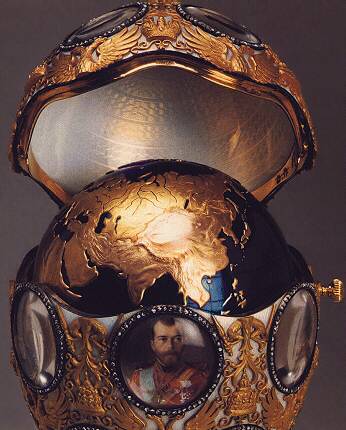
The Imperial Easter Eggs were exquisite examples of Romanov opulence; intricate toys encrusted with jewels.  For example, theegg3 Trans Siberian Egg had a small train inside that could be wound with a key so that it ran on a tiny track.  The Peter the Great Egg held a replica of his St. Petersburg statue which rose out of the egg when you turned a dial.  The Tercentenary Egg had hand-painted miniature portraits of all the Romanov czars and a globe made of coloured gold that showed Russian expansion.  Each of these “eggs” was flawless (the Trans Siberian train had windows made of crystal!) and cost millions of rubles.  Remember that the Faberge name was not always attached to the glitz we see today.  In the beginning, Faberge dealt exclusively in jewelry, objets d’art and unequaled elegant craftsmanship.  They were the greatest jewellers of the 19th century — no contest – by appointment to the Imperial House of the Romanovs and some of their wealthier friends.  Translation: Faberge made trinkets for the rich which were so expensive, even the rich couldn’t afford them. Only high-end nobility and their uber-wealthy compadres could meet the tariff.  The objets d’art Faberge made for the Russian aristocrats were practically obscene, especially when the average Russian of the time lived his entire life on black bread and cabbage–and not very much of that.  One Romanov egg could have set a Russian village up for lif, and by the time the Soviets confiscated them during the revolution in 1917, there were 50 or so of these baubles kicking around the Imperial palaces.

This is where it gets interesting because, like so many things that went through the Russian Revolution, there are strange circumstances surrounding the Romanov “Easter eggs.”

First, nobody is 100% certain how many were actually made.  Most sources have settled on 50, but some say 52, and some as high as 54.  Oddly enough, even though there are records, nobody seems to have kept track.  Granted, the Romanovs had been collecting art for three centuries; they had a bunch.  (Even today, The Hermitage in St. Petersburg has the largest single collection of art in the world, and most of it used to belong to the Romanovs.)  One piece here or there could go unnoticed.  However, when the ornaments are worth millions, somebody somewhere is supposed to know how many there are.  It’s pretty darn strange that even today, after nearly 100 years of research, scholars can’t agree on what was there in the first place.

Secondly, some of the “Eggs” have been lost.  Again, nobody seems to know how many.  The general figure is eight, but that’s open to discussion.  Regardless, how does one lose even one table-sized Easter egg that’s gold, heavy and sparkling with jewels?  It’s not like you could forget it with your umbrella on the bus. Somebody would notice.  Certainly, in all the confusion of 1917, the Imperial household may have misplaced a few things.  Also, it’s entirely possible that, during the Revolution, some of the People’s Commissars may have helped themselves to an item or two– just in case the whole communist gig didn’t work out.  These are possible scenarios, but the real problem is that when the Soviets confiscated everything Romanov, they treated in all with cavalier disdain.  This was capitalist decadence at the high end, and no self respecting Bolshevik was going to sully his ideology with it.  For example, when the “eggs” were finally inventoried (over several years in the 20s) because Stalin had bankrupted the country, the records were woefully incomplete — plus no photographs were taken.  To make matters worse, when Stalin gave businessman Armand Hammer nobody knows how many “eggs” to sell in America for the hard currency he needed, he didn’t bother to get a receipt.  So there are no records of what Hammer had, sold or gave to Value Village.  The Soviets didn’t care, as long as they got the cash, and Hammer conveniently burnt his books just in case the American Federales looked too closely at his communist connections.  Thus, somewhere between 1917 and now, at least eight — or maybe more — pieces of priceless Russian art have been lost.

egg2As we all know, aside from socks in the dryer, “lost” is a relative term.  These “Easter Eggs” have to be somewhere.  Yet, one would think that after all these years, their enormous value would bring them back into the public eye.  It hasn’t.  Obviously, some connoisseurs are content to enjoy their collection in secret–and keep their mouths shut.  However, most experts believe that, in some cases, whoever has one of the “lost” eggs may not be aware of what they own.  For example, we now know that, back in the 60s, a genuine Faberge egg, not identified as such, sold at a New York auction, for less than $10,000. (Sotheby’s is still trying to track down both the buyer and the seller.)  To put things into perspective, in 2007, the Rothschild Egg (which is not a Romanov egg) sold for 13.5 million dollars.  (Big difference, huh?)

The bottom line is that somewhere out there, there’s a czar’s ransom in “lost” Romanov treasure.  Perhaps now that the sugar shock of Easter has worn off, you might want to plan a trip to see Great Aunt Olga and take a browse through her china cabinet.  Who knows? It might be worth the trip.