Thirty years is a long time. It’s more than a generation. It’s on the very edge of living memory. So it’s no surprise that not many people know that today marks the 30th anniversary of two very important events in the history of tyranny. One — under the diligent efforts of an oppressive government — fading from view; the other, largely forgotten for very different reasons.
In the spring of 1989, protests across China were gathering momentum. They called for the total reform of the Communist government, and their epicentre was Tiananmen Square. The Square had been occupied by thousands of students from Beijing’s universities since the middle of April. On May 20th, the Chinese government declared martial law and ordered the students to leave. In an unheard of act of disobedience, the students refused. Two weeks later, on a warm evening in June, Deng Xiaoping called in the military, and the protesters in Tiananmen Square began hearing reports that the People’s Liberation Army was on the march. What they didn’t know was the unarmed citizens of Beijing were fighting a desperate battle to stop the tanks. All over Beijing, ordinary people had crowded into the streets to defy the People’s army – human barriers facing totalitarian steel. The army didn’t care. They had their orders. They opened fire. Stunned and enraged, the people fought back. They threw up makeshift barricades and pelted the trucks with bottles, stones and Molotov cocktails. But there was never any doubt: shopkeepers and office workers are no match for professional soldiers with automatic weapons. Hundreds were killed that night, thousands injured and the trucks rolled on; their objective, the students in Tiananmen Square. By midnight, the Square was surrounded and the young people were given an ultimatum: leave Tiananmen, or face the consequences.
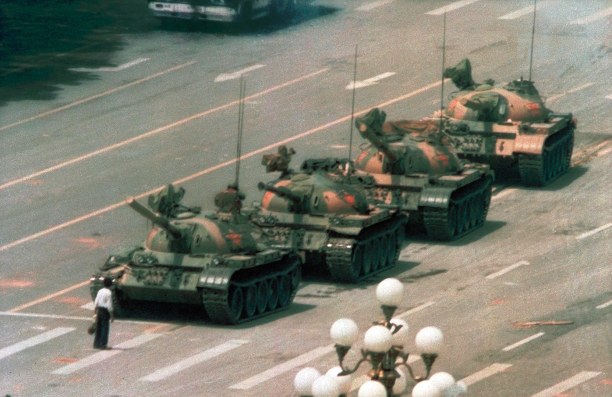
There is no definitive account of what happened next. Some say hundreds more were killed, but the Chinese government insists that there were no further casualties. What we do know is most of the students did not leave voluntarily. (There are videos of them, amid sporadic gunfire, shaking their fists at the soldiers and singing The Internationale.) But we also know that, by mid-morning, the students were gone, and later, when a crowd of people (mostly parents looking for their children) approached the Square, the soldiers once again opened fire and then called in more tanks. (We have a famous photograph of one man’s brave attempt to stop them.) Whatever happened in the dark, early hours of June 4th, by the end of the day, the Chinese Spring was essentially over; ironically, crushed by the People’s Liberation Army.
Halfway around the world, June 4th, 1989 was Election Day in Poland. But this was no ordinary election because, for the first time in 50 years, there was more than one name on the ballot. For the first time since Hitler and Stalin had carved up the country in 1939, Poles had an opportunity to choose who would rule them, and millions were determined to make that choice. In the big cities, the turnout was cautious; still, thousands waited patiently for their turn at democracy. In other parts of the country, small towns were virtually shut down as everyone who could, went to the polling stations. By the end of the day, it was clear that Lech Walesa’s Solidarity Party had broken the power of the Communists. They’d won every seat they were allowed to contest in the Sejm (parliament) and 99 out of 100 seats in the Senate. Their victory was so overwhelming many thought Moscow would annul the vote and send in the Red Army. (It had been done before.) But Mikhail Gorbachev was not Leonid Brezhnev, and in 1989, the Soviet Union had its own problems. The results were allowed to stand. It was the first tear in the Iron Curtain that had divided Europe and dominated world politics for 45 years. Here was proof that the Communist State was not invincible. Within four months, the people of Berlin had pulled down the Berlin Wall. Less than a year later, most of the other Warsaw Pact nations had held their own free elections, and Germany was reunified. Within two years, the Soviet Union itself collapsed: the Cold War was over.
Today, no one much remembers Lech Walesa, the Soviet Union or the Cold War, and China’s economic power has made it expedient to shut up about Tiananmen Square. Besides, our world is much more concerned about who’s wearing what on the Red Carpet and which celebrity wrote something unfortunate on Facebook five years ago. But we need to remember these tales of tyranny because — even though eventually the pen is always mightier that the sword — there are also hard occasions when the sword wins.
 WD Fyfe