What Time Is It?

time

Our lives are governed by time – that artificial construct that measures everything we do.  We divide our days into minutes and hours.  We multiply our days by weeks and months.  And we commemorate our years with an annual cake-and-candles celebration.  We work by the clock, sleep by the clock, arrive and depart by the clock and even play games by the clock.  Our language is full of references to time.  We say things like “fast food,”  “running late,” “split second” and “give me a minute.”  These phrases mean more than their literal meaning and everybody understands that.  Yet, despite our apparent obsession with all things temporal, there are lots of occasions that we don’t bother to measure or even name.  These are regular events that happen to everyone, so it seems weird that we treat them so casually.  Here are just a few examples — and I’m sure the world would be a better place if they had names.  Feel free to offer suggestions!

The time we spend waiting for doctors.  Every doctor, from Boston to Beirut, has a waiting room, and it’s called a waiting room for a reason.  It’s where we go to wait until – I don’t know — your name comes up in the lottery?  And this doesn’t just happen once in a while – it’s every time.  Personally (given this kind of regularity) I think we should have a name for the time we all spend rehearsing our symptoms and looking at out-of-date magazines.

The length of time between when the repairman says:
“No problem!  We’ll get this taken care of in a couple of hours.”
And
“Nah!  We had to order the part from the manufacturer in Borneo, and we have no idea when it’s going to get here.”
There should be a name for that feeling of gathering doom.

The length of time it takes to get rid of a headache.  I guess we could just call it “to infinity and beyond” and get it over with.

The time between when we buy the gym membership (and swear by all that’s holy we’re going to go 3 times a week) and the time we take the membership card out of our wallets to make room for the Cupcake-of-the-Month card.

The time we spend in a traffic jam, between when every car within 10 kilometres (6.21 miles) slows down to a crawl, and when we discover that there was no road construction, no collision, no dead pedestrians: in fact, no reason whatsoever for traffic to come to a standstill.  Frustration should have a name.

The time we spend with the remote control, dancing through the Netflix’s selections, trying to find something really, really good to watch.

The time between now and never.  This is a negotiable unit of measure that lasts from the time we say something like, “I’ll never drink tequila, again” and the time we think “What the hell” and pull out the Jose Cuervo.

The time between when the computer guy (it’s always a guy) starts telling us what to do to fix the problem and the time we realize we don’t understand a word of this gibberish and start jamming the keyboard — like a Rhesus monkey looking for a food pellet.

But my favourite is:

That situation when something important is going to happen in the near future and we’re completely ready for it.  We’ve done all the prep, got dressed, gathered our stuff, been to the toilet, etc., etc., and now … and now ….  Suddenly, there’s not enough time to do anything but too much time to do nothing.  Seriously!  This needs a name.

“Only” – An Unsung Hero!

unsung hero

“Only” is the hardest-working little word in the English language.  It does stuff that other words just dream about.  It modifies nouns, it modifies verbs, it connects phrases and, depending on where you place it, it can change the entire meaning of any sentence.  “Only” has so much talent; I’m sure all the other words are jealous.  But does anybody sing the praises of “only?”  Do you ever hear, “Good job, ‘only?’ or “Thanks, ‘only!’ You really spiced up my sentence?”  Nope!  Never happens!  The truth is, nobody thinks about “only.”  It just hangs out in the dictionary with all the other words (who don’t do half as much work, BTW) waiting for some writer who’s searching for subtletyThat’s when “only” jumps into the literary fray, without hesitation or fanfare, and gets the job done.  And what a job!  Here are just a few examples of what “only” can do.

It can kick-start an argument

“You phone me when you want to sleep with me.”
A legitimate statement, invitation or dismissal.
“You only phone me when you want to sleep with me.”
Suddenly, somebody’s a jerk and the war’s on.

It can convey emotion.

“He lost his friend when his dog ran away.”
Aww, that’s too bad.
“He lost his only friend when his dog ran away.”
OMG!  That’s s-o-o-o-o sad!

It can turn an ordinary evening into something special.

“She was wearing an apron when he came home.”
“She was only wearing an apron when he came home.”

Pair “only” with “if” and you get a ton of regret.

“If I’d kissed her, she wouldn’t have married Malcolm.”
“If only I’d kissed her, she wouldn’t have married Malcolm.”

Lawyers love “only” because it can mitigate the circumstances.

“She robbed the bank.”
“She only robbed the bank.”

But it can also assign blame.

“When the fire started, he tried to save himself.”
What a quick-thinking individual!
“When the fire started, he only tried to save himself.”
Selfish bastard!

Or it can turn a good deed into a reprimand

“She cleaned out the closet before she sat down and watched TV.”
Very responsible.
“She only cleaned out the closet before she sat down and watched TV.”
Lazy snot!

Or it can change the meaning entirely.  And this is where “only” really flexes its muscles.  Take a look at this single simple sentence.

“She told him that she loved him.”

Now, sit back and see how “only” changes the meaning — seven different times.

Only she told him that she loved him.
She only told him that she loved him.
She told only him that she loved him.
She told him only that she loved him.
She told him that only she loved him.
She told him that she only loved him.
She told him that she loved only him.

I think it’s time we all take a moment out of our busy lives, pour a glass and drink a toast to “only,” the unsung hero of syntax and semantics.

“Here’s to you, ‘only!’  Keep up the good work!”

Stuff I Learned From Food

cuisine-2248567_1920

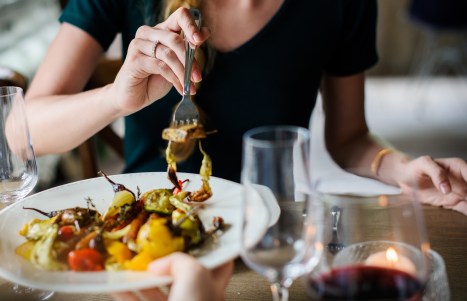
Humans are the only species on this planet (aside from cats) who play with their food.  We mush it, we mix it and we marinate it.  We slice it.  We spice it.  We shape it with our hands.  We do things to food that nymphomaniacs and pyromaniacs only dream about.  At various times in our lives, food is our trusted friend, our relentless lover and our sworn enemy.  Food shares the blame — and the praise — for being both our master and our slave, and we can never quite reconcile that schizophrenic relationship.  Here are just a few things I’ve learned from food.

Fast food is usually neither.

If you can’t pronounce the ingredients listed on the package, they’re probably going to kill you.

Really good soup is actually just very wet salad.

That green stuff in the back of the fridge is never salad.

Red wine hates white carpet.

You can try but you can’t really disguise something disgusting simply by saying it tastes like chicken.

Haute cuisine is a French phrase that means “a bad cut of meat camouflaged with a pretentious sauce.”

Calling Italian cuisine “food” is like calling the Mona Lisa “paint.”

Potato chips (crisps) are free.  You’re actually paying for all that flavoured air trapped inside the bag.

The biggest secret in the world is that the vast majority of consumer honey isn’t honey; it’s some kind of weird, processed corn syrup.  (Sadly, this is true.)

Even though Cheerios™ taste like cardboard, they’re actually good for you.

“Swiss cheese is only cheese now and then.”  – Mitch Hedberg

Broken cookies don’t have calories: the calories escape when the cookies break.  Sounds legit!

You can run British mud through a French kitchen and you’ll end up with something that tastes pretty good, but if you run French food through a British kitchen, you’ll end up with mud.

In North America, barbeque is the last bastion of acceptable male behaviour.

Surprise!  Perrier is just water in a cute, green bottle.

If you microwave leftover pizza and call it “Italian toast,” it tastes better.

And finally:

Forget lingerie, music and candlelight — coffee, red wine and chocolate are the Holy Trinity of a romantic evening.