The Commonwealth: Use Your Imagination

Deep in the afterglow of an incredible Olympic Games and a rekindled British spirit, there’s talk around the campfire that maybe the Commonwealth isn’t just a quaint affectation of a used-up Super Power.  In fact, no less an illustrian than ex-Canadian and convicted felon Conrad Black has run the idea of a resurrected Commonwealth up the international flagpole to see if anybody bothers to salute.  It’s a curious notion that isn’t going to get a lot of attention, but maybe it should.

In theory, The Commonwealth is the natural devolution of the British Empire – a collection of states bound together by (if nothing else) a common colonial experience.  These states share a tradition of British law, parliamentary democracy, education and language.  They are, in reality, and according to Commonwealth doctrine “not [entirely] foreign to each other.”  So much for theories.  In truth, the Commonwealth is an organization (and I know I’m going to get some emails about this) badly in need of a purpose.  What good it does do around the world goes largely unnoticed, and most people assume it’s just a holding tank for stodgy old colonials, with a few dusty monarchists congealing on the side.  Realistically, the Commonwealth simply does not swim where the big boys feed.  It has neither the infrastructure, the management nor the common direction to heft any weight internationally.  It’s only raison d’etre seems to be to voice a few high-minded principles and host the Commonwealth Games.

The weird thing is, however, an invigorated Commonwealth actually makes a lot of sense.  Look around.  Who takes the United Nations seriously anymore – aside from guys like Chavez and Mugabe?  Even Obama works around them when he feels the need.  OPEC is permanently attached to their petro-dollars, and the Arab League isn’t interested in anything beyond the Middle East and whatever anti-Israeli rhetoric is flavour-of-the-week.  Meanwhile, the European experiment is rapidly turning brown, and the Euro itself is on the verge of folding up like a cheap lawn chair.  If Merkel and Hollande can’t find some common ground soon, this time next year, this planet’s largest economic unit might be slowly sliding into the Mediterranean.

On the other economic hand, four of the sixteen largest GDPs in the world belong to Commonwealth nations.  In total, the Commonwealth has a combined Gross Domestic Product of over ten trillion dollars.  That’s second only to the EU and the USA.  It has a population of 2.1 billion — which makes it the largest single organization in history.  Folks, that’s enough purchasing power to get a discount outta WalMart!  Merely turning the Commonwealth into a Free Trade Zone without any other added economic attractions — would be like hitting the world economy with a double dose of adrenalin and a Red Bull™ chaser.  Whatever recession the IMF had in mind – forget about it.  It would be over instantaneously.  Individually, the Commonwealth states have enough natural and human resources to feed, clothe and power the world.  As a single economic unit with proper development and a little imagination, there is simply no limit to what it can accomplish.
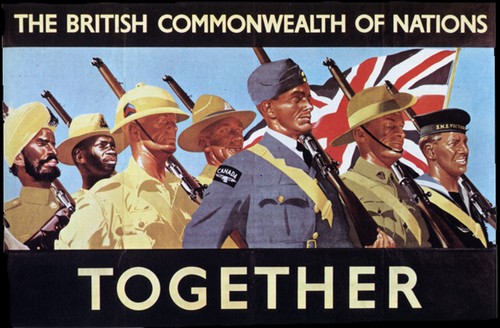
Actually, the idea of a super-economy, built out of the British Empire, is an old one.  It’s a 19th century philosophy that found its voice in Joseph Chamberlain, a Victorian Era politician.  His idea was to form the Empire into a closed shop, eliminating trade barriers within the British Empire but erecting tariff walls around it.  Forged as a single economic unit, the Empire would generate immense internal wealth and secure Britain’s position as the world’s only superpower for another century.

Unfortunately, Chamberlain never convinced the British government to step away from its policy of free trade.  As early as 1910, the balance of British trade was beginning to tilt away from the Empire in favour of America (with a corresponding outflow of cash.)  Four decades of that — and a couple of expensive world wars — and Britain simply couldn’t afford its empire anymore.  A simplistic view I’ll grant you, but true all the same.

Very soon, empires will no longer be political; they’ll be economic.  The Commonwealth has the potential to be history’s greatest superpower, but don’t hold your breath.  There are too many national egos involved.  But mostly economists don’t make policy; politicians do.  Unfortunately, they have neither the imagination nor the political will to make something as radical as a non territorial political entity work.

Olympics: A Postpartum World

The Olympics are over, and for those of us who have been going solid walls of TV coverage for the last two weeks, there’ll be a day or two of decompression – postpartum depression, if you will.  Since there’s only one way to “get the athlete off your back” and that’s going cold turkey, there will be some minor side effects.  They might include (but are not limited to) engaging in meaningless tests of skill with your friends or relatives, listening to various national anthems on YouTube and experiencing an uncontrollable urge to visit Jamaica.  Not to worry, though: these cravings will pass with time, and normal (whatever that is) will happen again, whether you like it or not.  Good luck!

Incredible as it seems, while you and I were gone, the world was carrying on without us.  Ironically, just as Team GB (Great Britain, for the uninitiated) was proving it could still run with the big boys, David Cameron’s coalition government was showing some serious signs of Banana Republic instability.  Davey boy needs to get his political house in order before the Olympic honeymoon‘s over, or he’s going to be relegated to shouting insults from the other side of the aisle.  Bad as that seems, Europe’s problemo numero uno is still the red ink that’s hemorrhaging out of Greece, Italy and Spain.  It’s obvious that the cozy relationship Angela Merkel had with her Gallic neighbours died when the French people au revoir-ed Sarkozy in May.  Angie better start cracking the Euro whip, or, overwhelmed by his own ideology, newly-minted French president Francois Hollande is going to try retrofitting his 20th century politics into Europe’s 21st century problems.  The last thing Europe needs right now is another dose of what got them into this mess in the first place!

Meanwhile, over in the desert, Bashar al-Assad is going for the gold as Syria’s candidate for dick-tator of the year.  At last count, he had out-Mubarak-ed Mubarak, and with the help of his Iranian buddy Ahmadinejad, was going for the full Gaddafi.  Correct me if I’m wrong, but didn’t we just slap the crap out of Muammar for half the malfeasance this guy is getting away with?  Assad is hanging onto power in Syria by his eyebrows, and if he thinks his friends in Tehran are going to pull his almonds out of the fire, he ought to give his head a shake.  As of the massacre in Aleppo, the only way Assad is going to end his days is Syria is getting dragged through the streets of Damascus in his underwear — and there’s nothing he can do about it.  Prolonging the agony is not going to save him.

It’s not all bad news, though: in America, Mitt Romney has named his running mate, Paul Ryan.  Ryan is a game changer.  Suddenly, the American presidential election is a whole lot more than just uber-cool Obama versus Massachusetts’ answer to The Man from Glad™.  It’s now a campaign of ideas.  Finally, somebody’s going to have to start talking about all the red ink America’s been accumulating (I’m looking at you, Barack) and offer something more than “hope” as a solution.  This may be the first time — ever — that an incumbent president had to run against the other party’s vice-presidential choice!  But what the hell!  We may even get beyond Wheatley versus Pedro (ala Napoleon Dynamite.)  Who knows?

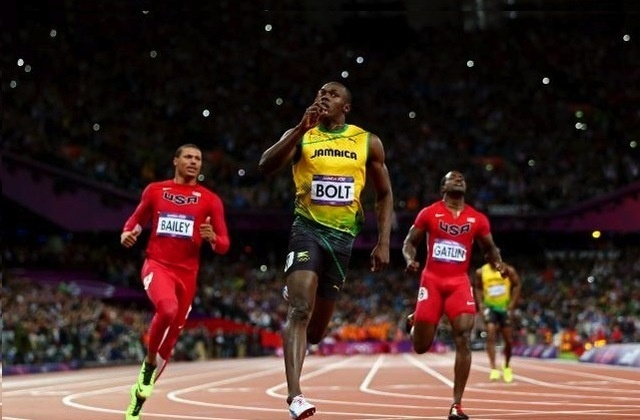
Tons of other stuff happened while you and I were watching Usain Bolt dismantle the record books and rebuild them in his own image.  For example, somebody discovered a huge island floating in the Pacific, north of New Zealand.  It’s called a ‘pumice raft,” and it’s made of coagulated rocks from an undersea volcano.  Apparently, this thing is as big as Belgium!  And, oh yeah: the Americans went interplanetary again and landed a rover on Mars.  The pictures are fantastic.

So, don’t get too bothered about your Olympic hangover.  There’s plenty of other things going on in the world.  Besides — football season starts in less than three weeks, and the World Series is right around the corner.

Why Are We Taking Syria Seriously?

I can say, without much fear of contradiction, that Bashar al-Assad is a punk.  Back in the day, Sinatra could have taken the guy!  Yet, here we are, eighteen months into the Arab Spring, and he’s still kicking around.  Muammar’s gone; Hosni’s on his last legs; and both of those boys ate ruthless for breakfast.  Yet there’s old Bashar, still bashing away at the opposition as if he didn’t have a care in the world.  He looks like Monty Python’s idea of an accountant, for God’s sake!  And he didn’t even seize power like a proper tyrant; he inherited it from his dad!  Just like you and I got the gold watch and the antique power tools.  So why is he getting treated like the bogeyman he never was?

The problem is everybody’s taking Syria seriously.  We’re all acting as if Bashar dines at the Head Table.  He doesn’t!  In any place other than Damascus, the waiters are shouting, “Ba’ath, Party of none.”  (In case you’re keeping score, Assad’s Syrian Ba’ath Party is the last fragment of a crowd of regional secularists, whose only other claim to fame was Saddam Hussein.)  The country might be strategically placed in the Middle East and have a few powerful friends, but that’s about it.  Syria hasn’t been a player on the world stage since right around the time Nero was getting his first violin lesson.  So let’s just put things into perspective, historically speaking, shall we?  This is the decaffeinated version, but it’s close enough for our purposes.

Syria sits on a multitude of ancient civilizations.  Humans have thrived there since before we quit hunting and gathering and started planting cash crops.  The brag is Damascus is the oldest continuously inhabited city on earth.  It’s easy to believe, since Syria sits on the crossroads of the old land routes from Egypt and Africa to Europe and the Far East.  Two millennia ago, it was so important that Rome sent Pompey the Great to conquer it, which he did in the 1st century BCE.  At one time, Antioch was the third largest city in the Roman Empire, right behind Alexandria and Rome itself.  In the 3rd century AD, there were two (and perhaps even three) Roman Emperors born in Syria.

However, on the “What have you been doing lately?” front, when the Roman Empire collapsed so did the fortunes of Syria.  Across the next two thousand years, the local environs were a battleground for any itinerant thug with an army.  For one brief, shining moment after the Moslem conquest, Damascus flourished again, but that came to a screaming halt on a sunny day in 1260 when a horde of Mongols showed up and put the boots to the whole area.  (Mongol devastation was so complete that it wasn’t until the early 20th century that Syria regained its pre-Mongol population.)  After another couple of centuries of chaos, the Ottomans came calling, around 1510.  However, by then, the trade route from Europe to the East had shifted to the sea.  Syria became a backwater, where it languished for 400 years.

In the early 20th century, the Ottomans were falling apart at the seams.  To complete the decline and fall, they allied themselves with Germany in World War I.  Syria was once again conquered by a marauding adventurer – this time, Lawrence of Arabia.  After the Ottoman surrender, the entire Middle East was chopped into bite size by British and French colonial bureaucrats, and Syria was given to France.  One World War later, the French went home; Syria was on its own for the first time since 64 BCE.  Not surprisingly, they weren’t very good at governing themselves: for the next twenty-five years, they pretty much played presidential musical chairs.  In 1970, Defence Minister Hafez al-Assad (Bashar’s daddy) said, “To hell with this noise!” and took control of the country — permanently.  He died in 2000, and here we are.

History shows us that Syria has always been easy pickings for anybody with a sword and an attitude but the plain truth is that, for the last forty years, it’s been punching way above its weight class.  Syria’s powerful “friends” have been using it as a surrogate; first Nasser and his Pan Egyptian nonsense, then the Soviets and now the Iranians and their minions.  Separated from its benefactors, Syria has neither the economic nor military heft to be anything more than a pain in the ass – even regionally.  I don’t know how we forgot that Bashar and his cohorts are nothing more than street corner gangsters, but we better remember that soon.  The guy’s a punk and he’s capable of anything he can get away with.  That makes him dangerous.

 Last Week’s Puzzle Answers

Here are the answers to last week’s puzzle.  I’ve left a space after the first two in case you want to go back and try your luck again

24 H in a D
24 hours in a day

90 D in a R A
90 degrees in a right angle


Zero A in a F H
Zero atheists in a fox hole
There are 2 S to every A
There are 2 sides to every argument

6 S. on a S S
6 sides on a Stop Sign

3 S and you’re O
3 strikes and you’re out

There are 8 N in an O
There are 8 notes in an octave

8 P in the S.S. plus P
8 planets in the Solar System plus Pluto

1 P is worth 1,000 W
1 picture is worth 1,000 words
7 W of the A W
7 Wonders of the Ancient World

1 W on a U
1 wheel on a unicycle

64 S on a C B
64 squares on a chess board

20,000 L under the S
20,000 Leagues Under the Sea

G and the 3 B
Goldilocks and the 3 Bears

1 is the L N
1 is the loneliest number

12 L of H
12 Labours of Hercules

28 D in F except in a L Y
28 days in February except in a Leap Year

Every C has 9 L
Every cat has 9 lives

12 D of C
12 days of Christmas

4 S in a S D of C
4 suit in a standard deck of cards

2 is C; 3 is a C
2 is company; 3 is a crowd

76 T led the B P
76 Trombones led the Big Parade

12 M in a Y
12 months in a year

K 2 B with 1 S
Kill 2 birds with 1 stone

13 in a B D
13 in a Baker’s Dozen

3 B M
3 blind mice

1001 A N
1001 Arabian Nights

4 H of the A
4 Horsemen of the Apocalypse

3 P in a H G
3 periods in a hockey game

40 D of R in the G F
40 days of rain in the Great Flood

4 Q in a D
4 quarters in a dollar

6 P on a S F
6 points on a snow flake

12 S of the Z
12 signs of the Zodiac

S W and the 7 D
Snow White and the 7 Dwarfs