
Illogical Lines
South America is full of strange places that defy explanation, but by far the most unusual is the Plains of Nazca. Nazca is a valley in Peru, surrounded by mountains and covered in flinty soil that cannot support vegetation. It is treeless and waterless, and, not surprisingly, nobody lives there. Yet, carved into the rock of the plains, are li nes – hundreds of them. Some are gigantic drawings of birds and animals: some are just lines that run for miles, parallel to each other or intersecting, abruptly stopping and starting.
Scientific dating has determined the lines were cut into the plains about 1,500 years ago. The unusual feature is that, although you can see the lines from the ground, you can’t see the huge patterns they make except from high in the air. No one knows who made the drawings, but, more importantly, nobody can figure out how a people without the power of flight could make such accurate designs or why they would make them in the first place, given the fact that they could never see them.
Archaeologists maintain that the lines of Nazca are really a set of ancient Inca roads. However, they don’t say why the Incas would build roads that run parallel to each other, start and stop in the middle of nowhere and be shaped like fish or birds. Others have matched the lines to the positions of the sun, moon and stars and say that the plain is really a massive calendar. Yet they fail to explain how anyone without the power of flight could ever read the calendar, or, more importantly, draw the thing accurately.
Of course, there is also speculation that the configurations are some sort of navigational aid for ancient space travelers. Yet why would any being sophisticated enough to conquer space come to a fruitless, waterless plain? Obviously, if these travelers did come from the far reaches of the galaxy, it’s almost certain that they had much better navigational equipment than lines scratched in the dirt. Whatever the lines at Nazca represent or why they were made, will remain a mystery, for many, many years to come.
The Coincidental Curse
In November, 1922, a group of amateur archeologists, headed by Howard Carter and Lord Carnarvon, opened the tomb of the Egyptian pharaoh, Tutankhamen. Inside, they found treasure bey ond the realm of dreams and a wealth of historical data that, even today, seventy years later, is still being analysed. But they may also have found something else. In March of 1923, before the tomb had even been properly explored, Lord Carnarvon fell ill and was taken to Cairo. On the 6th of April, he was dead, presumably from an infection caused by a mosquito bite. Nobody knows who started the rumor, but, within days, newspapers reports of Carnarvon’s death were talking about “the pharaoh’s curse” and saying King Tut had reached out from the grave and killed the man who had disturbed his final resting place. The media, even in those days, knew a feeding frenzy when they saw one, and soon the story was being reported around the world. Within a couple of years, the elaborate fiction was being taken for fact, and “the mummy” and “the mummy’s curse” had become monsters in league with Frankenstein and Dracula.
But was it all just a fiction? Sometimes, fact and fiction get confused. The facts are that, within six years of the opening of the tomb, a dozen people connected to the expedition were dead, including Lady Carnarvon, who, incredibly, also seems to have died from an infected insect bite. In the following years, more people died, including Howard Carter’s personal secretary, Richard Bethell, whose body was found sitting in a chair and whose cause of death was never revealed. Bethell’s father committed suicide, leaving a note which said, in part, “I really cannot stand any more horrors….” And the list goes on — X-ray technician Reid, personal assistant Mace, Egyptologist Weigall, Canarvon’s half-brother Aubrey Herbert — until the only surviving member of the original expedition was Howard Carter himself. During his lifetime (he died at age 66) Carter dismissed the curse as “coincidence.” Coincidence or not, why so many people connected with Tut’s tomb died, under such mysterious circumstances, will remain a mystery.
Gold in the Hole
In Nova Scotia, Canada, there is buried treasure just waiting for someone to claim it, even though its exact location has been known for over 200 years. The place is Oak Island, and it was first discovered in 1795, by a local boy who noticed a deep depression under an oak tree. Like everyone in the area, he had heard stories about Captain 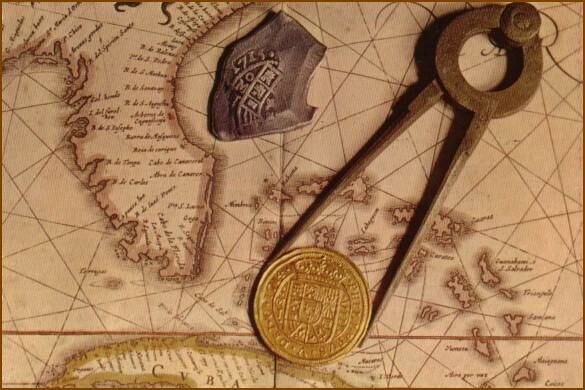 Kidd’s treasure, so, the next day, he returned with a couple of friends to dig it up. The boys soon found that the job was far beyond their capabilities. At ten feet below the surface, they found a layer of oak logs, which they had to dig up and remove. This happened again, at 20 feet, and again, at 30 feet. Finally convinced that this was no easy treasure hunt, the boys gave up. Since then, various treasure has ever been discovered on Oak Island, all evidence points to something buried in the earth. Artifacts – including a bosun’s whistle, a ship’s iron mooring ring and even shreds of gold – have been found there.
Yet, nobody knows who buried the treasure or even what it is. Obviously, the engineering is too extensive to have been done by a boatload of pirates. The whole system must have taken hundreds of men, years to complete. Where did the men come from? What did they have that was so important that they went to such unbelievable lengths to keep it hidden? How, given the difficulties, did they ever hope to retrieve it? And lastly, why is there absolutely no hint in any historical record of Oak Island, lost treasure or the time, manpower and money it took to construct? Today, people are still digging, but, until somebody finds something, Oak Island will remain a mystery.


 WD Fyfe