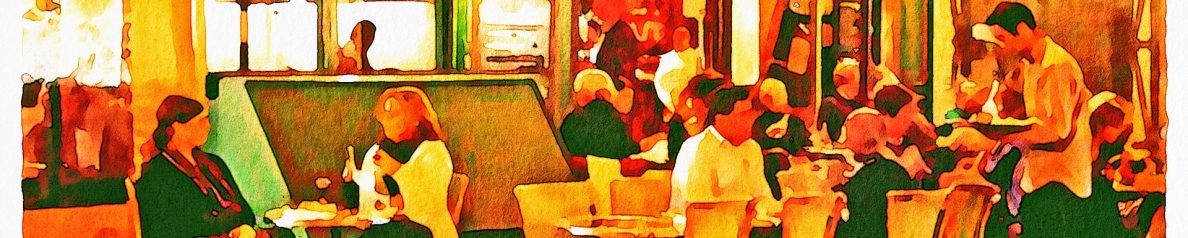
Firenze

Martina Ciampi delicately chose one of the tomatoes with her fingernails.  Maybe this was the man she needed, but she was too old a bunny to be taken in by a big reputation.  Men were dreadful gossips, all balls and bragging.  Still, if even half of what “they say” about this man was true, the saints had provided him for her at exactly the right moment.  Because men, like this man, were good for one thing (outside the bedroom) – violence. And Signora Ciampi needed a lot of violence right now.  She bit the tomato.  And with a little help, this man could deliver it for her.

Dreyfus did wonder what the woman across from him was thinking, but in all honesty, he didn’t really care.  He’d just been thrown sideways out of an ordinary tit-for-tat revenge story into a sinister business that was probably beyond his power to correct.  He selected another slice of wild boar and some bread and waited.  Now he needed this woman’s information, but it looked as if she was going to tell him the whole long story.

“Two brothers,” she began, “They came to Florence after Kosovo.  At first, no one cared.  Italian cities are full of people no one wants – refugees, migrants, gypsies – and the brothers fed on these throwaways.  And they got fat on the food no one else wanted.  No one complains when the faceless ones disappear or end up floating in the Arno with no kidneys.  And the brothers got rich, and the brothers got bold.  They bought businesses and brought their friends from Albania to run them.  Italians …” Martina wiped her hand through the air, “Don’t work for these men.  Now they think they own the streets.”

“Do they?”  Dreyfus asked offhandedly.

Martina sipped her wine and turned her head.  Should she lie to this man?

“Not all of them.” There was venom. “Not yet.”

Dreyfus chewed a little too deliberately.  This just kept getting worse.  Apparently, he’d stumbled into a turf war as well, but, more importantly, he’d accidently given this woman a primo opportunity to set up a game of lets-you-and-him-fight.  Smart Dreyfus was telling him to finish his wine, make his excuses and run.  But the other Dreyfus was sitting there, eating wild boar salami and wondering how much ammunition was in the package Sydney had left him at the hotel.

“But they think this can be their town, and they want to show everybody they can do what they please in their town.  They reach beyond the faceless ones.”  Martina made a claw with her hand and shook it, “To my people.  People who look at me to protect them.”

“My English girl?”

“She was at a party.  Too much to drink.  It’s happened before.”  It was dismissive, and Martina settled back in her chair and cut another piece of cheese.

Dreyfus swallowed and reached for his wine.  This was taking too long.  He needed information, not a history lesson.

‘How many?”

Should she lie to this man?

“Maybe twenty – uh – twenty hard men.  No more than that.  The rest …” Martina made a sneering face and shifted her eyes over Dreyfus’ shoulder.

He wondered if this woman was lying.  “That’s not very many.  In a place this size, you’ve got to have three times that many, maybe more.”  Dreyfus lifted his shoulder and opened his hand. “Why are you even worried?”

Martina shrugged. “The time when, the Ciampi didn’t worry about anything, but today – puh! — Italian men are soft.  They like their Lamborghini, their Gucci, their Romanian maiala.  Tight pants and no favas.  The days of the Liccasapuni are over.  Now we negotiate.  Talk.  Like bankers.”  Nobody does scorn like an Italian woman who feels she’s been wronged.

Holy hell!  This wasn’t just a turf war: it was an all-in-the-family power struggle.  Clearly, the young stuff wanted to live and let live with the Albanians, but Mamma was more interested in live and let die.  But why was this woman telling him all this?  It didn’t make any sense.  She could have (should have) just shopped the Albanian brothers as heroin dealers and been on her way.  The voice of smart Dreyfus was louder now, practically shouting at him to run … but it was too late.  The trap was already sprung.  Dreyfus felt the movement over his shoulder.  His eyes instinctively searched the table for something sharp.  The cheese knife?  Dreyfus turned just slightly as the driver stepped past.  He leaned down and whispered into Martina Ciampi’s ear.  She looked away, then looked directly at Dreyfus.

“The Albanians have taken the woman Perry-Turner.  They came to the …”

Dreyfus held a finger in the air, and for a nanosecond, his eyes betrayed his absolute fury.  Martina shuddered in surprise, and the driver stepped back and automatically reached inside his coat.

Don’t!” Dreyfus snarled.  There was a second of suspended animation.  Jonathan McCormick had warned him about this.  But he hadn’t listened.  And when he looked, all he saw was what he assumed was already there – a couple of lowlife drug dealers.  He’d been blindsided by his own expectations.  Now what?  There was only one way out.  Quit being played.  Do the unexpected, and put these people on the wrong foot for a while – all of them.  Dreyfus reached for the wine pitcher and poured some into his glass.  He looked back at Martina — measuring her – but only his eyes moved.  There was no anger in his face, just a terrible indifference — and it scared her.

“I’m not going to ask you how they know who we are,” he said evenly.  He cut a piece of cheese and took a slice of capocollo.  He’d had enough wild boar for a while.

“Just so,” Martina thought. “He said he was a deliberate man.”  But this was all wrong.  Suddenly, Signora Ciampi was wary of this man.

Dreyfus looked at the driver.  “You need to go wait in the car.”  He leaned back in his chair and turned to Martina. “And you need to tell me about these Albanian brothers.  We’ve got all afternoon, so I want the details.”  Dreyfus lifted his glass and drank.

The Next Day – In Florence

Florence is a tourist town.  Like Venice, it’s full of trudging backpacks with sensible shoes, queueing up and sitting down and taking photographs and spending money.  Every day (there is no tourist “season” anymore) from dawn until way beyond dark, the narrow medieval streets are overwhelmed by these grim-faced invaders.  But unlike Venice, in Florence, a few streets away from David and the Uffizi, there’s another city – Firenze – a tough little Tuscan town that hasn’t changed its ways since the Medici held sway on the banks of the Arno.  Dreyfus, Emily and Janet Miller chose to stay in a hotel deep in the heart of tourist country.  It overlooked the river and was within shouting distance of the Ponte Vecchio – three more anonymous foreign faces in the shadow of the Basilica.  Dreyfus would find Firenze later; right now, he was just trying to keep up with Emily’s rapid fire Italian — and Janet’s awkward what-do-I-do-with-my-hands was getting on his nerves.

“They’re going to meet us at a restaurant by the school,” Emily said as she gathered their passports, “I’ve sent the luggage up, and I’ve got directions.”

The man behind the reception desk caught Dreyfus’s eye, and they nodded acknowledgement.  Sydney’s package had arrived.  Dreyfus would pick it up later.

“I need – uh – I need, I need to change …” Janet half stood and pulled at her shirt.

“No, Jans– you’re fine.”  Emily stepped over, straightened her friend’s button line and brushed her hair back with her fingers.  “C’mon, we have to go.”

A few streets, a few turns, a few shops and shoppers, and fifteen silent walking minutes later, they found Piazza degli Strozzi.  It was long and thin, bright and grey and paved with new stones.  There were two sets of outdoor tables ahead of them, and from there, across the square, a dark-haired woman stood up.  A second, two — then steps, faster steps, a heel-clicking half run and the three women met and hugged and cried and clung to each other like rescued survivors.  Dreyfus slowed.  None of this was his, and he knew enough to casually stay away.  By the time he reached them, the tears were being sniffled and swallowed and hunted by Kleenex.  Through the sorrys and sympathies, there was suddenly a man with his hand out and …

“Jans, here– use this …”

“Let me see what …”

“Oh, Magpie. I knew you’d come.  I just couldn’t …”

Magpie? Dreyfus made a note to save that for a better time.

“Sinclair, isn’t it?”  The hand had a voice, and Dreyfus reached forward. “James Montrose, we met …”

“Yes, I remember.  My condolences.  This is a terrible time for you.”

“It’s a bad business.” Montrose’s voice shook against his middleclass upbringing.  For a few seconds they stood there, two men awkwardly aware they couldn’t help the women next to them, rescue them, make it better – fix anything.  They were without purpose.  But that changed.  A heavy Mercedes slowly rolled through the square and stopped beside them.  The driver got out.  In the afternoon sun, he wore a black leather jacket.

“Riccardo Ciampi,” he said at them.

Dreyfus looked at Emily.  She was surprised but nodded her approval.

Dreyfus turned back to Montrose.  “I’m very sorry, but I have some business to take care of, and it simply can’t wait.  Maybe we can get together later.”  Then he looked back to Emily: “Go ahead.  I’ll find you.”  As Dreyfus walked over to the car, the driver opened the rear passenger door.

Florence isn’t a large place, but it’s not built for automobiles, so it took the driver some time to cross the river and get to where he wanted to go.  Finally, he stopped beside a three-table restaurant, stuck on a narrow Y street corner.  He got out and opened the door for Dreyfus.  Dreyfus got out and saw a woman sitting at the furthest table.  She was of an age, certainly more than sixty, but after that ….  She was too handsome to have ever been a great beauty, but her cheekbones made her attractive, and her eyes made her interesting.

“You are Dreyfus Sinclair.” It wasn’t a question, and there was only a trace of Italian pronunciation.

Dreyfus nodded and didn’t wait for an invitation to sit down. “And you are?”

The woman offered a brown earthen jug.  Dreyfus reached over and poured himself a glass of deep red wine.

“Our grapes.  Do you eat?”

Dreyfus nodded and tasted the wine.  There was no suggestion of a toast.  He nodded again, set the glass down and waited.

“I am Martina Ciampi.  My son is a busy man, so I will help you with the dead English girl.” 

He turned his head slightly in a question.  Martina Ciampi smiled.

“When an English girl dies in Italy, everyone wants answers.”

Dreyfus noticed there was no traffic, no people walking, no anything except the two of them and the man standing by the car.  And even though it was a warm afternoon, most of the upper windows of the buildings around them were shuttered.  It made Dreyfus extremely aware that the gun he’d asked Sydney to get for him was sitting in a box back at the hotel.

“I don’t care about answers.  All I want to know is who gave her the White Powder.  Tell me that and we can be friends.”

A young woman came out of the tiny restaurant with a wooden platter of sliced meat, quartered tomatoes, bread and cheese.  She set it down on the table and turned away without looking at anything.

“Everyone knows Dreyfus Sinclair is a bad enemy.”  Martina stabbed a single slice of meat off the tray and held it in the air “But is he a good friend?” She slid the meat off the knife with her teeth.

“Everyone knows?”

“Powerful men have long arms, and when Jonathon McCormick sends you as his fist, people talk.  They say you’re untouchable.”

Dreyfus laughed, cut a piece of cheese and ate it off his knife.

“People say a lot of things, and this has nothing to do with Jonathan McCormick.”

“Hmm, just so.  He said you were an honest man.” Martina pointed to the tray.  “Wild boar.  Good for the stomach.”  She leaned sideways, reached into a large bag at her feet, brought out two pale blue folders and put them on the table.

“This is the police report.  It will be released with the girl’s body in two days.  Drug overdose, very sad.  It’s written in English.  You can read it if you like, but,” the woman slowly shook her head, “It’s a … a fantasy.”

Dreyfus took a slice of wild boar sausage, put it on a piece of bread and ate it.  He didn’t touch the folder.

“This is the other report, in Italian.  Will I tell you what it says?”

“Please.”  Dreyfus continued chewing and reached for his wine.

“The English girl,” Martina opened the folder and read from the first page, “Jordyn Janet Montrose died of pulmonary aspiration.”

Dreyfus swallowed, “She choked on her own vomit?”

Martina looked up from the page.

“The needle?”

“There was no heroin in her body except around the puncture wound.”

“So why,” Dreyfus reached his index finger over and tapped the file, “This?”

Martina tilted her head.  Dreyfus thought about it for a couple of seconds.  Clearly this woman was enjoying this a lot more than he was.  It was time to speed things up.

“Alright.  I’m not playing cat-and-mouse all afternoon.  Thanks for the vino.”  Dreyfus finished the glass, set it down and stood up.  The man at the car straightened.

“Hmm, just so.  He said you were direct.” Martina closed the folder and motioned for Dreyfus to sit down, “We’ll be direct, you and I.  Your pretty English girl had a bad reaction to anesthetic and died on an operating table.  There was vaginal bruising and bleeding.”

“Abortion?” Dreyfus interrupted.  Now he was confused.  He sat down.

“No,” Martina sipped her wine, “They were gathering eggs.  Like a farmer in the hen house.”

Sunny Italian afternoons are for lazy conversations about art and love and beauty; they’re not about greasy alleyways and murky light and wicked men with dirty fingers.  It was immediately clear to Dreyfus Sinclair – a random drug overdose was unfortunate but palatable; an abducted teenager, harvested for parts, was not for public consumption.  He felt like he needed a shower, but he poured another glass of wine.  After a few seconds …

“Alright.  Who?  And where do I find them?”

The Night Before

Dreyfus opened the door and turned on the light.  There were shoes under the side table.  Shoes?  And no umbrellas.  He dropped his in the stand.  And coats hanging in the hall.  And a suitcase?  One and one and one sometimes equal two.  Emily had come to London, and she’d brought a friend.  Who was apparently planning to stay?  Dreyfus shook the rain off his coat and hung it on an open hook.  He turned into the loft that was dark except for the task light over the sink.  He flipped the hall light off and waited until his eyes adjusted.  It was less than a minute before the light from the city silhouetted two women sitting on the terrace.  Curiouser and curiouser!  He walked across the room.  He didn’t know whether they’d seen the hall light or not and he didn’t want to startle them, so he made clumsy noises opening the door.  Both women, who were sitting at the table, facing the river, turned.

“Ms. Miller …” Dreyfus said, stepping outside.  He saw the teapot and swallowed the rest of the remark.  Then he sat down at arm’s length from the table so he could see them both.

“A night like tonight, you two should be sitting by the fire.”

“No, the river’s fine,” Emily said without looking at him.

There was quiet — not silence. The rain played on the water below them like low oboe murmurs.  Across the river, the city hummed and moved, slow motion lights wet with whispers. Somewhere a drifting siren, somewhere the faraway rhythm of steel on steel tracks for trains — and there and again long orphan sounds with no names, swallowed by the drizzling city lights and the night and the darkness.  It was wordless melancholy, and Dreyfus could feel it surrounding the two women.

“I should – uh – I – uh – I should go.” Janet just couldn’t anymore and fussed with her teacup.    

Emily put her hand up and shook her head.  She turned and looked at Dreyfus and sat up in her chair.

“We’ve had some bad news, today.  Terrible news.  Do you remember Monica?”

Dreyfus didn’t, but it was important, so he nodded and made a sound like agreement.

“They were here a couple of years ago.  We went for drinks and the next day we went shopping — remember?  And you met us for tea at Harrods.”

Dreyfus remembered now.  He could count on one finger the number of times he’d had tea at Harrods.  He rushed to fill in the pieces.  Attractive woman, boarding school hair, clothes off the rack and – uh – John? – no – James?  James.  And a daughter – pretty thing, knees and elbows, twelve going on twenty-five.  Practically curtsied when he held her coat for her.

“She lost her daughter.”

Janet twisted her neck and looked away, and Dreyfus could see the glisten in Emily’s eyes.  This was bad.

“The police found her in the back of a car with a needle in her arm.”

Janet moved abruptly.  Her chair pushed the table and the cups rattled on their saucers.

“I can’t do this.” Her voice was wet, “I can’t.  I have to go.   I – ah — God I can’t, really, I …”

Even in the darkness, Dreyfus could see her look was cornered, frightened, fleeing.  This wasn’t Janet Miller – not the one he knew.  It worried him.

“No, you’re not going anywhere in this.  There’s a bed upstairs.  Go up and lie down.  You’ve had a horrible shock.  We need to leave this for tonight, and you need to try get some sleep.  The bed’s there.  Go.”

Janet looked at Emily.  Emily moved her head, stood up, and offered her hand.  “Come, I’ll show you.”  Janet stood up and obediently followed her to the door.

“The stairs.  Straight up.”  And hugged her friend.  For a time, the rain fell into the river.  And sometime later, Emily came back out onto the terrace.

“I’ll take that drink, now.”

Dreyfus went in, poured two glasses and came back outside.  He handed one to Emily and sat down in Janet’s chair.  They both took a serious mouthful.  It was warm in the wet night.

“She’s very shaken.  How about you?”

“Jans was JJ’s godmother.  I am too, but it wasn’t the same.  Monica just included me because the three of us were at school.  For Jans, it was special.  She even went to see her last November . . .  yeah, left the country.  And they were talking about having her come up to Pyaridge for part of her summer holiday.”

There was more quiet.

“She wasn’t an addict, Dreyfus.”

Dreyfus didn’t answer.  One hit, two hits, twenty – it didn’t matter – the white powder didn’t care.  This JJ wasn’t the first teenager to experiment with evil and find it unforgiving.

The rain and the river continued, finding each other in the night and travelling together to the faraway sea.

“I don’t ask you for much.”

“You don’t ask me for anything.”

“I’m asking you for this.”

“Alright,” Dreyfus agreed.

“Come with us to Florence and find the men who did this to that poor little girl.   And make sure that they never do it to anyone else.”

Dreyfus looked out into the rain.  He sipped his whisky and turned to look at Emily.  She looked back at him.

“You need to be sure.  I’m not a policeman.”

Emily didn’t move her eyes.  “I don’t want a policeman.  They don’t deserve a policeman.  She was sixteen.”