The Vice President: A Short History

Despite what the pundits have been telling us for a week or so — and all the yipping that went on last night — the vice president (not this one particularly) really isn’t worth that much.  His (or her?) job is to wake up every morning and ask the important question: “How’s the president feeling, today?”  After that, he can have a leisurely breakfast, read the paper, work in the garden or play on the Internet, if he likes.  Of course, if some second tier somebody dies somewhere in the world, he has to show up and look sad, or if some not-so-notable notable comes to Washington, he has to show up and look happy.  To paraphrase Dorothy Parker: “His emotional range must run the gamut from A to B.”  However, for the most part, the vice president’s time is his own.  Yet, even though the office is totally useless on a daily basis, it does serve an essential purpose: the vice president must be ready and able to run the country if the president can’t.  It’s kinda like the first runner up in a beauty contest.

Actually, originally, that’s the way it worked.  The vice president was the guy who lost the election.  Obviously, this wasn’t an ideal arrangement, even back in the day.  For example, John Adams’ vice president was Thomas Jefferson.  I’d have loved to have been a fly on the wall when those two started tearing into the nation’s business.  After all, about the only thing they ever agreed on was when to die.  To put this into perspective, in this century, George Dubya’s vice presidents would have been Al Gore and John Kerry; Barack Obama would have been stuck with John McCain.  Just let that sink in for a moment.

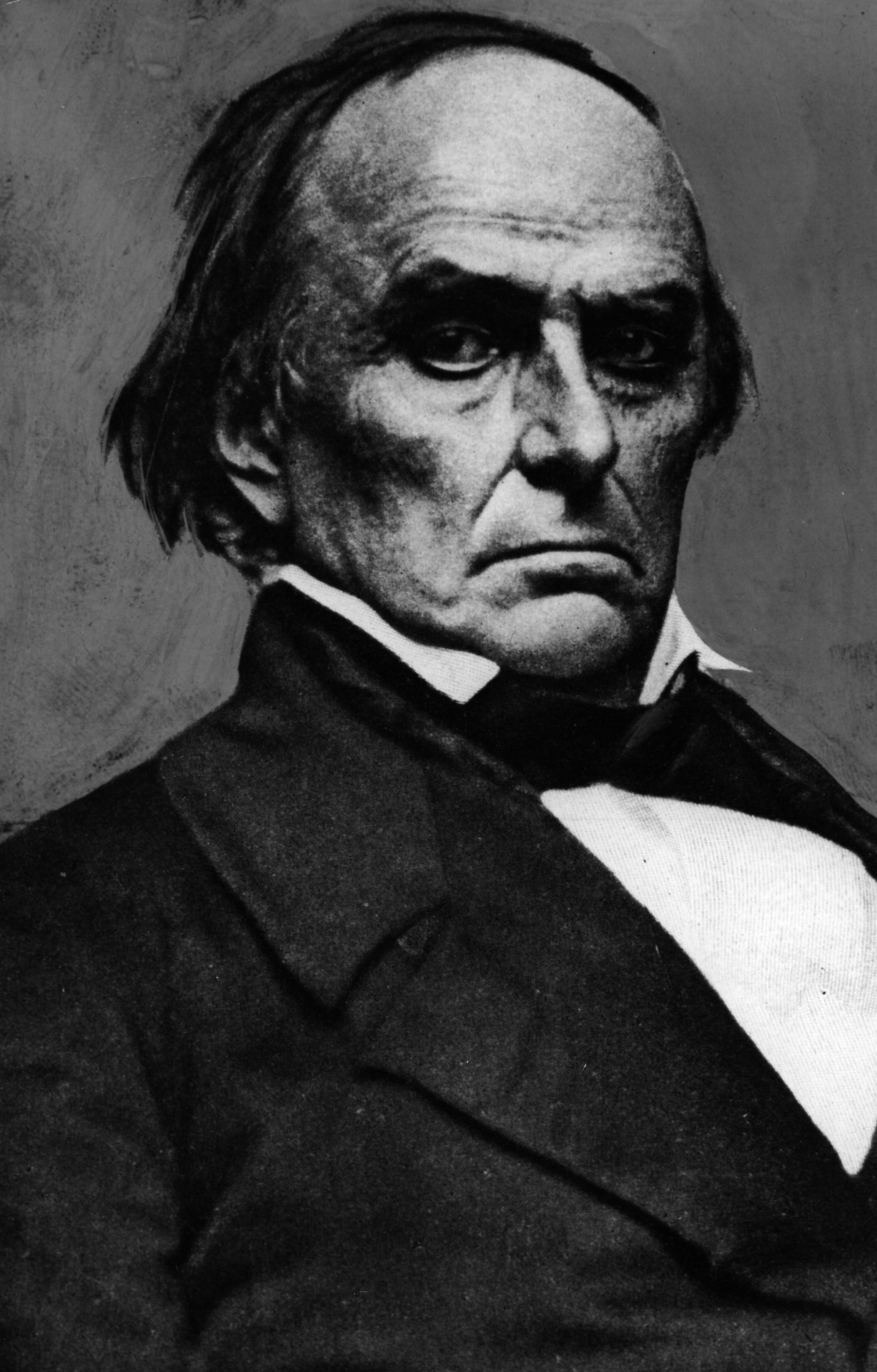
Oddly enough, the vice presidency is not an automatic ticket to 1600 Pennsylvania Avenue1.  Actually, it’s almost a political dead end.  Of the forty-seven vice presidents so far, only fourteen have ever gone on to become president.  Eight of them took office when their bosses suddenly died; one, Gerry Ford, became president when Richard Nixon resigned and only five have ever been elected independently (and one of those, Richard Nixon, had to run twice.)  In fact, most politicos regard the office with some disdain.  Daniel Webster, who was offered the vice presidency by two separate administrations,2 replied the first time by saying “I do not propose to be buried until I am really dead and in my coffin.”  Likewise, John Nance Garner, who was, for a time, Franklin Roosevelt’s vice president, described the office as “not worth a bucket of warm piss.”  Not much has changed since Garner’s time.
For many years, both parties either let the backroom boys choose their vice presidential candidate or threw it open to the convention floor.  Either way, there have been some spirited campaigns for this worthless office – John Kennedy in 1956, for example.  However, in 1976, Ronald Reagan ran into political trouble and needed a boost to try and unseat Gerry Ford during the primaries, so he named his running mate, Richard Schweiker, early.  It didn’t help: Ford won the nomination.  However, this has become the norm.  Now, all the campaigning for second banana is done in the backrooms, long before the delegates ever meet.

Also, for many years, being selected as a vice presidential candidate was sort of a consolation prize for not getting the Big Kahuna.  However, these days, vice presidents usually bring balance to the ticket, either geographically, politically or — twice — (Geraldine Ferraro and Sarah Palin) by gender.  Of course, there are some cynics who maintain that the vice president is chosen simply as assassination insurance.

Regardless, most vice presidents have done their jobs uneventfully and vanished into history.  And the nine who were called upon to fulfill their primary function have served adequately, if not spectacularly, with one notable exception: Theodore Roosevelt, who was so good at it, they put him on Mount Rushmore with Washington, Jefferson and Lincoln.

1BTW, some people think the vice president lives and works in the White House – he doesn’t.  Actually, up until the 1970s, the vice president had to find his own accommodations in Washington.  And it wasn’t until Jimmy Carter made some space for Walter Mondale that the VP even had a formal office in the West Wing.

2From the Pretty Darn Strange Department: If Webster had shut up and taken the job — either time — he would have ended up as president.  Both men who invited him to be their Veep died in office.
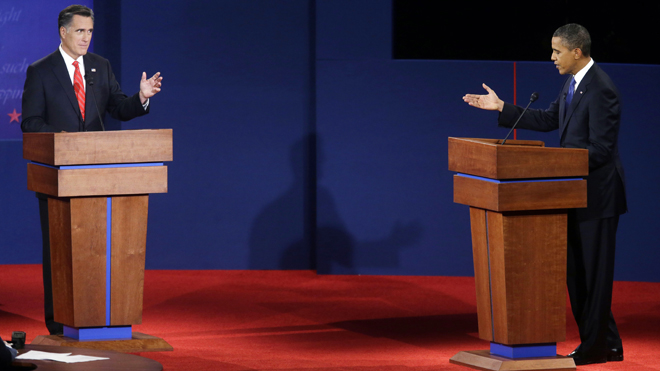
Barack Obama and the Great Debate

Okay, that’s it!  I’ve had enough!  The Obama apologists have finally jumped the shark.  The latest missive from the Our-Guy-Is-Never-Wrong school of journalism is maybe President Obama just doesn’t want to be president anymore.  Do you believe this?  It’s getting to the point where everything this guy does has some pure and saintly purpose.  He screws up one debate and suddenly we’re no longer worthy of his leadership.  It’s as if Obama were some ancient god who has grown weary of his bickering children (who continue to ignore his teachings) and more in disappointed than in anger, must now forego the redemption of the human race until mankind is ready for his message.  Or maybe Barack just operates on such a high plane of consciousness that ordinary human traits like fulfillment and ambition don’t apply to him.  I don’t know which it is, but come on, people!  Get real!

Last week, when they turned off the microphones on the Romney/Obama debate, the air pressure dropped in every newsroom in America as journalists, commentators and caterers collectively gasped in horror.   It was right out of the scene in The Man Who Would Be King when the High Priest of Kafiristan discovers that Danny bleeds red like everybody else and isn’t a god.   The priest raises his hand to show Danny’s blood to the assembled multitude, and for a full three seconds, they all stand there, stunned.   Such was the case last Wednesday.  The echoes in Denver took a long time dying as the interior monologue of every bicoastal opinionator was screaming, “Holy crap!  What just happened?”  When they shook themselves back to reality, the wailing was uncontrollable.  The guy from The Daily Beast was practically in tears, Bill Maher tried to slash his wrists with the sharp end of his tongue, and I’m sure Chris Matthews strangled at least one fact checker in abject rage on his way to the microphone.  From there, everybody east and west of the Continental Divide who wasn’t hanging onto something simply got buried in the Excuse-and-Blame avalanche.

Nothing was sacred.  One commentator said that Romney (the dirty cheater) had an unfair advantage because he’d had several recent debates during the primaries and Obama hadn’t had any.  Another guy blamed Senator John Kerry for being too easy on the president during their practice sessions because he wants to be Secretary of State.   They accused Romney of having notes on his handkerchief.  They blamed the format, the venue and the altitude.  Hell, at one point they even turned on Jim Lehrer and denounced him for being old, semi-retired and losing control of the situation – which, apparently, gave Romney yet another unfair advantage.

If I sound bitter, I am.  I’m absolutely fed up to the eyeballs with the cult of personality that surrounds this president.  He’s not Kim Jong-un for God’s sake!  President Obama puts his pants on, one leg at a time, just like everybody else.  He can and does make mistakes.  He has off days and bad nights.  He proved that, last Wednesday.  He is not all-knowing, all-seeing and all-wise.  And face it, folks: he is not now, nor, was he ever, America’s one-size-fits-all Glorious Leader.  And while I’m on the subject, just because I disagree with Barack Obama’s political philosophy, that doesn’t make me stupid, an insensitive moron or a witless dupe of some Republican propaganda machine.  I am just as aware of the issues as the next person and my opinion is just a valid as theirs is.

Here’s the deal: President Obama screwed up last week.  For whatever reason, he didn’t get the job done.  However, just because he didn’t meet the expectations of his supporters doesn’t automatically mean he was the victim of a plot, a conspiracy or Jim Lehrer’s gross incompetence.  Whether you like the guy or not, it’s time to remember he’s just a guy, trying to do his job the best way he knows how.  If you think he’s doing a good job, vote for him.  If you don’t, don’t.  But this never-ending beatification is getting really tiresome.

Christopher Columbus — Five Point Two Oh

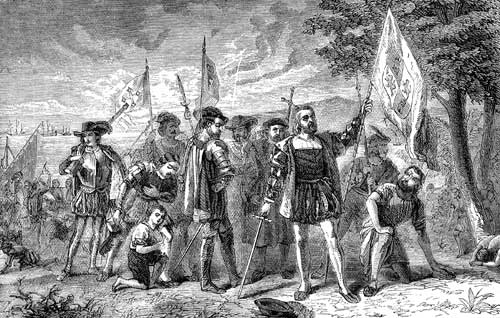
Like it or not, on October 12th, 520 years ago, Christopher Columbus showed up somewhere in the Caribbean and changed history.  He didn’t exactly discover America — it had been here all along — but he did reveal it to a less-than-curious European population.  Actually, for the longest time, our European ancestors didn’t care much about the Western hemisphere.  They just thought it was a great lumpy bit that kept getting in the way.  After all, Columbus had convinced the Spanish monarchs Ferdinand and Isabella to give him a boatload of money for a passage to India.  He wasn’t about to admit he’d miscalculated the distance by several thousand miles.  So, for a generation or so, Chris and his Spanish compadres dicked around in El Caribe, insisting that untold riches were just over the horizon and playing poor cousin to the Portuguese.  The Portuguese had gone the other way, by the way, with Vasco da Gama in 1498, and had actually reached the spice emporiums of India where they were making nothing but money.  It wasn’t until Cortez, one of the most enigmatic figures in history, discovered gold around the necks of the Aztec nobility in 1519 that the big boys back in Spain, France and England sat up and took notice.  What happened next was nearly five centuries of relentless worldwide imperialism that ended in 1956 when French and British paratroopers landed on the Suez Canal in the last wheezing gasp of European hegemony.  That’s a pretty bold footprint for the son of a weaver out of the ‘hood in Genoa.

Actually, that’s the gist of it.  Despite the fact that Columbus was just one of literally hundreds of ambitious men seeking their fortune in an expanding world, he’s the guy everybody latches on to.  For the last fifty years, he’s been taking the hit for every dirty deed ever perpetrated on the indigenous peoples of our world since he weighed anchor on August 3rd, 1492.  His name is now so blackened by revisionist history that people who’ve never heard of Francisco Pizarro look the other way when it comes up in polite conversation.  It’s gotten so bad that even historians forget what he was doing here in the first place.  So here’s a quick and dirty history of why Christopher Columbus — without all the “ain’t it awfuls” everybody is so much in love with these days.

In the first part of the 15th century, an obscure group of Turks called the Ottomans was moving up the social ladder by beating up their neighbours.  In 1453, they conquered Constantinople, the last Christian bastion of the (long outmoded) Roman Empire.  For the next couple of hundred years, they pretty much ran the show in the eastern Mediterranean.   At the other end of the Mediterranean, the Christian kings (and queens) of the Iberian Peninsula had spent the last seven centuries fighting with their neighbours, the Moslem Moors, and were on the verge of sending them packing, back to North Africa.  Meanwhile, around about the same time, Europeans were finally recovering from the Black Death that had killed anywhere from 30 to 50% of the population.  It was the biggest seller’s market in history, and a whole new middle class of merchants. labourers and trades people had coin in their jerkins to indulge themselves in the finer things in life: things like ivory and silk and the hottest commodity of them all: exotic spices.  Supply and demand were about to meet in a head-on collision.

Politics, religion and economics have always been strange bedfellows.  However, it didn’t take a da Vinci to figure out that, regardless of how much people were willing to pay to put pepper in their paella, all spices came from the east — and unfortunately that window, Constantinople, had been closed.   Suddenly, between religious animosity and the cost of doing business (it was a six month caravan ride across North Africa) the price of anything but bland in Europe went through the roof.

Enter Henry the Navigator, king of Portugal.  His nautical boys had been sailing down the coast of Africa for a century, and he knew that, if you went south far enough, you ended up going east — and that’s where the spices were.  He put two and two together and decided that, instead of sucking up to the Moslems for cinnamon and nutmeg (and paying outrageous prices for the privilege) he could simply go around them.  For half a century, the Portuguese tried.

At the same time, our buddy Columbus was doing his homework.  Like all educated men of the period, he knew the world was basically a sphere, and like all sailors, he had a rough and ready knowledge of how to calculate latitude.  Besides, he’d shipped out with the Portuguese a time or two and had a hunch that Africa was a lot bigger that anyone realized.  So he did the math and, based on (very) simple ratios, he surmised that, if he sailed west instead of east, he’d find India — somewhere around Cancun.  The problem was Columbus had no idea how to figure out longitudes.  He wasn’t alone.  Longitude or east/west distance would baffle scientists and explorers for another 300 years.  Anyway, Columbus took his project to the money people of the time – royalty — and was turned down every time.  Their argument was “Look, Chris!  The world’s bigger than that!”  However, our boy stuck to his guns and kept knocking on doors.  Finally, Ferdinand and Isabella of Spain (who had already turned him down once, BTW) decided what the hell.  They gave him a 10% share of the profits, told him he had to raise half the money himself and agreed to name him Admiral of the Seas — if he actually got back.  My thought is they didn’t think he would.  Regardless, Columbus did the medieval equivalent of a fist pump and the next thing you know Rodrigo de Triana, a lookout on El Pinta, is shouting “Land Ho!”

That’s it — in a nutshell.  The revisionists can talk as they please about who was responsible for what — after he got here.  However, the only reason Columbus ever showed up at all is pepper was selling for big bucks on the European market, and he and a whole pile of other people wanted to cash in on the profits.  You see, history doesn’t change; the people who tell it do.