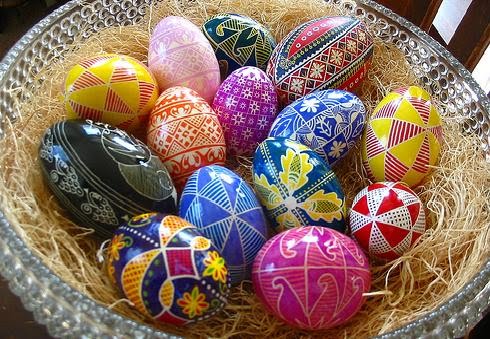
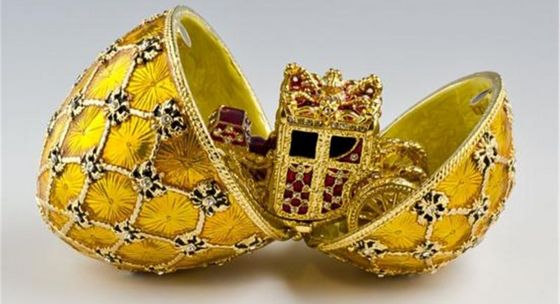
 I know I’m a day late and probably a few rubles short, but I want to talk about eggs. No, not the ones that the bunny left yesterday or the ones that show up in your McMuffins, but real, honest-to-God Easter eggs that retail for 8 to 10 million dollars. These are the Romanov Eggs, incredible treasures left over from the days of Imperial Russia.
Just a quick review. The Romanovs were the boys (no girls allowed — except Catherine the Great) who ran the show in Imperial Russia for three hundred years. At the peak of their power, in the 19th century, their writ ran from the North Pole to the Himalayas and from the Vistula River to the Pacific Ocean. It’s hard to understand these days, but as absolute autocrats, they literally owned everything within those borders— down to the last babushka, and, more importantly, the grandma who was wearing it. When a Romanov said jump, you didn’t waste his time asking how high; you got your ass into the air. It’s no accident that the Russian word czar is derived from the Latin Caesar and that’s how the Romanovs thought of themselves. Unfortunately, that’s what eventually got them into trouble, but that story’s for a different time.
It was Czar Alexander III who came up with the idea of an Imperial Easter Egg. Somewhere in the mid 1880s, he decided to give his wife, the Czarina Maria, a present for Easter. (BTW, Easter is the highest holiday on the Russian Orthodox religious calendar.) However, if you’re Czar of all the Russias, you can’t very well cruise down to Walmart and check out the sales; you have to come up with something special. The Czar settled on an understated single egg, but one so elaborate it would thrill a woman who literally had everything. He called on Pierre Faberge to make it so, and the result was beyond everybody’s wildest expectations. The Hen, made of gold and enamel, looked like a real egg. However, it opened up to reveal a yolk ,which, in turn, opened to reveal a chicken which also opened to reveal a diamond miniature of the Imperial crown and a ruby pendant that the Czarina could wear. Everyone was so delighted with Faberge’s efforts that an Easter tradition was born. From that Easter in 1885 — until Lenin and his pals put a stop to it in 1917 — Faberge made a number of Easter Eggs for the Imperial House of Romanov.
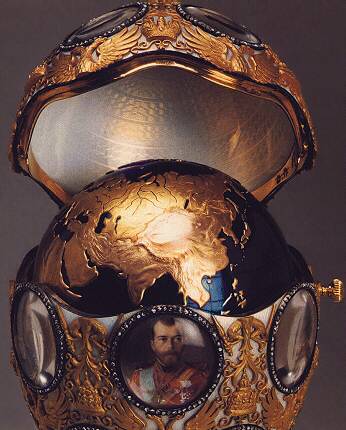
The Imperial Easter Eggs were exquisite examples of Romanov opulence; intricate toys encrusted with jewels. For example, the Trans Siberian Egg had a small train inside that could be wound with a key so that it ran on a tiny track. The Peter the Great Egg held a replica of his St. Petersburg statue which rose out of the egg when you turned a dial. The Tercentenary Egg had hand-painted miniature portraits of all the Romanov czars and a globe made of coloured gold that showed Russian expansion. Each of these “eggs” was flawless (the Trans Siberian train had windows made of crystal!) and cost millions of rubles. Remember that the Faberge name was not always attached to the glitz we see today. In the beginning, Faberge dealt exclusively in jewelry, objets d’art and unequaled elegant craftsmanship. They were the greatest jewellers of the 19th century — no contest – by appointment to the Imperial House of the Romanovs and some of their wealthier friends. Translation: Faberge made trinkets for the rich which were so expensive, even the rich couldn’t afford them. Only high-end nobility and their uber-wealthy compadres could meet the tariff. The objets d’art Faberge made for the Russian aristocrats were practically obscene, especially when the average Russian of the time lived his entire life on black bread and cabbage–and not very much of that. One Romanov egg could have set a Russian village up for lif, and by the time the Soviets confiscated them during the revolution in 1917, there were 50 or so of these baubles kicking around the Imperial palaces.
This is where it gets interesting because, like so many things that went through the Russian Revolution, there are strange circumstances surrounding the Romanov “Easter eggs.”
First, nobody is 100% certain how many were actually made. Most sources have settled on 50, but some say 52, and some as high as 54. Oddly enough, even though there are records, nobody seems to have kept track. Granted, the Romanovs had been collecting art for three centuries; they had a bunch. (Even today, The Hermitage in St. Petersburg has the largest single collection of art in the world, and most of it used to belong to the Romanovs.) One piece here or there could go unnoticed. However, when the ornaments are worth millions, somebody somewhere is supposed to know how many there are. It’s pretty darn strange that even today, after nearly 100 years of research, scholars can’t agree on what was there in the first place.
Secondly, some of the “Eggs” have been lost. Again, nobody seems to know how many. The general figure is eight, but that’s open to discussion. Regardless, how does one lose even one table-sized Easter egg that’s gold, heavy and sparkling with jewels? It’s not like you could forget it with your umbrella on the bus. Somebody would notice. Certainly, in all the confusion of 1917, the Imperial household may have misplaced a few things. Also, it’s entirely possible that, during the Revolution, some of the People’s Commissars may have helped themselves to an item or two– just in case the whole communist gig didn’t work out. These are possible scenarios, but the real problem is that when the Soviets confiscated everything Romanov, they treated in all with cavalier disdain. This was capitalist decadence at the high end, and no self respecting Bolshevik was going to sully his ideology with it. For example, when the “eggs” were finally inventoried (over several years in the 20s) because Stalin had bankrupted the country, the records were woefully incomplete — plus no photographs were taken. To make matters worse, when Stalin gave businessman Armand Hammer nobody knows how many “eggs” to sell in America for the hard currency he needed, he didn’t bother to get a receipt. So there are no records of what Hammer had, sold or gave to Value Village. The Soviets didn’t care, as long as they got the cash, and Hammer conveniently burnt his books just in case the American Federales looked too closely at his communist connections. Thus, somewhere between 1917 and now, at least eight — or maybe more — pieces of priceless Russian art have been lost.
 As we all know, aside from socks in the dryer, “lost” is a relative term. These “Easter Eggs” have to be somewhere. Yet, one would think that after all these years, their enormous value would bring them back into the public eye. It hasn’t. Obviously, some connoisseurs are content to enjoy their collection in secret–and keep their mouths shut. However, most experts believe that, in some cases, whoever has one of the “lost” eggs may not be aware of what they own. For example, we now know that, back in the 60s, a genuine Faberge egg, not identified as such, sold at a New York auction, for less than $10,000. (Sotheby’s is still trying to track down both the buyer and the seller.) To put things into perspective, in 2007, the Rothschild Egg (which is not a Romanov egg) sold for 13.5 million dollars. (Big difference, huh?)
The bottom line is that somewhere out there, there’s a czar’s ransom in “lost” Romanov treasure. Perhaps now that the sugar shock of Easter has worn off, you might want to plan a trip to see Great Aunt Olga and take a browse through her china cabinet. Who knows? It might be worth the trip.

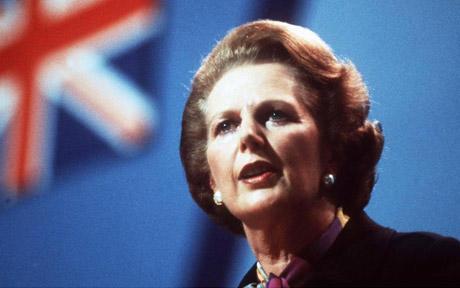 We cannot look at historical figures without the telescope of history, so it’s hard to judge what our contemporaries will look like to the ages. As hostages of living memory, we get caught in the fever of the times and think with our hearts and not our heads. Margaret Thatcher is such a figure. To some, she was the embodiment of all that is wrong with representative government — the conservative terror that nightmares all “progressive” dreams. To others, she was a Joan Bull of Britain, standing with Elizabeth I, Nelson and Churchill in the stubborn defence of British attitudes and values. Regardless, she was Britain’s first female Prime Minister and held that office for eleven years, longer than anyone else in the 20th century (including Winston Churchill.) And, like it or not, she revolutionized politics in Britain and around the world.

 WD Fyfe