 I don’t usually spend much time perusing Forbes’s billionaire list (it makes me feel poor) but between the current economic meltdown and the Occupy Wall Street protests, I decided to take a look and see just who these rich bastards are. A couple of things surprised me. First of all, a third of the Top 100 is still American. I would have thought the numbers would be a lot less. Granted, some are repeat offender family members, but that’s to be expected; inheritance laws being what they are. (The Waltons, for example, have enough money to buy Neptune if they want to, and the Koch brothers aren’t far behind.) The second thing is most of the names I expected to see aren’t there. There are no Rockefellers, Astors, Gettys, Duponts or Vanderbilts – just to name a few. In fact, none of the names I remember as being synonymous with wealth show up on the list at all. It strains the imagination to believe the Carnegies and the Harrimans are looking around for lunch money, but they’re no longer the super rich I remember from my youth. Times apparently have changed, and 100 million dollars ain’t what it used to be. The next thing that struck me is that, of the thirty-two Americans in the Top 100 Billionaires, twenty of them are “self made” according to Forbes, and of those twenty, ten of them “made themselves” with computer technology. All in all, an interesting haul of useful information from a twenty-minute Google search, but what does it all mean?
First of all, the recent rumours of America’s economic demise are greatly exaggerated. The US government might be choking itself to death on debt, but it seems American business, if not booming, is bashing along quite nicely. Secondly, despite what some would tell you, being rich is not a closed shop. Money in America is not concentrated in the hands of a few permanent players who refuse to share the ladder of success with the poor. I’m not stupid enough to think that every kid is a potential Horatio Alger character, but I am smart enough to know they exist. After all, two thirds of the richest people in America made their money in their own lifetimes. Their offspring might end up ignorant dolts like Conrad Hilton’s, but these folks haven’t been sitting on their assets, reaping the dividends of grandpa’s ingenuity. Thirdly, wealth is transitory. JohnD. Rockefeller was once the richest man in the world; today, the Rockefeller family doesn’t even get honourable mention. To paraphrase Chris Rock (cleaned up for an adult audience) “He might be rich, but he ain’t wealthy.” Finally, America has moved past the Industrial Age. Aside from the Walmart children and Michael Dell, the super-money in America is being made out of digital thin air. The Industrial Revolution is over, and the Post Industrial Revolution is upon us — even though most of us don’t recognize it.
Here’s a quick history lesson. The wealthy industrialists of the 19th century made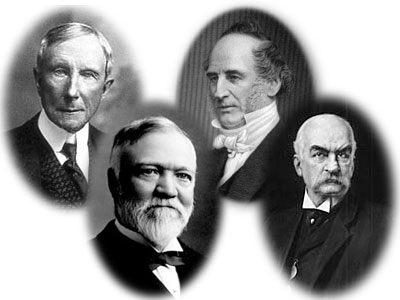 massive amounts of money on the backs of cheap, abused immigrant labour and indolent government regulations. They pillaged their way across America giving most governments the finger and doing as they pleased. They fixed prices, bought politicians and corrupted both the Stock Market and the money supply. They centralized supply and demand in their own hands and built a personal infrastructure that exploited the hinterlands to facilitate it. Their workers were used up, worn out and thrown away, like any other tool of the trade. They were, at best, laissez-faire capitalists and, at worst, ruthless pirates. In short, they weren’t called Robber Barons for nothing!
Now here’s the part the Occupy Wall Street crew never learned in high school. That was over a hundred years ago. Those people are dead. The only thing that remains from those times is the names of the guilty, shown off on places like Carnegie Hall, Rockefeller Center and The Ford Foundation — to name just a few. Laissez-faire capitalism hasn’t been seen in America since FDR learned his ABCs. Since 1933, there have been enough government regulations written to clearcut every forest in Minnesota, twice over. Commercial legislation may not be perfect but – folks, get it through your heads — it’s not 1881 anymore. Labour and industry are not naturally antagonistic. Arbitrarily resetting the clock to accommodate that lost political philosophy isn’t doing anybody any good.
 Not only that but the great smokestack industries of America are dying, and they’re not coming back. American workers do not toil away in factories and foundries these days, making good money building toasters and televisions. They don’t have to; Asians are doing it for them. And because of that, the days of lifetime assembly line employment are fading. Just take a quick look at Detroit and points south. Industry in America doesn’t need masses of unskilled labour anymore, and it’s never going to again. This is a fact that howling at the banks is not going to change.
Here’s another history lesson. When the Industrial Revolution swept through England and America, every home-based craftsman who didn’t change was wiped out. For good or evil, they were ruined by the changing economic times. We live in a similar age. As the old-fashioned industries fold up shop in America, workers are going to have to change. They are going to have to get new marketable skills — skills that are in demand. Work ethic isn’t good enough anymore. Nor is trying to resurrect dying industries, and screaming for industrial concessions and government bailouts to do that, is madness.
 Open your eyes! Google, Facebook, iTunes, Oracle and on and on are all billion dollar industries with no moving parts. They’re American — born and raised. They bestride the world beyond the wildest fantasies of Rockefeller, Vanderbilt, Astor and J.P. Morgan put together. They’ve turned ordinary people into multi billionaires in less than a decade. This is the future.
We can be Luddites, metaphorically tossing our shoes into the virtual machinery of our times with Occupy Wall Street nonsense, or we can look beyond our past (and our noses) to see what’s happening around us. Either way, we need to remember this: the Luddites may have stopped the machines for an afternoon or even a whole day, but they didn’t stop history for one second.







 WD Fyfe