Hogmanay: Let’s Get Scottish

zip

Although, lately, it’s become a bit of a drunken bash, Hogmanay is actually a very ancient festival.

What? You’ve never heard of Hogmanay?

Sorry! I tend to forget that most people don’t have the advantage of being born Scottish.

For the uninformed, Hogmanay is basically New Year’s Eve, but, like haggis and hating the English, it has a distinctive Scottish flavour.  You see, for most of Scotland’s history, Christmas was no big deal.  Back in the day, the powers that be in Scotland’s Protestant Church weren’t all that keen on the heathen bits of Christmas (stuff like trees, presents, and mistletoe.) So, rather than muck about, they simply banned it, and for several hundred years, there was no Christmas north of Hadrian’s Wall.  In fact, Christmas, as the rest of the world knows it, only became a holiday in Scotland in 1958!  Instead, the Scots celebrated Hogmanay on December 31st.  The great irony is, of course, Hogmanay is about as pagan as you can get without a human sacrifice.  So much for the wisdom of the Church of Scotland!

As with most modern festivals, though, good luck trying to figure out where Hogmanay came from!  Its origins are a tangled mess of several cultural influences.  First, there is the Gaelic celebration of Yule and the even older winter festival, Samhain.  (Or maybe it’s the other way round?  I can never keep those two straight.)  Either way, these were high holidays on the Celtic calendar for a millennium before Christianity came to Caledonia.  Meanwhile, sometime in the 8th century, marauding Vikings started showing up, battle axe in hand, to add a little rape and pillage to the Scottish shore.  Some of these Norsemen liked the look of the place and took up residence and, no strangers to wild parties, added their traditions to the mix, including a Winter Solstice celebration.  So, by the time Robbie Burns wrote “Auld Lang Syne” (the quintessential New Year’s song) in 1788, Hogmanay was already Scotland’s quintessential winter festival — and had been for 1,000 years.

In contemporary times, Hogmanay is still celebrated as an optimistic look into the future.  Most Scots clear out the clutter of the old year, including getting rid of unused items, old clothes and even breaking off bad relationships and settling debts.  The point is to welcome the new year with a clean slate.  The most vigorously observed custom, though, is “first-footing.”  This is the first person to come through your door in the new year.  Folklore dictates that it should be a tall, dark man.  (In Scotland, short blonde woman, stay home!  I’m not kidding!) And he should bring bread, salt or coal as a gift to the household.  This ensures prosperity and good fortune in the coming year.

Of course, if it’s Scottish, it includes alcohol. Toasting in the New Year is done so enthusiastically — from Gretna Green to the Isle of Skye — that  not only is January 1st a national holiday, but January 2nd, as well.  (Pragmatic people, the Scots!)

So (as the man said) we can raise a cup of kindness to last year, but let’s reserve the next two for the year to come.

Happy New Year, everybody! (wherever you are in the world)
Christmas: A Victorian Invention (2017)

victorian-christmas

Obviously, Christmas, as we know it, started quite literally in the year dot.  Like it or don’t, the birth of Christ is the single most important event in the history of Western civilization.  Here in the 21st century, we continue to celebrate the day as a religious, secular or “hell of a good time” holiday.  It’s a tradition.  However, it’s a relatively new one.  Our celebration at Christmas started accidently, in the1840s, when these two events coincided.  First of all, an English author published a novel; secondly, Queen Victoria married a German.  Without these two isolated events happening at just the right time, we’d all be sitting around December 25thburping up turkey and looking for batteries — for no apparent reason.

When Queen Victoria ascended the throne in 1837, there was a feeling that this was the beginning of a new age in Britain.  The Napoleonic Wars were long over and mostly forgotten, and the world was enjoying a time of relative peace.  The industrial revolution was producing not only a new prosperity but also a new middle class who had both money and leisure.  They could enjoy things like travel, family life, and even hobbies such as reading for pleasure.  Also in 1837, a relatively unknown author named Charles Dickens published a newspaper serial called The Pickwick Papers.   Within about 5 chapters, he had suddenly become the J.K. Rowling of the 19th century.  The new English middle class fell in love with Pickwick.  Soon, people on both sides of the Atlantic were lining up to get the latest instalment of his adventures.  One of the most enchanting episodes in The Pickwick Papers was a fanciful description of a Christmas festival.  Christmas was undergoing a bit of a revival at the time, and Dickens’ highly fictional description gave people something to emulate.  It was very much the same as when people today talk and act like their electronic friends on TV.

For the next couple of years, Charles Dickens kept himself busy.  He published some very successful novels — Oliver Twist and Nicholas Nickleby, among others.  Then, like most successful authors, he decided to shoot his mouth off.  He ran afoul of his American audience by advocating some rather radical ideas like universal copyright (so those damn Yankees couldn’t steal his stuff) and the abolition of that quaint American custom of slavery.  Suddenly, he was losing some pretty valuable customers on the other side of the Atlantic.   He wanted to get them back, so he began writing a series of books he described as, “… a whimsical sort of masque intended to awaken loving and forbearing thoughts.”  He succeeded.  In 1843, he published A Christmas Carol and the world changed dramatically.  Once again, both sides of the Atlantic went crazy for Charles Dickens.  Scrooge, Cratchit and Tiny Tim were more popular then, than Elsa, Anna and whatever the snowman’s name is, are today.

Everybody wanted to celebrate a traditional Christmas the way Dickens described it because — before Dickens wrote it — nobody actually kept Christmas that way.  He made it all up.  He took several traditions that were already there and put them together in a stylized setting.  It was fiction.  Plus, Dickens didn’t just write A Christmas Carol; there were five books in the series.  Every time our Victorian ancestors turned around, there was Charles with another feel-good Christmas story.  It must have been like getting beaten over the head with a rainbow.  By the time Dickens was done, Christmas was everywhere.  You couldn’t get away from it.

Meanwhile, in 1840, Queen Victoria married Prince Albert of Saxe-Coburg and Gotha, her German first cousin.  Albert showed up at Buckingham Palace with all his German sensibilities intact, including some very noticeable Christmas traditions — like decorations and the tannenbaum or Christmas tree.  Christmas trees had been around for some time, but it wasn’t a common practice in England to cut down a tree and haul it into your house.  Any trees that did get cut down around Christmas were normally thrown into the fire as Yule Logs.  However, the popularity of the young, good-looking monarchs was such that, when Victoria and Albert appeared with their children in front of a Christmas tree, in The London Illustrated News, Christmas celebrations became uber-fashionable.

The social ladder now had a new rung, and people all over England and America began decorating their houses at Christmas, just like they assumed their aristocratic betters were doing.  Thus, the height, breadth and weight of the Christmas table one set became society news and reason for gossip.  Everybody wanted to know what Jenny Churchill was wearing or what the Astors served for dinner — so they could do it, too.  It was Entertainment Tonight – only with bonnets and bustles.  Christmas was not only everywhere; it was trendy.  The result was that Christmas became the #1 holiday of the year — and has been, ever since.

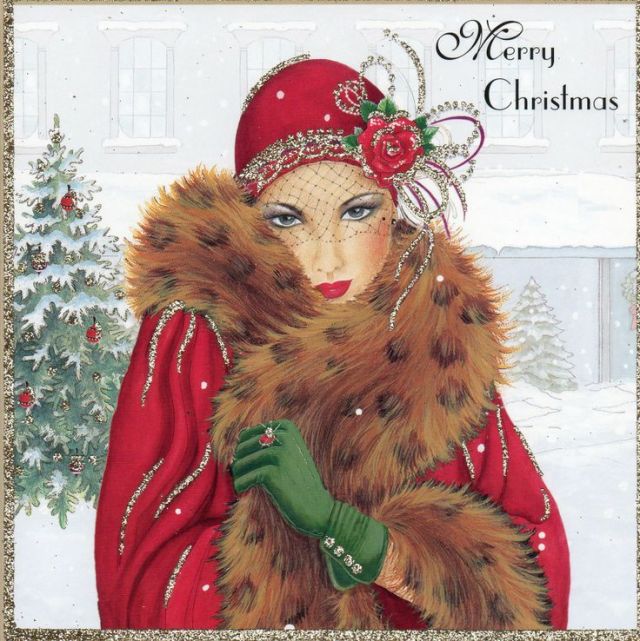
Today, our Christmas celebration is surprisingly similar to that of our Victorian ancestors.  Of course, there have been refinements along the way.  In 1843, Horsley and Cole, a couple of bored Englishmen, invented Christmas cards.  Saint Nicholas was turned into Santa Claus by Thomas Nast and Coca Cola.  At some point, religious hymns became “I’m Dreaming of a White Christmas” and “Jingle Bell Rock.”  Add we’ve added Rudolph the extra reindeer and that stupid Little Drummer Boy (who was put on this earth just to annoy me.)  However, it’s basically the same Christmas they would have had a century and a half ago.  So, when you push your chair back from the table and look at the beauty of your own personal Christmas, take a nanosecond and thank Charles, Victoria and Albert, who invented it for you.

(Originally published in 2011.)

christmas 2