The Royal Family: Fact Not Fiction

queenI can’t help myself.  I love arguing with anti-monarchists.  I never win, so dedicated are they to their point of view, but it renews my faith in the human ability to remain steadfastly obstinate in the face of overwhelming truth and logic.  Let me explain.

For as long as I can remember, the battle cry of the I-hate-the-monarchy crowd has been that the royals are a bunch of useless inbred Germans who cost a lot of money and don’t do anybody any good (notice, they were useless twice.)  And if we got just get rid of them (this is the good bit) we could use the cash they’ve been squandering on polo and tiaras to feed the homeless, clothe the starving and restore peace in our time to Afghanistan.  This is an idiot argument based on fairytale logic you could drive a golden carriage through.

The quaint assumption that once the Queen and her family are off the clock the politicians would automatically use the ex-monarchy money for something useful — instead of the stupid crap they always buy — is ludicrous.  Aristotle, wherever he’s buried, isn’t spinning in his grave; he’s doing the meringue.  Besides, the cost recovery for keeping the royals in the style to which the rest of us would like to become accustomed is worthy of the brilliant money management skills of George Soros and Warren Buffett … combined.

Everybody knows that the monarchy is maintained by the British government.  However, ridiculous as it may sound, a lot of people think that David Cameron and George Osborne show up at Buckingham Palace once a year with a big bag of money stained with the tears of widows and orphans.  They hand it over to the Queen and clear off before she unleashes the corgis.  Nice try — but not even close.  Actually, the money the British government provides for the monarchy is based on a deal, brokered way back when, by King George III.  It’s all very complicated, but here’s the decaf version.

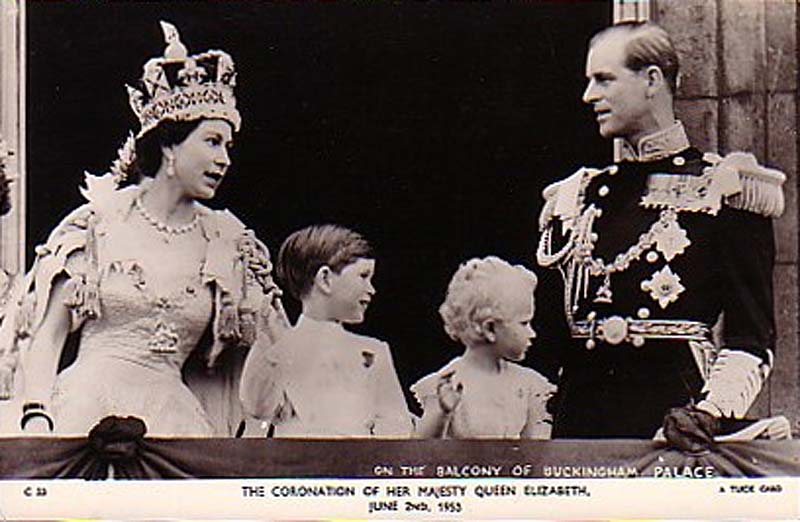
In 1760, George III, not the sharpest royal blade, was up to his sceptre in debt.  He worked out a deal with the British government to exchange the revenue (only the revenue) from his Crown Estates for a one-time debt reduction package and an annual financial grant to keep him in crumpets for the rest of his life.  The government of the day said, “You bet!” and the Civil List was born.  Ever since then, every sovereign has renewed the agreement by voluntarily (voluntarily!) forgoing the revenue from the Crown Estates.  The government, in turn, takes on the financial responsibility of maintaining the institutions of the monarchy, not the Royal Family itself.  In fact, Charles, Camilla, William, Kate, Harry and now little George don’t get a penny for their personal use.  I imagine, given it’s the British Isles; most of the taxpayer money is spent on mending the plumbing.

Now, let’s crunch the numbers.  As of March 2012, the annual surplus (Brits don’t like the word profit) on the revenue fromroyals the Crown Estates was just shy of £240,000,000.00 — a hefty chunka change.  Meanwhile, the monarchy, in all its various and assorted glory, costs the British taxpayer, give or take a farthing or two, about £40 million per year.  Do the math: that’s a 600% return on your investment!  The mighty shysters of Wall Street would kill for numbers like that.  However, before you start counting your shillings, this isn’t even where the big money is.

Pound for pound the Royal Family is a tourist attraction that rivals Vegas.  The souvenir industry alone is worth billions.  Walk down any High Street in Britain: you’ll find royal faces on everything from coffee cups to black light posters.  (Yes, I’ve seen those, more than once.)  Furthermore, the crowds the monarchy generates are incredible.  Show up at Buckingham Palace (any day of the week) for The Changing of the Guard, and you’ve got to fight your way in to get a picture.  The line of people waiting to see the Crown Jewels stretches for blocks – every day.  Let’s just crunch a single number.  Last year, in the two months it was open; more than 400,000 people toured Buckingham Palace, and the vast majority were not from London.  Those people had to eat somewhere, they had to sleep somewhere and, by Tube or by taxi, they had to show up to take the tour.  This is business as usual in Britain; throw in a Royal Jubilee, a wedding or a birth announcement and you could pave Hyde Park with American dollars—or, more recently, with Chinese yuan.

There will always be someone ragging on the Royal Family.  However, as the man said, “A little knowledge is a dangerous thing.”  The anti-monarchists are just too strident to think the thing through.  It might cost every Brit– man, woman and child– about 65p (75 cents, this side of the Atlantic) to have a Queen, but if they fired Her Majesty and gave the money back, nobody — from the Isle of Wight to the Isle of Skye — would be ahead more than the price of a hotdog.  Plus, many of them would be ruined by the economic downturn.  In actual fact, the Royal Family is one of Britain’s most valuable sustainable resources.  So, ladies and gentlemen, charge your glasses.  God Save the Queen!

Detroit: Big Problem/Simple Solution

detroit1Detroit is broke — or maybe not, depending on what the courts say.  Either way, when you owe north of 15 billion dollars and your tax base is shrinking faster than the Donner party, legal opinions are not that relevant.  Like it or not — you’re broke.  This isn’t the first time a big city has gone under, but the interesting thing about Detroit is nobody seems all that concerned about it.  Damage Control is priority #2 right now, with Blame Allocation taking the top spot.  All over the country (and the world) journalists are acting like the high school kids they really are and airing their study hall “ain’t it awful” gossip across the media, sliced and spiced with equal parts of juvenile smirk, and “it could happen here.”  They’re kicking each other out of the way to get at the root cause of this Motor City Madness in 750 words or less and spinning it into everything from racial demographics to Henry Ford was a capitalist.  Strangely enough, though, nobody’s bothered to under-think the problem and come up with a viable solution to Detroit’s dilemma – until now.

Everybody knows that urban centres (remember when we use to call them “cities?”) are incubators for thousands of professional politicos who make their bones (sometimes literally) in civic committees and city council meetings.  These on-the-job trainees sometimes go on to bigger and better things, but normally they “Peter Principle” out and either get indicted or eventually just retire.  By way of documentation, of all the mayors, in all the cities, in the entire history of America, only Cleveland and Coolidge ever went on to become president.  Just sayin’.  Unfortunately, the demands for sound judgement put on these less than mediocre managers are usually more than they can bear.  What ends up happening is they try and do too much with too little and find themselves behind the fiscal eight ball a day late and more than a dollar short (to mix my clichés.)  To be fair, the folks who run our cities are given tons of responsibilities, not very much authority and never enough cash, so, for the most part, even the ones who are working flat out haven’t got an even chance.

I don’t know much about Mayor Bing, but Detroit is typical of this phenomenon.  However, there’s more, and it’s got nothing todetroit do with him or his predeceasers.  In the late 40s and early 50s, American cities crashed headlong into cultural change.  The result was massive internal injuries which were not treated at the time.  Basically, the middleclass automobile moved families out of the urban into the sub-urban.  Without the middle class to support them, shops, theatres, restaurants etc. closed, the tax base disappeared and whole urban neighbourhoods began to deteriorate.  Meanwhile, the new suburbanites needed more and bigger roads to get them back into the cities to work every day.  These expressways, built in the 50s and 60s, ignored natural neighbourhood boundaries (look at any map) and cut most cities to pieces.  Under the overpasses, the neighbourhoods deteriorated even further.  By the mid 70s, the middle class had vanished from the big cities, taking their tax dollars with them, and urban America was on Life Support.

The civic politicos, underachievers that they are, decided the solution to the problem was to throw money at it.  They did this — beyond anybody’s wildest expectations.  However, they made two fundamental mistakes.  One, they didn’t use any of the money they were pouring into the neighbourhoods to try and repatriate the middle class.  Thus, the problem remained, teetering on disaster, but now dependent on regular infusions of cash.  And two, the money wasn’t theirs; they’d borrowed it against a future tax base that didn’t exist.

The vicious circle of urban flight combined with financial sleight of hand worthy of Charles Ponzi, and the rest is Detroit history.

So now that we know where the swamp came from, maybe it’s time to kill a few alligators.

Don’t be over awed by the magnitude of Detroit’s debauch.  Like all things economic, the solution to this, and every other city’s financial problem, is quite simple.  Quit spending so damn much money!  Nobody — I repeat nobody — from the homeless guy on Eight Mile to Elena Ford — has ever borrowed themselves out of debt.  Here’s a tip: spend the money you have, not the money you wish you had.  What a novel idea, right?  However, sure as Michael Moore makes movies, unless Detroit and a few other places start taking this radical approach they’re going to go broke again in less than a generation — “financial creativity” be damned.

Only History Will Judge the Egyptian Revolution

egypt3Even though they never taught us this in school, one of the problems with history is it’s messy.  Timelines tend to overlap, the good guys and the bad guys change sides with surprising regularity, and pivotal events are far more complicated than the “name five causes of” exam questions we grew up with.  As I recall, Mr. Barnaby (not his real name) from Social Studies 12, droned on about The Industrial Revolution as if it started one Tuesday morning after James Watt invented the steam engine.  It abruptly disappeared when an unruly mob of starving peasants got fed up with Marie Antoinette’s “let them eat cake” attitude, tore down the Bastille and started the French Revolution.  That somehow morphed into a Reign of Terror, which ended only when Napoleon showed up and started a bunch of wars.  Oddly enough, all these events took place before Christmas and Barnaby’s musings on the American Revolution — which had nothing to do with the Industrial Revolution (because we studied that last term.)  I said all that to say that, when we’re looking at recent events in Egypt, we must use as our template real history, not the made-up variety we were taught in high school.

Real history shows us that long before Imhotep the Builder decided his Pharaoh needed a stairway to heaven, Egypt was ruled by dictators.  Stick a pin anywhere in the timeline and you’ll find (in various degrees of ruthlessness) Pharaohs, some foreign pharaoh wannabes, an assortment of kings and khedives, the British, and a string of military strongmen.  That’s five or six thousand years without a lick of liberal democracy.  That all changed, however, a little over two years ago, when, during the still misunderstood Arab Spring, the people of Egypt told their latest tyrant, Hosni Mubarak, to clean out his desk.  In was a great victory for democracy, and Mubarak wasn’t even in handcuffs before the interim government set up free elections.  Unfortunately, after a thousand generations of getting stepped on by jackboots, few, if any, Egyptians, outside a cadre of academics, had the faintest idea what that meant.  More importantly, since the first thing they teach you in ruthless dictator school is how to silence the opposition, once Mubarak was gone, the political vacuum he left behind looked like a Black Hole.  In fact, the only organization on the ground between Alexandria and Aswan was The Moslem Brotherhood.  These are the boys (girls aren’t allowed) who think the Iranians are doing a bang up job in the Islamic Republic business.  In the ensuing election, The Moslem Brotherhood slid easily into power and took the vote count as a mandate for their point of view.  And that’s the problem.

In real life — unlike in Mr. Barnaby’s Socials 12 class — not all revolutions are created equal, nor do they occupy an easilyegypt4 definable spot in time.

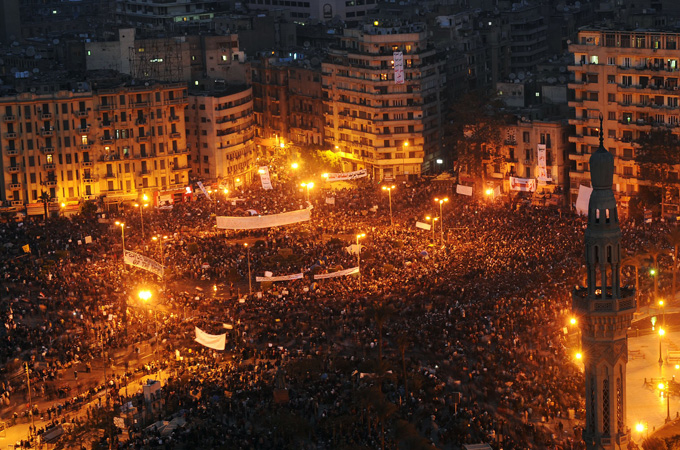
Egypt’s revolution was never about republican ideals, Islamic or otherwise.  It was about economic stability.  Those people who came to Tahrir Square in 2011 may have chanted democratic slogans, but their priorities were closer to home — jobs and affordable prices.  Two years later, that hasn’t changed.  In fact, if anything, the need has gotten worse.  Since the revolution, the tourist industry has collapsed – and, with it, most of the rest of the economy.  Food and fuel prices are in the stratosphere.  (Remember, Egypt does not have vast oil reserves like its neighbours.)  Unemployment is officially listed at around 14%; unofficially, it’s much, much higher.  Young people are hearing long-winded discussions about democratic ideals as their economic future dissolves into the Nile.  Ballot boxes are no damn good without bread on the table.  So they went back into the streets – in their millions — to try and get it right this time.

Unfortunately, the results were predictable: two accelerating political bodies, playing chicken, with Egypt in the middle.  The only national institution with any credibility left, the military, stepped up and told the politicos to fix it or face the consequences.  Defiant in the face of overwhelming opposition, Mohamed Morsi and the Moslem Brotherhood refused — and the rest is history.  Not that neatly-packaged history you learned in high school but real blood-under-the-fingernails history that is happening all around us.

They may occupy only a single chapter in Mr. Barnaby’s textbook, but the French Revolution took 80 years — and two Napoleons — to resolve itself.  The same was true in the United States where the great-grandchildren of Washington, Jefferson and Adams had to fight a Civil War to finally settle their political differences over the cornerstone of the American Revolution, the Constitution.  And the Russians never did get their revolution right, stumbling along for 75 years until the whole thing just collapsed under its own weight in 1991.

Tearing a society apart is easy; putting it back together again is hard work.  Two years is no big deal to the infinite march of history.  So, despite what the pundits might tell you, the Egypt revolution isn’t over.  It’s only just begun.