
People I Feel Sorry For!

I Feell Sorry

There are tons of people in this world I truly feel sorry for — and not just the usual suspects, either.  I feel sorry for those folks who never get to ride the sympathy train — people, who, for one reason or another, have been neglected by the caring/sharing 21st century.  For example, nobody ever feels sorry for Vladimir Putin, but can you imagine how disheartening it must be to wake up every morning and realize you’re still Vladimir Putin?  See what I mean?  Anyway, here are just a few folks I feel sorry for – and why!

I feel sorry for atheists because…

They have nothing to say when somebody sneezes.
They have nothing to scream when they’re having great sex.
And they have no one to appeal to when they’re scared shitless.

I feel sorry for rich people because…

When you can buy whatever you want, whenever you want, Christmas and birthdays must be a total disappointment.
They never get super-psyched when they find money under the cushions of the sofa or in a pair of old jeans they were going to give to charity.
They never get to sit around and imagine how cool it would be to win the lottery.

I feel sorry for joggers because…

They have to go outside in the cold, the wind, the rain and all kinds of crappy weather — when sensible people have just said, “To hell with it” and curled up with a good book.
They must spend hours and hours trying to figure out how to work jogging into every conceivable conversation.
They’re the ones who always find the dead bodies.

I feel sorry for Californians because…

When people want to sound brainless, they always fake that “whatever” Valley Girl accent.
Half their state is asphalt and the other half is on fire — so how much fun can that be?
One of these days, a massive earthquake is going to come along and kill them all.

I feel sorry for sensitive men because…

Even though all the girls tell the world that you’re exactly the kinda guy they’re looking for, chances are good that the minute some bad boy comes along, you’re going to get dumped into the “friend zone.”
Every time your girlfriend says “What are you thinking?” you’ve got to scramble to come up with something — even though the only thing playing in your head is Vader’s Theme from Star Wars!
You have to spend your entire life pretending that you forgot you have testosterone.

I feel sorry for the British Royal Family because…

They always have be in a good mood and never get to just lose it and start swearing at strangers who annoy them.
They can never excuse themselves to go to the toilet.  They have to hold it – sometimes for hours.
Every moron in the world can criticize them, call them names and say they’re useless — and they can’t do anything about it.

I feel sorry for millennials because…

They have to use words like “re-gifting” and “tasking” and “self-care” — which make them all sound like complete idiots.
It must be very discouraging to spend every day rediscovering that you’re not the centre of the universe.
All the other generations think they’re assholes.

But mostly:

I feel sorry for smart people because…

They have to work twice as hard as everybody else to find an interesting movie on Netflix.
They actually understand how totally screwed the world really is.
They have to start a blog to find other smart people to talk to.

Neighbour Shaming!

neighbour

Today, I’m speaking out about neighbour shaming.  For too many years, thousands (if not millions) of people have quietly lived with the pain and humiliation of living on a street with a neighbour shamer.  It’s time to break the silence.

The main problem is our world has not yet woke to the social devastation caused by neighbour shaming.  Neighbour shaming behaviour is still acceptable and, in fact, even actively encouraged by many public organizations and the media.  So it’s no wonder many neighbour shamers don’t even realize that what they’re doing is inappropriate, and most victims are unaware that they’re being victimized.  They still believe that there’s actually something wrong with them.

So what is neighbour shaming?  And how do we end this unacceptable behaviour?

It’s quite easy to spot a neighbour shamer.  They’re the people whose houses have neatly manicured lawns, perfectly edged sidewalks, trimmed hedges, window boxes and nicely painted fences.  They’re the folks who spend their evenings and weekends planting, weeding, raking, pruning, sweeping and generally working their asses off to create a beautiful home and garden.  The problem is these alt-horticulturists have created a toxic urban environment by setting an unrealistic and unattainable standard for the rest of us.  Through their selfish, thoughtless actions, they make everyone else in the neighbourhood look like a bunch of lazy hillbillies.  But, we’re they’re not hillbillies.  They’re just ordinary people who are struggling – struggling with weeds, aphids and rose blight.  And they could be facing their own challenges — perhaps they grew up in an apartment or an orphanage, perhaps they were abused by florists, or maybe they suffer from gnomophobia (a fear of garden gnomes.)  At first glance at an unattractive garden, it’s easy to be judgemental, but not everyone understands soil composition, mulch, or the dos and don’ts of fertilizing.  Plus, many victims have serious time, space and financial disadvantages.  It’s time we were honest and recognized that “having a green thumb” is, in reality, “green privilege.”

The Home and Garden Industry is a multi-billion dollar business whose profits depend on neighbour shaming, but you can fight back.  Here are just a few things you can do to raise awareness in your community.

1 — Go to the neighbour shamer on your street and tell them how their perfectly symmetrical flower beds make you feel.  Explain to them that the sound of their hedge clippers is causing you emotional harm.  Open a dialogue.  You might be surprised.  Many neighbour shamers feel the same social pressures you do; sometimes, even more.

2 — Organize a neighbourhood garden party to show that you don’t need an immaculate lawn to enjoy life, and people can still party and have fun, surrounded by brambles, weeds and dog shit.

3 — Contact home and garden magazines or websites and tell them just how offensive their “before and after” pictures really are, and then suggest they would be more inclusive if they provided equal coverage of derelict houses and waste ground.  Write or email television networks and demand they broadcast trigger warnings to caution viewers that gardening programs can cause stress or harm self-esteem.

4 — You can also start a support group to let people know they’re not alone or even turn your own garden into an empty, concrete “safe space.”

And finally, but most importantly:

5 – Always remember it’s not your fault your garden kinda sucks, and even though that workaholic, perfect-sized, handy-husbanded, helpful-childrened, cupcake-making, bikini-wearing bitch down the street can grow gorgeous rhododendrons in her sleep — you’re still a good person.

Two Tales Of Tyranny

tank-man

Thirty years is a long time.  It’s more than a generation.  It’s on the very edge of living memory.  So it’s no surprise that not many people know that today marks the 30th anniversary of two very important events in the history of tyranny.  One — under the diligent efforts of an oppressive government — fading from view; the other, largely forgotten for very different reasons.

In the spring of 1989, protests across China were gathering momentum.  They called for the total reform of the Communist government, and their epicentre was Tiananmen Square.  The Square had been occupied by thousands of students from Beijing’s universities since the middle of April.  On May 20th, the Chinese government declared martial law and ordered the students to leave.  In an unheard of act of disobedience, the students refused.  Two weeks later, on a warm evening in June, Deng Xiaoping called in the military, and the protesters in Tiananmen Square began hearing reports that the People’s Liberation Army was on the march.  What they didn’t know was the unarmed citizens of Beijing were fighting a desperate battle to stop the tanks.  All over Beijing, ordinary people had crowded into the streets to defy the People’s army – human barriers facing totalitarian steel.  The army didn’t care.  They had their orders.  They opened fire.  Stunned and enraged, the people fought back.  They threw up makeshift barricades and pelted the trucks with bottles, stones and Molotov cocktails.  But there was never any doubt: shopkeepers and office workers are no match for professional soldiers with automatic weapons.  Hundreds were killed that night, thousands injured and the trucks rolled on; their objective, the students in Tiananmen Square.  By midnight, the Square was surrounded and the young people were given an ultimatum: leave Tiananmen, or face the consequences.

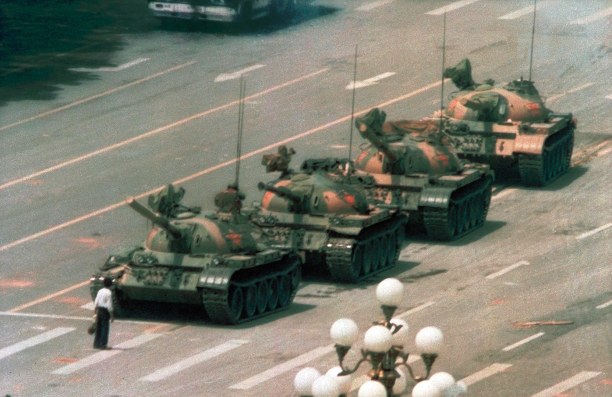
There is no definitive account of what happened next.  Some say hundreds more were killed, but the Chinese government insists that there were no further casualties.  What we do know is most of the students did not leave voluntarily.  (There are videos of them, amid sporadic gunfire, shaking their fists at the soldiers and singing The Internationale.)  But we also know that, by mid-morning, the students were gone, and later, when a crowd of people (mostly parents looking for their children) approached the Square, the soldiers once again opened fire and then called in more tanks.  (We have a famous photograph of one man’s brave attempt to stop them.)  Whatever happened in the dark, early hours of June 4th, by the end of the day, the Chinese Spring was essentially over; ironically, crushed by the People’s Liberation Army.

Halfway around the world, June 4th, 1989 was Election Day in Poland.  But this was no ordinary election because, for the first time in 50 years, there was more than one name on the ballot.  For the first time since Hitler and Stalin had carved up the country in 1939, Poles had an opportunity to choose who would rule them, and millions were determined to make that choice.  In the big cities, the turnout was cautious; still, thousands waited patiently for their turn at democracy.  In other parts of the country, small towns were virtually shut down as everyone who could, went to the polling stations.  By the end of the day, it was clear that Lech Walesa’s Solidarity Party had broken the power of the Communists.  They’d won every seat they were allowed to contest in the Sejm (parliament) and 99 out of 100 seats in the Senate.  Their victory was so overwhelming many thought Moscow would annul the vote and send in the Red Army. (It had been done before.)  But Mikhail Gorbachev was not Leonid Brezhnev, and in 1989, the Soviet Union had its own problems.  The results were allowed to stand.  It was the first tear in the Iron Curtain that had divided Europe and dominated world politics for 45 years.  Here was proof that the Communist State was not invincible.  Within four months, the people of Berlin had pulled down the Berlin Wall.  Less than a year later, most of the other Warsaw Pact nations had held their own free elections, and Germany was reunified.  Within two years, the Soviet Union itself collapsed: the Cold War was over.

Today, no one much remembers Lech Walesa, the Soviet Union or the Cold War, and China’s economic power has made it expedient to shut up about Tiananmen Square.  Besides, our world is much more concerned about who’s wearing what on the Red Carpet and which celebrity wrote something unfortunate on Facebook five years ago.  But we need to remember these tales of tyranny because — even though eventually the pen is always mightier that the sword — there are also hard occasions when the sword wins.