“I remember these,” Emily said, looking out over the river. She was nervously answering a question Dreyfus hadn’t asked. But he was busy searching through the kitchen cupboards, trying to find where Mrs. Flynn kept the serving trays. He never used them, but for some reason, he wanted the square silver one to serve the drinks on.
Emily turned her head and gestured back at the windows. “I didn’t remember they were quite so big. This place is huge.”
Dreyfus stopped and pointed to the loft behind him. “This from a woman who eats breakfast in a cathedral. Besides, you spent most of your time up there.”
“I spent most of my time whacked out on painkillers.”
Dreyfus opened another cabinet door. Pans. No luck. This was getting awkward. Emily wasn’t sure what to do either. She looked around, trying to remember things so she’d have something to talk about. This was not the reunion either one of them had envisioned in the long goodbye at Peterborough train station.
They hadn’t seen each other for nearly a month. Dreyfus had left Pyaridge Hall a couple of days after New Year to catch a plane for Panama. The purpose of the trip was to explain supply and demand to a corrupt government official who was demanding a bigger bribe to supply customs clearances for Hudson and McCormick ships. Normally, Dreyfus loved the tropics (especially in January) but when he arrived, he discovered that Senor Estasfador was arrogant and enthusiastically stupid. Plus, despite the sun, sand and pina coladas, Dreyfus found he was oddly homesick for the chilly rain of London. It made him irritable, and after a couple of weeks of failed negotiations, haughty dismissals and hurry up and wait, he decided to solve the problem. He walked into El Estasfador’s office, pulled him out of his comfortable chair and threw him out the window. The flight from the first floor and the cuts, contusions, broken wrist and shoulder convinced everyone that there had been a misunderstanding and the bribe was, indeed, satisfactory. The papers were signed that very afternoon, and the next day Dreyfus was on his way home.
Meanwhile, Emily had stayed on at the estate, to hurt a little and heal a lot and divide her time equally between being an unhappy puppy and a snarling bitch. Eventually, Janet Miller, estate manager and concerned friend, suggested Emily either fly to Panama and get it over with or risk being smothered in her sleep. Two days later, Emily was on a plane to New York City. However, unaware of the surprise, Dreyfus was already changing planes at JFK. They passed each other somewhere over the Atlantic.
Now, maxed out on frustration, they were together again and couldn’t quite figure out what to do with each other. The simple fact was neither one of them had ever done this kind of thing, and they didn’t actually know how to act. The ten plus days at Pyraridge Hall had been a full-on love affair, giddy and silly and just a bit dizzy, with enough erotic content to make Aphrodite blush. But that had been time out of time, hidden in the country — and now this was the real world. And they were both desperately afraid that the other one had had time to think about it.
“What are you looking for?” Emily’s exasperation bubbled over.
“Something for the drinks,” Dreyfus said, defeated. “I’m trying to impress you.”
Emily pointed to the low liquor cabinet across the room. “Whisky? Glasses?”
“No, I was trying to find a tray to put things on and …” Dreyfus was embarrassed. “I just wanted everything to be nice.”
Emily turned directly to Dreyfus, who was clearly uncomfortable, and tilted her head sympathetically. “I know what you mean,” she said. “I bought a bikini.”
Dreyfus looked the question.
“At JFK, before you called. When I was still going to Panama. I bought a bikini.”
Dreyfus shrugged and opened his hands, palms up.
“I don’t wear bikinis, Sinclair. Too much Emily,” Emily fluttered her hands and shivered her shoulders, “Hanging out everywhere.”
Dreyfus, who’d seen quite a bit of Emily over the Christmas holidays, didn’t understand, and his face showed it.
“I bought it for you.”
Dreyfus recognized Emily’s tone and swallowed the adolescent joke. He exhaled. “We’re trying too hard?”
It wasn’t a real question, and Emily didn’t answer.
“Go sit down. I’ll pour you a drink.” Dreyfus gestured to the sofa and went to the liquor cabinet. “There’s a remote on the table for the fireplace.”
Emily walked across the room. “I remember the fireplace,” she said, sitting down. “And the soup. God! That was the best soup.”
“Do you want some? Mrs. Flynn usually leaves me some. I could look?”
“Maybe we’re trying too hard?” Emily said, over her shoulder.
Dreyfus agreed to himself and poured two generous glasses. He went over, handed Emily her glass and sat down on the floor at her feet with his arm on her leg.
Emily touched her glass to his and said. “Let’s start again.”
There was a ting and they both drank.
“How was Panama?”
Dreyfus shook his head and chuckled. “Nothing special. I threw a man out of a window.”
Emily nodded. “As you do,” she said solemnly.
There was a pause.
“What about you?”
“Janet threatened to kill me.”
It was Dreyfus’ turn to nod. “How is the indomitable Ms. Miller?’ There was a touch of mock sarcasm.
“Be nice. She likes you. Actually, I deserved it. I’ve been an absolute horror for weeks.”
Emily reached down and pressed Dreyfus’ hand against her leg. “I missed you so much it hurt,” she said, shaking her head and looking at Dreyfus as if it were the first time.
Dreyfus looked up and it was his Emily and nothing had changed. “I missed you so much I threw a man out of a window.”
Emily laughed, bent her head down, “You win,” she said and kissed him, long and deeply.
And the late afternoon became evening and the evening became night, and they talked the hours away and didn’t go to bed until morning.
But that was alright because they didn’t leave the bedroom again for three days.
–
Emily sat in the big chair by the tall windows, wrapped in a sheet — toga style. She was warm — content without being sleepy. It was raining and the light was January dim. She took a bite of old, cold pizza and considered the half glass of wine.
“What time is it?”
Dreyfus half rolled over in the bed to look at the clock. “Six, just gone.”
Emily tried to look through the rain to the city across the river for a reference. The lights were all wet and runny.
“Is that morning or afternoon?”
For a second Dreyfus wasn’t sure. “Morning … I think. Why?”
“I have to go home. I have work to do — I hope? I haven’t done anything since before Christmas.” Emily sat up and put the half-finished slice of pizza back in the box. “And I didn’t get paid for that.”
“Back to the country?” Dreyfus sat up.
“No, Notting Hill. I have to go to the studio. I need to get my mail. See who’s on my answering machine.” Emily shook her head, “I have things that …”
“Wait. Wait. It’s pouring out there. Nothing’s that urgent.”
Emily was about to answer but stopped, startled.
“Jesus Christ! My suitcase is still at the airport!”
Dreyfus shrugged.
“I don’t have any clothes, Sinclair! Somebody broke the zippers on my one and only pair of slacks.” It was an accusation. “Any hope of a couple of safety pins?”
Dreyfus looked at her as if she’d asked him for a unicorn.
“I didn’t think so.” Emily looked around, “And where? Never mind. If you find my knickers, burn them.”
Dreyfus chuckled and swung his legs over the bed.
“I need to have a shower.” Emily stood up, moved her hips uncomfortably and frowned. “And you need to shave.”
Dreyfus stood up and rubbed his chin. “Okay. Okay. Slow down. It’s Sunday.” Dreyfus closed one eye and thought about it, “Yeah, it’s Sunday. Let’s go take a shower and we can figure things out from there.”
Emily tightened her lips, looked sideways and stuck her arm straight out with her index finger in the air. The sheet drooped provocatively and she clutched it with her other hand.
“No. You stay over there. I’m perfectly capable of having a shower by myself.”
“What if you get soap in your eyes?” Dreyfus smiled.
“That’s the only thing that’s going to be in me for a bit. And put some … clothes …” Emily paused and took a quick look around. For the first time, she realized there was nothing in the loft but a bed, an upholstered chair and a small round table.
“Where are your clothes?” It was a cautious question.
Dreyfus looked vague and gestured to the floor in front of him.
“No, your clothes? Suits? Ties? Shirts? Clothes? Your clothes?”
“Oh,” Dreyfus laughed and pointed, “Behind that wall.”
It was Emily’s turn to look vague.
“Here, I’ll show you.”
Dreyfus stepped up, walked across the bed and stepped down.
He certainly does look good naked, Emily thought, without actually thinking.
Dreyfus pushed one of the white bricks and part of the wall swung open, throwing a slant of hard light across the dim loft. Emily couldn’t see into the space properly, but it looked large.
“It’s a closet … um …” Dreyfus twinkled his fingers, “Ah – a walk-in closet. I keep everything in here. There’s another one just like it on the other side. That’s where you can put your things.”
Suddenly, it was definitely morning. There was no mistaking it. Emily wondered why men always got so nesty after an abundance of sex. She smiled to herself. It was as if, having discovered a source, they were determined to safeguard the supply.
“Do you have Narnia in there?”
Dreyfus detected the subtle millimetre of distance in Emily’s tone. It was definitely morning.
“I haven’t found it yet, but I can probably find you something to wear. It won’t be stylish, but it’ll cover the vital bits.”
Emily recognized the step back in Dreyfus’ voice, as well. It was nice to be understood. She turned, dropped the sheet and walked across to the bathroom.
“Fresh towels in the …”
“Nah, I’m alright.”
Dreyfus watched her walk away.
–
Sometime later, Emily leaned on the rail and looked down at Dreyfus. He was sitting at the table behind a newspaper and a silver pot that was probably coffee. She hadn’t noticed it before, but the whole place was cloister bare – all straight lines and flat surfaces. There weren’t even handles on the cupboard doors. She rubbed her hair with the towel. The shower had been difficult — too many knobs and she couldn’t remember how Dreyfus had manipulated them. But eventually, she got hot water, and now she felt crisp and clean, although between Dreyfus’ sandpaper soap and eau d’antelope shampoo, she thought she smelled a little manly. She rubbed her hair and walked back to the bathroom to get rid of the towel.
Dreyfus had left clothes on the bed, a gigantic pair of wool hygge socks and a kosovorotka shirt with white brocade at the neck and cuffs. It was long, but oddly, aside from the sleeves, it fit rather well. She tried the belt – it made her look like cinched-in potatoes. She discarded it and rolled up the sleeves as she walked down the stairs.
“What do you think?” she asked at the bottom and did a heel to toe catwalk walk across the room.
Dreyfus folded the newspaper and dropped it on the floor. “Pure sex. That shirt certainly fits you a lot better than it ever did me. Coffee in the pot and cups behind me. No cream, I’m afraid. And there’s sugar somewhere, but I …” Dreyfus shrugged.
“Black is fine,” Emily said, picking a cup off the tree. She sat down across from Dreyfus and poured herself coffee. It was a dull and rainy day, but the light through windows told her it was definitely day.
“I sent Sydney to find your suitcase.”
“Mh-mh, Sydney.” Emily sort of laughed, then thought about it. “My suitcase isn’t lost. It’s at baggage claim.” She saw the question on Dreyfus’ face and added, “I was in a hurry.”
He smiled and nodded. “Do you want me to have him stop and pick up your mail or bring you anything?”
Emily sipped her coffee. “No, but maybe he could wait while I get changed and then take me home.”
Dreyfus considered his options. He didn’t want Emily to go home. But the truth was she was the first woman who’d ever been in the loft the morning after the night (nights?) before, and he really didn’t know what to do with her. “I thought we could go out to dinner.”
Emily put her cup down. “It’s seven-thirty in the morning?”
Dreyfus tilted his head, “Early dinner?”
It was Emily’s turn to consider the options. She didn’t really want to go home, but sitting having your morning coffee in somebody else’s clothes doesn’t offer a lot of reasonable alternatives.
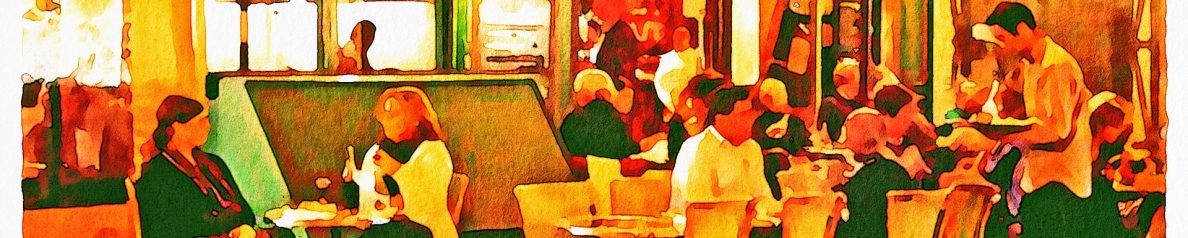
“You know, we’ve never really had a first date. And I’ve had a standing reservation for us at Clos Maggiore since – uh – December. We could get some proper food. I don’t know about you, but I’m definitely tired of takeaway. Fresh air. Take a walk in the rain. Go see a show if you like? Or …”
It all sounded fine, but getting there was the problem, and Emily, still a little muddled over the last few days and trying hard to work with “This is your closet.” suddenly found herself speaking.
“For God’s sake, Dreyfus! What the hell do you do in this place when you’re not on top of me?”
Dreyfus laughed. It was a good laugh, full of fun.
“Fair question,” he said and made no attempt to explain.
“Seriously,” Emily said, looking around, “You’ve got a coffee pot, four cups and a …” She waved her hand.
“Toaster,” Dreyfus volunteered.
“A toaster.” She sat back in her chair. “Gandhi had more personal possessions. There’s nothing here. This is on the road to pathological.”
“You just noticed?”
“I’ve been busy.” Emily widened her eyes.
Dreyfus laughed again and shook his head.
“Don’t worry. I don’t have a mental disorder. I just spend a lot of time living out of a suitcase, and I like it that way. So …” He opened his hands.
Emily stopped in mid thought and thought about it. It made perfect sense, actually. Dreyfus Sinclair was the most ego neutral man she’d ever met; of course that would show up in his personal life.
“My place must have driven you crazy. Five centuries of clutter.”
“No, it’s not like that.” Dreyfus shrugged, “I don’t care what other people do.”
“But what is it you do? I mean here.” Emily moved her hands, “By yourself. I know you don’t listen to music.”
Dreyfus pointed a warning finger, and Emily almost giggled.
“I don’t know. What everybody does?” He half squinted at her, “I read. I write. There’s always letters to write. I like doing that. I go out. I – uh – I go to school. When the mood takes me.”
“School?”
“Yeah, there’s a lot of schools in London. Weekends, evening classes. I’ve taken all kinds of things. History. Geography. I took a woodworking class once. Fascinating! All those little machines that do things. Last spring, I took Ballroom Dancing. That was fun.”
Emily felt a deep involuntary twitch as she imagined Dreyfus in a tuxedo. “Can you tango?”
“No,” Dreyfus exhaled, “I had to fly out to – umm – Germany, I think. I didn’t finish. But I can box step like a champion.”
“They never taught us tango at Cheltenham Ladies. I’ve always thought it was a huge gap in my education.”
There was a pause. And for Emily, that moment was the best moment of the morning — when Dreyfus didn’t immediately offer to sign them up for lessons. It meant that “This is your closet” was simply a place to put her clothes.
“Any chance of some toast?” she asked and poured herself more coffee,
Sometime later, Sydney showed up with her suitcase and long Italian sandwiches – said his hellos, read the room, admired Emily’s hand and made his goodbyes. Eventually, Dreyfus went up to shower and shave. Emily’s suitcase was distinctly tropical, but she added a layer, and with a hairband elastic crimped at the hip for a more formal look. Then, unfashionably early, they called a taxi and finally managed to have a first date.
You can find the start of Dreyfus and Emily’s adventures here


 WD Fyfe