

3 Things That Rule The World

buildingsWe live in a marvelous age.  We carry the sum total of all knowledge in our pockets or our purse.  We can communicate around the world with the tap of a finger.  We can travel across time zones like a striding colossus and enjoy the styles and flavours from half a world away at a whim.   And even though we don’t do it, we have the ability to feed, clothe and house every person on this planet — 3, 4. 10 times over.  In short, we are the masters of our universe and sovereigns of all we survey.  Yet even though we live in a techno-Disneyland, our society is based on three simple inventions that haven’t fundamentally changed in well over a hundred years.

The Piston Engine — Find something that moves on this planet and chances are good it’s propelled by a piston.  Whether it’s internal combustion, hydraulic or steam, the piston is the thing that drives our world.  Trucks, buses, cranes, boats, trains and all the other mighty machines that shape our destiny (including the ubiquitous automobile) are all piston-powered.   Yet the contemporary piston mechanism hasn’t changed that much since James Watt radically improved the design of the steam engine in 1775.  Even that all-powerful genie in a fragile jar, nuclear power, is actually nothing more than the fuel that heats the water of a very conventional piston-powered steam engine.

The Dynamo — Turn the up-and-down motion of a piston in a cylinder into rotating motion by the use of a camshaft, and not only can you move things forward, but that same spinning rod can literally turn magnetic fields into electricity.  Michael Faraday discovered this in 1831, and by the late 1860s, industry had perfected his rudimentary dynamo to produce usable electricity — and the basic mechanics of that hasn’t changed since.  Today, 99.99% of all electrical energy on Earth is generated by some modern version of the 19th century dynamo.  And the simple fact is without electricity, our society would collapse within hours.

The Flush Toilet — It’s impossible to imagine modern megacities without the flush toilet.  The logistical nightmare of waste disposal without an automatic system would make contemporary urban life inconceivable.  In fact, the flush toilet was the product of the first megalopolis, London.  In the mid 19th century, London (like all cities in England) was a cesspool — literally.  Human waste was handled by “night soil men” who collected it, carted it through the streets and disposed of it in huge evaporation fields — or simply threw it into the river.  The whole place stank, and disease was rampant.  The flush toilet changed all that, and more importantly, forced governments to build modern sewer systems.  Today, every home has a flush toilet (sometimes 2 or 3) but the actual mechanism that makes it work is virtually the same as the ones perfected by Sir Thomas Crapper (and others) 150 years ago.

And the moral of the story is if you want employment in our contemporary world, forget the ever-changing technology market and go be a mechanic, an electrician or a plumber.  Those jobs are going to be around forever.

Foods That Lie

foodThe holier-than-thou among us — and Internet nerds — like to point out that our food is woefully contaminated by all manner of terrible crap.  Yeah, so what?  We all know that Grape-Nuts cereal doesn’t actually have any grapes in it — or nuts either, for that matter.  (It’s made of wheat and barley.)  And any European will tell you that American cheese might very well be American, but it certainly isn’t cheese.  In fact, it’s so far from cheese that the manufacturers — yes, manufacturers — have to call it a ‘cheese product.”  And that’s the thing.  These days, various government regulations make certain we’re aware of what we’ve about to put in our mouths, so if you don’t want to eat tridisodiumonotoneglycirodium phosphate or whatever? Simple solution:  don’t.  However, there’s still a lot of food out there casually strolling through legal loopholes to masquerade (“scam” is such a hard word) as something it’s not.
(BTW, this isn’t about GMOs.  That’s a whole different kettle of faux fish.)

Orange Juice — “100% pure orange juice” is orange juice.  However, in order for your breakfast beverage to survive the month or so it takes to get to you, the OJ people actually remove the oxygen from it.  This prevents the orange part of the juice from turning green and the juicy part of the orange from getting slimy.  Unfortunately, removing the oxygen also removes the smell and the taste.  Both of these are artificially reintroduced during processing.  This isn’t a nefarious plot to con you out of your orange juice.  Use your head!  It’s just a very long journey from the tree to your table.  If you want pure orange juice, buy oranges and squeeze them yourself.

Tuna — If you’ve been to a sushi restaurant lately and ordered tuna maki, tuna roll or tuna anything else, chances are good you didn’t actually get tuna.  You probably got escolar, a cheap and plentiful fish that’s been “substituted” for tuna (and not just in sushi restaurants) ever since overfishing devastated the wild tuna stocks.  The truth is the only way you can be sure you’re getting real tuna is pay the big money or buy it in a can.
And while we’re on the subject…

Wasabi — The hot green condiment that’s a staple of Japanese cuisine — except mostly it isn’t.  Real wasabi is prohibitively expensive (it only grows in a few places in Japan) so most sushi restaurants use a combination of horseradish, mustard and food colouring.  They call it wasabi because people like me don’t know the difference.

Olive Oil — You get what you pay for.  Real olive oil is mega-expensive. Anything else is a combination of other oils (soy, mostly) that have had olives carefully described to them.

Honey — Not all honey is created equal.  Some honey is created by bees in a hive.  However, other honey is created by folks in a factory who take a small amount of honey (enough to justify the name) and add fructose, sucrose, glucose and any other -ose they happen to have kickin’ around.  Technically, this is still honey, but in actual fact, it’s syrup.  The way to tell the difference?  The busy bee sugar is pure honey and will start to crystallize the minute you open the jar. The other stuff is too lazy to bother.

Blueberries — The only similarity between consumer blueberries (found in cereals, muffins, cakes etc.) and real round blueberries is both of them are blue.

Coffee — Most consumer brands of coffee have a small percentage of foreign bits and bobs hidden away in the grind.  Basically, this is just part of the harvesting, roasting, grinding process.  No big deal — it’s still coffee.  However, some of the cheaper brands actually add things like grain, soy beans and corn to the mix — just enough so they don’t have to claim them as ingredients on the label.  Coffee?  Kinda, but if you’re devoted to real coffee, buy the beans.

What it comes down to is pure food is all about the money.  Either ya pony up the big bucks for the good stuff, or ya shut up and eat your tridisodiumonotoneglycirodium phosphate.

***********************************

Technical Difficulties

I seemed to have hit the wrong button and now WordPress won’t let me like, reply or even acknowledge comments.  We’re working on the problem.  I hope we can fix it very soon but until then I want everybody to know I’m not ignoring you.  Cheers WD

OMG – Darwin Was Right

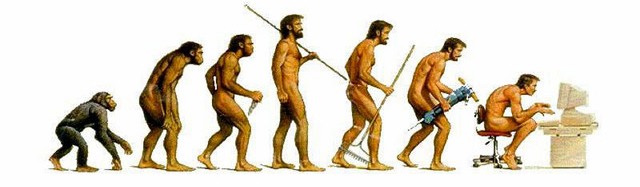
age of man1

We got lied to about evolution.  Hold it!  Before you let fly the anti-Christian fireworks, I didn’t say anything about a man in the sky who created the heaven and earth in six days and then took Sunday off to watch a ballgame.  All I said was we got lied to about evolution — and we did.

Everybody knows the story of Darwin.  There are some people who don’t believe it, but in general, Darwin, like Freud and Nietzsche, is one of the good guys.  The problem is what people actually know about Darwin’s Theory of Evolution would fill a mouse’s ear.  Most of our “common knowledge” is nothing more than “collective ignorance.”  It runs like this: living species adapt to their environment and those who adapt best, survive and even thrive; those who don’t, end up gathering dust in a Natural History museum.  While this is basically true, the underlying theme is this process is beneficial.  Unfortunately, Darwin didn’t say anything about that.  In fact, it probably never occurred to him.  The whole “evolution is good for you” school of thought came from other Victorians, a few Edwardians and a lot of Nazis, who wanted to seal the deal on “we’re-better-than-you-are”– once and for all.  So as Josef Goebbels might have said, if you tell a lie loud enough and long enough, people tend to believe it.  That’s why most contemporary people will tell you, evolution is a good thing.  Crap!

First of all, evolution does not come with a moral component.  It is neither good nor bad — it’s indifferent.  Faster lions don’t get extra points for catching the gazelle – they get to eat.  If they eat, they get to mate and pass their “faster than a speedy ungulate” genes on to their offspring.  Likewise, gazelles who avoid becoming a Happy Meal™ get to spend a romantic evening with a fast female, listening to the lions digest Too Slow Uncle Joe.  Nature, in its wisdom, takes its course, and the “faster than a hungry lion” gene is also passed along.  Then the process starts all over again.  The evolutionary race on this planet is never-ending.  By definition, it’s evolving.

Second, Darwin’s theory only applies to a self-contained natural environment like the Galapagos Islands where “Faster! Higher! Stronger!” makes a difference.  Once a foreign element is introduced into Darwin’s theory, all bets are off.  Just ask the Dodo bird or the Passenger Pigeon.  They were poster children for evolutionary excellence.  At one time, there were so many Passenger Pigeons in North America they blackened the sky, except — oops — now, they’re all dead.  So what happened to evolution?  Shotguns!    Evolution comes to a screaming halt when faced with a speeding bullet, or any other man-made apparatus.  When that happens, natural selection becomes nothing more than an after-dinner conversation.

The problem is, despite the lies we’ve been told about evolution, at the end of the day, Darwin was right.  The fellow who gets the lion’s share of the food and the females will pass his genes on to the next generation.  Unfortunately, our species no longer relies on “Faster! Higher! Stronger!” for its success.  We’re more into “Smarter! Richer! Sneakier!”  Nor do we live in a self-contained natural environment anymore.  Physical attributes still work for lions and gazelles on the African veldt, but they’re not quite so handy for humans in London or Chicago.  We are techno-termites who hunt our food and our females with credit cards.

Meanwhile, evolution doesn’t care.  It just keeps pumping away, rewarding the genes that survive and discarding the ones that don’t.  The problem is we humans still attract each other physically with the broad male shoulders and wide female pelvic bones we needed to get to the top of the evolutionary ladder.  However, look around! These traits are now pretty much useless.  In fact, given our complex techno-eccentric world, their intrinsic value is actually questionable.  In a nutshell, evolution may be rewarding the wrong genes.  And thus, when we understand what Darwin was actually telling us, it looks remarkably like our species might just be evolving itself right out of business.