
 Yesterday afternoon, money folks around the world exhaled. American lawmakers, through no fault of their own, came to their senses and voted to extend the American debt ceiling to a number beyond the comprehension of mortal man. The crisis was averted, and now we can all go about our business again. Crap! This is only a temporary truce. The real war is still going on.
For the last couple of months, there’s been a media laser beam zeroed in on the House, the Senate and Barack Obama, as each one, in turn, demonstrated their inability to grasp simple economics. As in, if Johnny has 14 trillion apples and he eats every single one of them, his kids are basically screwed on the apple front. There have been any number of talking head solutions: stop spending my money; tax that guy over there; blame the Chinese; sell the Grand Canyon — and the etceteras just get stranger after that. It’s hard to imagine that anybody (politicos or pundits) within limousine distance of Capital Hill has the foggiest idea of what’s going on. Perhaps they should ask the servants – who would probably tell them you can’t borrow yourself out of debt.
Everybody knows that once money gets a nickel past a billion, it’s no longer real.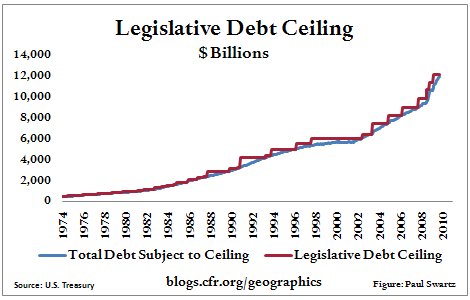 It’s figures on a page, triangles on a pie chart or bars on a graph – that’s all. There is no real connection between Sangee’s Daycare money in Lincoln Nebraska and firing off million dollar missiles in war-torn Katphoodistan. Try as they might, even the brainiest of America’s elected representatives can’t conceive of how much money they’re playing with. Nor can they understand the simple dollars and cents or it. The concept that it’s Sangee’s money they’re spending is overwhelmed by the magnitude of the mortgage. So let’s quit with the rhetoric, folks, and get on with it.
Outside the media glare, there’s a whole different round of battles going on between the House, the White House and the Senate. (What I like to call The Axis of Feeble) It’s these battles that are dictating the course of events in Washington, not any lawmaker’s inherent concern for Sangee, her money or her well-being. (FYI, Senators Johanns and Nelson, I’m not picking on you. I just think Lincoln represents America more than Miami does.)
 One of these is the never-ending war between the Executive and Legislative branches of government. This firefight has flared and died throughout US history, depending on how tough the president is. These latest skirmishes started when Richard Nixon and Rose Mary Woods destroyed 18.5 minutes’ worth of audiotape — and 184 years of White House prestige — one afternoon in 1973. Currently, President Obama’s hands-off approach to leadership, has opened the door for crybabies like Boehner to stride around as if they’re on their way to the OK Corral. Unfortunately, none of them could win an audition on Buffalo Bill’s Mild West Show. This is where ineffective governance comes from: half a dozen wannabes, whine-slapping each other across the media. Like it or not, at least Pelosi had the cojones to tell Obama what Obamacare was going to look like. This crew is scared of their own shadows, and America is whispering because of it. There’s enough naked power in Washington at this moment to light the entire world — and not three people in town willing to reach for the switch. Expect more of the same until somebody quits signing pledges to do good and actual does it. Or until somebody in the White House hotwires the podium to the teleprompter and Obama has to come up with a policy beyond, “We hope to change.”
Furthermore, for the last year or so, the only issue American lawmakers seem interested in fighting for is infighting. The two-party system is rapidly dissolving into a four, six or eight party fiasco, bent on emulating a 1920s Balkan republic. The beauty of the two-party system is consensus has to be reached within the party before it ever goes to the electorate. Whether it was Republicans, Democrats, Whigs or Free Soilers, historically, parties have always fought it out among themselves, long before election time. They came up with a coherent plan, presented it to the people and let them decide. This allows for some pretty big umbrellas; different constituents can gather together in general agreement to advance a common purpose. These days, every Tom, Ron and Michele has their own agenda. Every issue is a consensus-building minefield. Every petty opinion demands a voice in a St. Vitus Dance of disagreement. And every time you turn around, nothing is getting done because every cockeyed notion available needs to be considered. Propelled by deluded self-importance and an ever-present phalanx of self-serving lobbyists, lawmakers have abandoned ideals in favour of narrow topical ideas which have no connection to the common good (beyond the next election.) They disdain compromise, in favour of self-proclaimed principles whose shelf life is tied to FOX, CNN and MSNBC. How can I make these statements? Easy! I’ve witnessed the last six months of Washington tomfoolery.
 Yesterday, American lawmakers raised the debt ceiling because they had to. They had no choice. The very best, well-informed, educated, supported, principled government on the planet ran out of time — like a sophomore with a term paper. Why? It’s not like they didn’t know the deadline was coming. There are several versions of what just happened in Washington, depending on which side of the aisle your sympathies lie. However, it was John Adams who said, “Facts are stubborn things; and whatever may be our wishes, our inclinations, or the dictates of our passion, they cannot alter the state of facts and evidence.” The facts are those in America charged with maintaining and enhancing the common good have turned their considerable skills, resources and attention away from that task to fight the uncivil wars of petty politics. They haven’t abandoned Sangee in Nebraska so much as ignored her. Honestly, if I were
she, come November 2012, I’d shake their buttons off.




 WD Fyfe