Jack the Ripper (II)

Call me Jack the Ripper

When evil comes calling in the night, it comes quietly.  It’s a rustle of dry leaves, a scratch at the window, a creak on the stairs in the dark.  We stay still and hold our breath and hope it doesn’t find us.  But, the next day, in the sunlight, we laugh louder and make jokes and juggle our fear, more curious than cautious.  This was London in 1888.  Ordinary people held captive by the horror of grisly, unstoppable murder, lost their sense of perspective.  There was gossip and innuendo and even physical violence.  There were wild accusations — against immigrants, butchers — the Jews.    And there were letters – hundreds of letters.  Some were written with good intentions, some as jokes, some by unbalanced minds, frightened and confused.  Some were even written by journalists looking to ramp up a good story.  Most of them were fakes.  It’s generally agreed, however, that three were not.

On September 27th, the Central News Agency received one of these letters.  Although, at first, they thought it might be just another hoax, they passed it on to the police. It read:

Dear Boss,
I keep on hearing the police have caught me but they wont fix me just yet. I have laughed when they look so clever and talk about being on the right track. That joke about Leather Apron gave me real fits. I am down on whores and I shant quit ripping them till I do get buckled. Grand work the last job was. I gave the lady no time to squeal. How can they catch me now. I love my work and want to start again. You will soon hear of me with my funny little games. I saved some of the proper red stuff in a ginger beer bottle over the last job to write with but it went thick like glue and I cant use it. Red ink is fit enough I hope ha. ha. The next job I do I shall clip the ladys ears off and send to the police officers just for jolly wouldn’t you. Keep this letter back till I do a bit more work, then give it out straight. My knife’s so nice and sharp I want to get to work right away if I get a chance. Good Luck.Yours truly
Jack the Ripper

Dont mind me giving the trade name

PS Wasnt good enough to post this before I got all the red ink off my hands curse it No luck yet. They say I’m a doctor now. ha ha

Whole libraries have been written about the motivations for murder.  There are more theories than there are victims.  We do not know with any certainty why people kill randomly and without reason.  In Victorian England, the study of psychoanalysis was just beginning.  Very few people understood the workings of the human mind nor how easily it could be broken.  To the average person on the London streets, the man who called himself Jack the Ripper was an unholy horror.  He needed to be hunted down and killed before he killed again.  But he did kill again.

On Sunday, September 30th, at about 1:00 am, Louis Diemschutz, a trader in cheap jewellery and steward of the International Worker’s Club at 34 Berner Street was returning to the club.  When he opened the gate for his pony, it shied away from the entrance.  Diemschutz could see there was something lying by the gate, but it was too dark to see anything else.  He went into the club to get a light and some help.  He wasn’t gone more than a minute or two.  When he and two friends returned with a lantern they discovered the body of a dead woman.  Her throat had been cut from left to right.  She was still warm and the blood was still flowing.  She was Elizabeth Stride – Jack the Ripper’s third victim.

At approximately the same time, Catherine Eddowes left the Bishopsgate Police station.  She had been jailed earlier that evening for drunkenness but was now relatively sober, and so she was released.  When she left Bishopsgate, she gave her name as Mary Ann Kelly and gave her address as #8 Fashion Street.  When Eddowes left the station, she walked away in the opposite direction to that of Cooney’s Lodgings, where she was staying.  Instead, she went down Houndsditch, probably to Duke Street and through Church Passage to Mitre Square.  It would have taken her 10 to 15 minutes to reach Mitre Square.  At approximately 1:30 am, Eddowes was seen at the corner of Duke Street and Church passage — by three witnesses — talking to a man.  At about the same time, Constable Edward Watkins passed through Mitre Square on his rounds.  At 1:45 am, Watkins came back through Mitre Square and discovered the body of Catherine Eddowes.  Her throat has been cut from left to right, and her body had been mutilated but not slashed.  The bottom of her right ear had been cut off and left at the scene, and some of her internal organs were missing — notably her left kidney.

On the darkened streets of Whitechapel, two murders in less than one hour – two victims and no suspects.  Obviously, Diemschutz disturbed the murderer on Berner Street and he may have still been there when the pedlar went into the Club to get help.  Then a second murder some distance away.  Was it just crime of opportunity?  Or was the blood lust so powerful it could not be ignored?  But why didn’t Catherine Eddowes go back to Cooney’s Lodgings?  And why did she call herself Mary Ann Kelly? 

On October 1st, the Central News Agency received a postcard which they immediately sent on to the police.  It read.
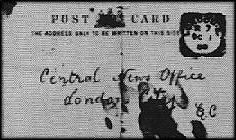
I was not codding dear old Boss when I gave you the tip, you’ll hear about Saucy Jacky’s work tomorrow double event this time number one squealed a bit couldn’t finish straight off. ha not the time to get ears for police. thanks for keeping last letter back till I got to work again.

Jack the Ripper

This postcard makes direct references to both the murders of the previous night and to the earlier unpublished “Dear Boss” letter before they were known to the general public.  All the evidence says that these are the words of Jack the Ripper.  And he wasn’t finished.  On October 16th a package was delivered to Mr. George Lusk, chairman of the Whitechapel Vigilante Committee, which had been organized to patrol the East End streets after Ann Chapman’s murder.  It read:
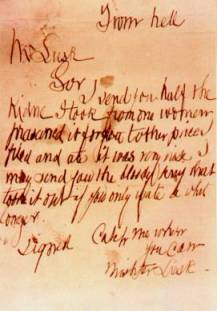
From hell.
Mr Lusk,
Sor
I send you half the Kidne I took from one woman and prasarved it for you tother piece I fried and ate it was very nise. I may send you the bloody knif that took it out if you only wate a whil longer

signed
Catch me when you can Mishter Lusk

Inside the package, preserved in wine, was part of Catherine Eddowes’ left kidney.

Friday: From Hell: Why We Remember Jack the Ripper

History, Bitter & Twisted October 22

Arrivals:

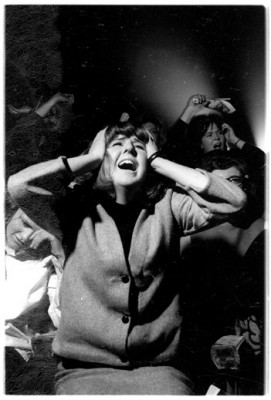
1811 – Franz Liszt was an 18th Century piano-playing celebrity.  Liszt drove women (and not a few men) crazy with how good he was; Heinrich Heine called it “Lisztomania.”  Liszt’s fans were almost hysterical in their devotion.  They swarmed him, tugging at his clothes and stealing his gloves and scarves.  They took locks of his hair and even his broken piano strings to hang around their necks or make into bracelets.  At his concerts, people fainted and peed their pants; he was that good!  At the insistence of one (he had several, including George Sand) of his mistresses, Princess Carolyne zu Sayn-Wittgenstein, he gave up touring at age 35 and spent the rest of his life composing and living off his reputation.

1943 – Catherine Deneuve, a French actress who contradicts the rumour that beauty is only skin deep.  This woman is so beautiful it hurts.  In her movies, she portrays women who are elegant and somewhat aloof – even cold.  In real life…who cares?  She has had public affairs with several movie people, including Roger Vadim and Marcello Mastroianni.  Her love scene with Susan Sarandon in The Hunger pushed more than one borderline lesbian over the edge.  She was the model for Marianne, the national symbol of France.  Like goodness, sometimes beauty is its own reward.

1844 –  Although there is some minor disagreement over the actual date, October 22nd, 1844, was supposed to herald the Second Coming of Jesus Christ.  Unfortunately, things didn’t work out, and October 23rd came to be known as “The Great Disappointment.”  The whole thing started in 1822, when William Miller, a Baptist preacher, published his personal calculations, indicating that the Second Coming was literally right around the corner.  Things immediately got out of hand when several flaky sects took him at his word and prepared for the wondrous event.  Millerites, as they were called, preached and prayed and brought all kinds of people along with them – probably half a million, or so.  However, Tuesday night came and went, just like every other Tuesday before or since, leaving a lot of empty souls in its wake.  The real terrible thing about this is that William Miller was not a charlatan; he actually believed that Christ was on His way.

1962 – President Kennedy appeared on TV and told the world the US had discovered nuclear weapons in Cuba.  He said, “It shall be the policy of this nation to regard any nuclear missile launched from Cuba against any nation in the Western Hemisphere as an attack on the United States, requiring a full retaliatory response upon the Soviet Union.”  He also said that the US Navy had instituted a blockade of Cuba and ships carrying weapons would be turned back.  In response, Khrushchev and the Soviet Union said that any US action against their ships would be viewed as an act of war.  For the next seven days, nuclear holocaust was a real option — to the point where nuclear bombs were actually armed on Strategic Air Command bombers.  Luckily, Khrushchev realized that the Kennedy boys were not just rattling their Sabres; they intended to use them.  He thought about it, made the best deal he could, and backed down.  The Soviet missiles were dismantled and sent home.  This was the closest the world has ever come to blowing itself to smithereens – so far.

Departures:

1906 – Paul Cezanne, a French painter who is part of the pivotal connection between Impressionism and Modern Art.  Working at the same time as Toulouse-Lautrec, Cezanne saw colour, light and shape differently.  His colours were thicker, his light bolder and his lines were harder.  He saw shapes rather than forms, and worked with optical perception rather than visual presentation.  After his death in 1907, there was a huge show of his paintings in Paris.  It’s not his fault that young artists like Picasso and Duchamp took Cezanne’s work as a stepping-off point to pursue their own ideas of light and form.   His work remains linked to the 19th Century, but many of the artists who came after him shot his ideas forward into the abstract, leading to the Armory Show of 1913 and a complete break with the old world.

1934 – Charles “Pretty Boy” Floyd, just another crook who has been arbitrarily painted heroic.  Most of this middle class myth comes from Woody Guthrie’s song “The Ballad of Pretty Boy Floyd” (1939.) Guthrie (who normally had more sense than this) represented Floyd as a kind of Robin Hood, a “regular Joe” driven to a life of crime by the Depression.  Pony pellets!  Just to set the record straight, there is no evidence — hearsay or otherwise — that “Pretty Boy” ever delivered groceries to any poor families at Christmas.  He didn’t rob from the rich and give to the poor.  And he sure as hell never had a social conscience or he wouldn’t have shot and killed at least 2 police officers who likely both had wives and children.  And one more thing: “Pretty Boy” wasn’t driven to a life of crime; he walked there by himself — when he committed his first robbery, in 1922 – eight years before the Depression even started.  God, people are stupid!

History, Bitter & Twisted October 20

Arrivals:

1632 – Christopher Wren always wanted to get his hands on St. Paul’s Cathedral.  In 1661, he worked on some repairs there, and in 1666, he envisioned a new dome for it.  Chance and a clumsy baker came along, and later that year, the cathedral burned down — along with the rest of London.  Although I don’t think Wren was happy about the Great Fire of London, it did give him his big break.  He immediately submitted a design to rebuild the whole city on a European model, with wide boulevards and spacious piazzas.  Charles II took one look and realized that Wren’s design would, first of all, cost too much and secondly, take way too long – people were homeless now.  However, Charles did ask Wren to rebuild the city’s churches.  He designed and built over 50 of them, but he always held out for a crack at St. Paul’s.  Finally, in 1670 he was given the money and the go-ahead.  It took Wren 5 designs, 3 kings, 1 queen, and 41 years to complete the Cathedral.  It was worth it.  Fortunately, in the 20th century, it survived the bombing of London in World War II.  Unfortunately, after the war, when nobody cared about beauty, St Paul’s got crowded in by a bunch of rectangles and cubes.  Fortunately, it still dominates these petty intrusions, as Wren’s masterpiece.

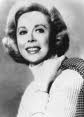
1927 – Long before there was Dr. Phil and his 3-ring media circus, there was Dr. Joyce Brothers, the woman who invented Pop Psychology.  Brothers got her start on a local New York TV station, doing an afternoon advice program in 1958.  The format was simple: Brothers would take questions from the audience and answer them.  The show was such a success (Brothers actually gave good advice) that it was syndicated on both TV and radio.  She also wrote a newspaper column and a monthly column for Good Housekeeping Magazine.  Never afraid to promote herself, Brothers has appeared on tons of talk shows been a regular on TV game shows like Match Game and Hollywood Squares and made cameo appearances on pretty well every sitcom known to man.  She has a Ph.D. in psychology and got her start on TV when she won on The $64,000 Question game show.  Her category was boxing.

1973 – The Sydney Opera House was formally opened by Queen Elizabeth II.  The opera house is to Sydney what the Eiffel Tower is to Paris and Big Ben is to London. It is one of the most recognized structures in the world.   It is also an essay in what happens when we let government bureaucrats off the leash.  The original design for the Opera House was accepted in 1957.  The completion date was scheduled for Australia Day, January 26th, 1963, and it was supposed to cost 7 million dollars.  Construction started in 1959, and all hell broke loose.  Apparently, nobody in the government had told the architect, Jorn Utzon what they actually wanted, so the design had to be changed several times.  In 1965, a new government was elected, and construction was put under the authority of a whole new department.  So things had to be changed again.  Then it turned out that the original construction was not strong enough to handle the redesigned structure, and that had to be changed.  Tension between the architect Utzon and the construction committee continued until he finally resigned in frustration.  He went on to call the whole affair “Malice in Blunderland.”  Then the new team redesigned most of the interior, wasting more time and money.  Things went on like this for several more years.  In the end, the Sydney Opera House cost $102 million — 14 times the original estimate — and was over 10 years late.  Luckily, the place is absolutely fantastic, so nobody seems to mind.

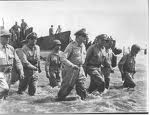
1944 – Douglas MacArthur made good on his promise and returned to the Philippines.  Early in World War II, when the Japanese army overran the Philippines, General MacArthur had been ordered to escape and go to Australia to lead the counterattack.  He was not pleased, and with the simple phrase “I shall return.” Indicated that he was going to come back and kick somebody’s ass.  After 3 years and several extremely bloody campaigns, he did.  MacArthur was an incredible general and an even better showman.  He understood the public’s need for a hero and worked hard on his image, including meticulously taking the metal bands out of his hat so it looked ruffled and casual.  Similarly, the famous footage of him striding towards the shore at Leyte was filmed twice for dramatic effect.  He also filmed the Japanese surrender on board the USS Missouri, in 1945.    

Departures:

1890 – Sir Richard Burton, a 19th century adventurer who joined the army early, went to India and then promptly “went native.”  Unlike most imperialists of his time, he thought “native” cultures were viable, dynamic and interesting.  He adopted local clothes (which made a lot more sense than Oxford wool) learned the language and studied the religion.  He travelled throughout India and the Middle East and even disguised himself as a Moslem and went to Mecca.  During his lifetime, he attracted a great following, mostly due to his adventures but also because he was seen as exotic.  However, this brought him into conflict with Victorian society who thought that he’d “gone a little too native.”  He also published number of books that were blatantly sexual — The Kama Sutra, for one.  His friends and supporters called these “extensive studies” but most everybody else called them porn.  Oddly enough, even though he was publicly frowned upon by polite society Queen Victoria knighted him in 1886.  His most famous journeys were with John Speke, searching for the source of the Nile.

1926 – Eugene Debs, the only man in history who ever ran for President of the United States five times – once even from his jail cell in the Atlanta Penitentiary.  Debs was a socialist before it was cool.  In his day, in fact, it was so un-cool to be a socialist that he went to jail for it.  Debs spent most of his life (when he wasn’t in jail) as a union organizer.  He was an organizational genius and a brilliant orator but he got caught in the ideological wars that have always plagued the socialist movement.  As a result, he spent twice as much time and energy dealing with internal squabbles as he did building the labour movement.  In 1918, he gave a speech criticizing America’s entry into World War I and urging men to resist the draft.  He was arrested, tried and sentenced to 10 years in prison.  In 1921, President Harding commuted Debs’ sentence (he was not pardoned as is generally believed) and he was released.  And even though socialism was still not all that acceptable, over 20,000 people welcomed him home.