Arrivals:
 1632 – Christopher Wren always wanted to get his hands on St. Paul’s Cathedral. In 1661, he worked on some repairs there, and in 1666, he envisioned a new dome for it. Chance and a clumsy baker came along, and later that year, the cathedral burned down — along with the rest of London. Although I don’t think Wren was happy about the Great Fire of London, it did give him his big break. He immediately submitted a design to rebuild the whole city on a European model, with wide boulevards and spacious piazzas. Charles II took one look and realized that Wren’s design would, first of all, cost too much and secondly, take way too long – people were homeless now. However, Charles did ask Wren to rebuild the city’s churches. He designed and built over 50 of them, but he always held out for a crack at St. Paul’s. Finally, in 1670 he was given the money and the go-ahead. It took Wren 5 designs, 3 kings, 1 queen, and 41 years to complete the Cathedral. It was worth it. Fortunately, in the 20th century, it survived the bombing of London in World War II. Unfortunately, after the war, when nobody cared about beauty, St Paul’s got crowded in by a bunch of rectangles and cubes. Fortunately, it still dominates these petty intrusions, as Wren’s masterpiece.
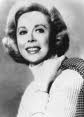 1927 – Long before there was Dr. Phil and his 3-ring media circus, there was Dr. Joyce Brothers, the woman who invented Pop Psychology. Brothers got her start on a local New York TV station, doing an afternoon advice program in 1958. The format was simple: Brothers would take questions from the audience and answer them. The show was such a success (Brothers actually gave good advice) that it was syndicated on both TV and radio. She also wrote a newspaper column and a monthly column for Good Housekeeping Magazine. Never afraid to promote herself, Brothers has appeared on tons of talk shows been a regular on TV game shows like Match Game and Hollywood Squares and made cameo appearances on pretty well every sitcom known to man. She has a Ph.D. in psychology and got her start on TV when she won on The $64,000 Question game show. Her category was boxing.
—
 1973 – The Sydney Opera House was formally opened by Queen Elizabeth II. The opera house is to Sydney what the Eiffel Tower is to Paris and Big Ben is to London. It is one of the most recognized structures in the world. It is also an essay in what happens when we let government bureaucrats off the leash. The original design for the Opera House was accepted in 1957. The completion date was scheduled for Australia Day, January 26th, 1963, and it was supposed to cost 7 million dollars. Construction started in 1959, and all hell broke loose. Apparently, nobody in the government had told the architect, Jorn Utzon what they actually wanted, so the design had to be changed several times. In 1965, a new government was elected, and construction was put under the authority of a whole new department. So things had to be changed again. Then it turned out that the original construction was not strong enough to handle the redesigned structure, and that had to be changed. Tension between the architect Utzon and the construction committee continued until he finally resigned in frustration. He went on to call the whole affair “Malice in Blunderland.” Then the new team redesigned most of the interior, wasting more time and money. Things went on like this for several more years. In the end, the Sydney Opera House cost $102 million — 14 times the original estimate — and was over 10 years late. Luckily, the place is absolutely fantastic, so nobody seems to mind.
1944 – Douglas MacArthur made good on his promise and returned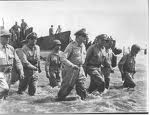 to the Philippines. Early in World War II, when the Japanese army overran the Philippines, General MacArthur had been ordered to escape and go to Australia to lead the counterattack. He was not pleased, and with the simple phrase “I shall return.” Indicated that he was going to come back and kick somebody’s ass. After 3 years and several extremely bloody campaigns, he did. MacArthur was an incredible general and an even better showman. He understood the public’s need for a hero and worked hard on his image, including meticulously taking the metal bands out of his hat so it looked ruffled and casual. Similarly, the famous footage of him striding towards the shore at Leyte was filmed twice for dramatic effect. He also filmed the Japanese surrender on board the USS Missouri, in 1945.
—
Departures:
1890 – Sir Richard Burton, a 19th century adventurer who joined the army early, went to India and then promptly “went native.” Unlike most imperialists of his time, he thought “native” cultures were viable, dynamic and interesting. He adopted local clothes (which made a lot more sense than Oxford wool) learned the language and studied the religion. He travelled throughout India and the Middle East and even disguised himself as a Moslem and went to Mecca. During his lifetime, he attracted a great following, mostly due to his adventures but also because he was seen as exotic. However, this brought him into conflict with Victorian society who thought that he’d “gone a little too native.” He also published number of books that were blatantly sexual — The Kama Sutra, for one. His friends and supporters called these “extensive studies” but most everybody else called them porn. Oddly enough, even though he was publicly frowned upon by polite society Queen Victoria knighted him in 1886. His most famous journeys were with John Speke, searching for the source of the Nile.
1926 – Eugene Debs, the only man in history who ever ran for President of the United States five times – once even from his jail cell in the Atlanta Penitentiary. Debs was a socialist before it was cool. In his day, in fact, it was so un-cool to be a socialist that he went to jail for it. Debs spent most of his life (when he wasn’t in jail) as a union organizer. He was an organizational genius and a brilliant orator but he got caught in the ideological wars that have always plagued the socialist movement. As a result, he spent twice as much time and energy dealing with internal squabbles as he did building the labour movement. In 1918, he gave a speech criticizing America’s entry into World War I and urging men to resist the draft. He was arrested, tried and sentenced to 10 years in prison. In 1921, President Harding commuted Debs’ sentence (he was not pardoned as is generally believed) and he was released. And even though socialism was still not all that acceptable, over 20,000 people welcomed him home.






 WD Fyfe