
Arrivals:
 Although it has no such official designation, October 18th should be called “The Day of the Television Ingenue.” It’s the birthday of Dawn Wells (1938), Pam Dawber (1951) and Erin Moran (1951). All three of these women played the wholesome girl-next-door on television sitcoms. Wells was Mary Ann Summers on Gilligan’s Island (1964-67.) Pam Dawber was Mindy McConnell on Mork and Mindy (1978-82.) Erin Moran was Joanie Cunningham on Happy Days (1974-84.) None of them ever really overcame her sweet appearance (Joanie was actually called “Shortcake”) and so once their characters were over, so were they. Dawn Wells went on to do musical theatre and Mary Ann, impressions. Dawber played an older Mindy in a short-lived sitcom, My Sister Sam. And Erin Moran stepped way out of character, and refused to do the Happy Days Reunion Special then looked totally flaky when she tried to explain why she wouldn’t play nice.
—
 1954 – Texas Instruments demonstrated the world’s first transistor radio, the Regency TR-1. The radio went on sale in November and honestly didn’t do very well, chiefly because it was too expensive and it didn’t work. It wasn’t until Sony started producing cheap, dependable radios that everybody and his friend bought one. The transistor radio quite simply revolutionized society. In the old days, most homes had a stand-up tube radio that plugged into the wall, and the entire family gathered around it to listen. With the advent of a truly portable radio, young people were no longer tied to their parents’ living rooms or even their parents’ houses. They could — and did — take their music with them. But more importantly, young people were no longer tied to their parents’ choices, so they could listen to the new music: blues, jazz and outlaw rock and roll. These were the first cracks in the traditional family unit and the beginning of the soon-to-be famous generation gap.
1867 – In a formal ceremony in Sitka, Alaska the United States took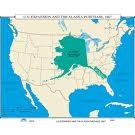 possession of Alaska from the Russian Empire. The United States had bought the territory the previous March for $7,200,000. At the time, this was considered an outrageous price, mainly most people had no idea just how big Alaska actually was, and they were quite content to call the whole thing a gigantic frozen mistake – or Seward’s Folly. Seward was Secretary of State at the time. Alaska, along with the Louisiana Purchase, proved to be, one of the best real estate deals in history, and Seward has long since been vindicated. One of the things I’ve always wondered, however, is when Seward was approached by the Russians, how did he know what a good deal he was getting?
—
Departures:
1871 – Charles Babbage, a super smart mathematician who thought it would make sense for machines to do mathematical calculations. He figured (no pun intended) that they (the machines) could do lots of calculations at a time — very quickly — and never make mistakes. This was back in 1822, when the only machine the world had for such things was a pencil. Babbage had obviously seen the Jacquard loom and the punch cards it used for delicate patterns. His theory was that those same punch cards could be used for his calculating machine. Unfortunately, for Babbage, his “difference engine” as he called it, was never finished. In 1991, a “difference engine” was constructed from his plans which worked perfectly, proving Babbage had invented the computer.
 1931 – Thomas Edison, the guy who invented everything. He held over 1,000 patents in his lifetime. The fact is, however, some of the things he invented he didn’t actually “invent.” It was more like he was a perfectionist; he perfected other people’s stuff so it was commercially viable. Consider, for example, his most famous invention, the light bulb. In 1880, pretty well everybody knew that if you took a thin piece of metal, put it in a vacuum and heated it with an electric charge, it would glow. The problem was it usually didn’t glow bright enough or didn’t last long enough to be of any use to anybody. Edison just kept experimenting with different materials in different combinations until he got one that worked. He filed a patent and thus ‘invented” the light bulb. Of course, Edison did actually invent a lot of things and that’s what made him rich and famous. Legend has it that, when Edison died, his famous friend Henry Ford captured his last breath in a bottle, sealed it and kept it on his desk for years.




 WD Fyfe