Apple: A Misguided Religion

Sometimes I think I’m the only person on this planet who’s fed up with Apple.  Yeah, yeah, yeah — I know!  They’re the uber coolest company of all time; they invented all the iCrap that nobody but your grandma uses anymore and oh (like I could ever forget) Stephen Jobs never wore a tie!  But for God sake’s, guys!  Get over yourselves!  You’re not a religion, no matter what your basement dwelling followers tell you.  In the real world, above ground, the only difference between Apple and every other Tom, Dick and Harry tech company is price.  Apple stuff is so wildly overpriced it’s a wonder anybody at the iStores, from manager to minion, can even look at themselves in a mirror in the morning.  Saying Apple is proud of their products is like saying Kim Kardashian is a media whore.  D’uh!

Normally, I leave Apple alone.  Way back in the day, I had a Mac — I loved it – but I grew up and outgrew my burning need to “share” odd photographs, soft core porn and my particular taste in music that week.  However, yesterday (believe me, the date doesn’t matter) Apple introduced yet another new iSomething and I wondered what it was.  Then, like a perpetual old fool, I took a gander.  Apparently, this most recent Galileo moment in electronic history is a new iPad, which looks so strikingly similar (inside and out) to the old iPad as to be the same machine.  In fact, aside from a memory tweak, it is the same machine.  Yet, despite this obvious sleight of hand, the reviewers were going onapple5 as if the da Vincis down at Cupertino, CA had just revolutionized computering in the 21st century.  According to them, this was the greatest human achievement since triple bypass surgeon — at merely twice the price.  Nor were they done!  After singing iPad 4’s (4.5? 5? 29?) praises until they got writer’s cramp, they went on for seven or eight more paragraphs in speculative hallelujahs about what Apple was going to come up with next.  It was like listening to Tom Cruise talk about L. Ron Hubbard.

I’m not very tech savvy, and I don’t want to go all Dennis Miller on the thing, but let’s stop for a minute and take a look at what we’re dealing with here.  Essentially, the iPad, in whatever number sequence Apple wants to give it, is an oversized, overpriced smart phone that doesn’t make telephone calls.  It’s as big as a turkey platter with more memory than any average human being can possibly use, a camera that can pick out nasal hair at 50 paces and solid walls of Benny and the Jets sound, if that’s what you’re into.  However, with a price tag that would bankrupt a Mexican drug lord, it doesn’t give you anymore battery life or connectivity than my $49.00 Samsung – which, BTW, fits in my back pocket.  iPads are so conspicuously large you can’t manipulate them with fewer than three hands.  Plus, even though they weigh less than lunch at Taco Bell, their side to side size dictates they don’t actually fit anywhere.  This sheer unbendable volume makes a mockery of their primary purpose – portability – and there are no other redeeming features, like a workable keyboard, to compensate for that.  In a reasonable world, iPads would be the new Betamax — with a commensurate consumer shelf life.  Unfortunately, we don’t live in a reasonable world.

apple3I’m not dissing Apple just for the hell of it.  I’m not a committed Android, Microsoft, Blackberry or anything else, user.  Honestly, I don’t know enough about what makes what work electronically even to have a choice.  However, I do know a con job when I see one.  For my money, when you have two items that look the same, act the same and were probably made in the same factory, but one costs more than three times as much as the other one…well…B. T. Barnum was definitely right.

It’s obvious; the real thing Apple is selling is “cool.”  So be it.  If you can sell the sizzle off a bad cut of meat, you’re a crooked jerk, but all the more power to you.  My problem is the boys down at the Apple clubhouse think they don’t put their pants on one leg at a time like the rest of us.  And every time I mention it, I get the Stephen Jobs/Johannes Gutenberg lecture.  I agree; the guy was a genius, but that doesn’t give him (or his post-mortem company) the arrogant right to gouge everybody.  But what really burns my bacon is that even though most people outside the Apple cabal realize it’s not the one true path to enlightenment nobody is willing to admit it – except, maybe, me.
Happy Birthday, Wikipedia!

wikiWhere does the time go?  I looked around the other day and discovered that Wikipedia was 12 years old.  I remember when it was a stumbling child.  People thought it was cute in those days: an amateur attempt at “all of us are smarter than one of us.”  Of course, real academics frowned on such antics: knowledge was their personal property, and one simply didn’t throw it around promiscuously.  However, even as their teachers scolded, tons of high school students — and more than a few undergrads — were salvaging their GPA with daring midnight raids on Wikipedia’s fact factory.  In the last decade those undergrads have grown up — and so has Wikipedia.  Today, both are shaping the society that a couple of years ago didn’t take either of them seriously.

Wikipedia is the latest attempt at gathering the world’s accumulated knowledge into one mighty force which, since knowledge is power, fears nothing.  The Egyptians tried it, a little over two millennia ago, with The Great Library at Alexandria.  It worked quite well for a couple of centuries, until one sultry night, in 48 BCE, it got in the way of Julius Caesar’s legions, and he burned it down.  Accumulated knowledge has always been at the mercy of fire and the ambitions of politicians.

From that time, despite what various apologists will tell you, it took us seventeen hundred years to try again.  In 1728, Ephraim Chambers, a printer in London, collected everything he and his friends knew to be true, and wrote it down.  The Chambers’ Cyclopaedia wasn’t the first of its kind, nor the best, but protected by the rule of British law and the guns of the newly minted Royal Navy, it not only survived, it grew.  Of course, not to be outdone by their nearest and dearest rivals, the French printed their own encyclopedia, Encyclopedie (Extremely long name) in 1751.  This, in turn, prompted the British to haul in the big boys; awiki1 couple of Scots named Colin Macfarquhar and Andrew Bell, who produced the Encyclopedia Britannica, in 1768.  For the next 250 years, even though there were 1,001 imitations, the Encyclopedia Britannica remained the Big Kahuna of “all ye know” in the world.  And its reputation as the “go-to” guy for “and all ye need to know” was such that the Nazis thought it worthy of incineration in the 1930s.  Had the Nazis spent more time reading books instead of burning them (thanks, Indiana Jones) the world’s knowledge may not have survived the mid 20th century.  Fortunately it did — and after World War II, Britannica (or something like it) migrated to every library and suburban school in the English-speaking world.  It was the greatest mass distribution of knowledge since Gutenberg and a serious blow to a lot of post-war know-it-alls.  Encyclopedias were everywhere, but they still weren’t necessarily everybody’s.  The world’s knowledge was still controlled by an exclusive club.

If you’re of an age, you remember the Encarta discs from the 1990s.  They made every computer in the world a fountain of knowledge, not only readily available, but portable.  Suddenly, everybody from nuclear physicists to primary school children could carry the world’s repository of information in their backpacks — and frequently did.  From there, it was only a few short digital steps to Jimmy and Larry and the final democratization of the accumulated wisdom of the world.

wiki2Jimmy Wales and Larry Sanger launched Wikipedia in January, 2001. It offered the world’s knowledge to the world, without restriction or restraint.  It was information “of the people, by the people, for the people.”  Twelve years later, the sum total of human experience is now available to anyone with a telephone.  Information is no longer the exclusive province of the few – jealously guarded and subject to attack.  Literally billions of people carry it with them, at school, on the bus and where they work.  It cannot be burned, stolen or hidden away.  It is the best defence against the next Adolf Hitler who comes along with a bunch of marching torches and a “better” idea.  The age of the flammable page is over.

Happy Birthday, Wikipedia!  You’ve come a long way, baby!

Darwin was Right! We’re in Trouble!

As we used to say, back in the day, this is going to blow your mind.  We got lied to about evolution.  Hold it!  Before you let fly the anti-Christian fireworks, I didn’t say anything about a man in the sky who created the heaven and earth in six days and then took Sunday off to watch a ballgame.  Nor did I mention Gaia, the Earth Mother, the Mighty Manitou nor Thor the Thunderer.  I said we got lied to about evolution and we did.

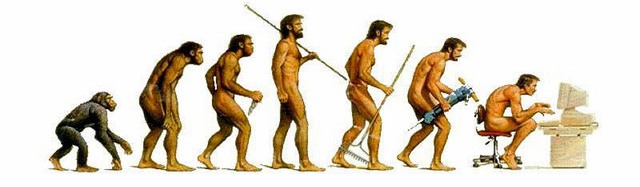
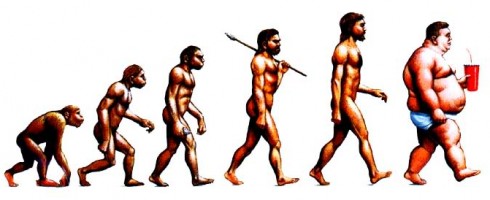
age of man1Everybody knows the story of Darwin.  There are some people around who don’t believe it, but, in general, Darwin, like Freud and Nietzsche, is one of the good guys.  The problem is what people actually know about Darwin’s Theory of Evolution and natural selection would fill a mouse’s ear.  Most of our “common knowledge” is nothing more than hearsay.  It runs like this: living species adapt to their environment and those who adapt best, survive and even thrive; those who don’t, end up gathering dust in a museum.  While this is basically true, the underlying theme is this process is beneficial.  Unfortunately, Darwin didn’t say anything about that.  In fact, it probably never occurred to him.  The whole “evolution is good for you” school of thought came from a pile of other Victorians, Edwardians and Nazis, who wanted to seal the deal on imperialism, once and for all.  They thought that between the authority of God Almighty and Charles Darwin, they had all the bases covered.  They could justify their right to govern the world as they pleased, exploit it to their hearts’ content, and tell anybody who didn’t like it to take a hike.  The 19th century liberal education system we still live with today was slanted in that direction, so as Josef Goebbels might have said, if you tell a lie loud enough and long enough, people tend to believe it.  Thus, pretty much anybody who has a reasonable opinion about evolution in this century will tell you, to quote Martha Stewart, “It’s a good thing.”  Crap!

age of manFirst of all, evolution does not come with a moral component.  It is neither good nor bad– and mostly indifferent.  Faster lions don’t get extra points for catching the gazelle – they get to eat.  If they eat well, they get to mate and pass their “faster than a speeding ungulate” gene sequence on to their offspring, who begin the process again.  On the same hand, speeding gazelles don’t get any extra points either, just for surviving.  They get to spend a romantic afternoon with a fast female from the next herd, listening to the lions burping up Uncle Chester.  Nature, in its wisdom, takes its course and the “faster than a hungry lion” gene is also passed along.  The evolutionary race on this planet is never-ending; by definition, it’s evolving.

Second, Darwin’s theory only applies to a self-contained natural environment where “Faster! Higher! Stronger!” makes a difference.  Once a foreign element is introduced into Darwin’s theory, all bets are off.  Just ask the Dodo bird or the Passenger Pigeon.  They were poster children for evolutionary success, except — oops, they’re all dead.  Evolution comes to a screaming halt when faced with a speeding bullet, or any other man-made catastrophe.  Darwin’s theory doesn’t cover “Smarter! Richer! Sneakier!”  When faced with that, natural selection becomes nothing more than after-dinner conversation.

Of course, despite the lies we’ve been told about evolution, Darwin was right.  The fellow who gets the lion’s share of the food and the females will naturally pass his genes on to the next generation.  The problem is our species no longer relies on “Faster! Higher! Stronger!” for its success.  Nor do we live in a self-contained natural environment anymore.  Physical attributes might still work for lions and gazelles on the African veldt, but they’re not quite so handy for humans in London and Chicago.  We are techno-termites who live stacked in sky-reaching urban conglomerates where food is hunted by credit card and females attracted by poetry and sports cars.  The skills we needed to get this far on the evolution track are now useless.  In fact, their intrinsic value, given the current human condition, is actually questionable.

age of man3Meanwhile evolution doesn’t care.  Good, bad or indifferent, it just keeps pumping away, rewarding the genes that survive and discarding the ones that don’t.  The problem is the shotgun was never factored into the evolution of the Passenger Pigeon, and it’s doubtful that any of our astonishing technical accomplishments will figure prominently in ours.  The very things that have made us the dominant species on this planet may not be rewarded by a benign universe.  In fact, when we understand what Darwin was actually telling us, it looks as though our species might just be evolving itself out of business.