
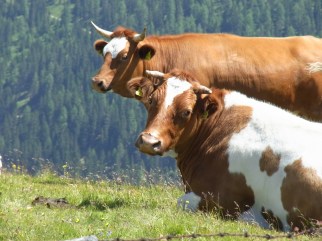
 Apparently, the Two Cow Theory Of Economics has been running around Cyperspace for years. Who knew? I just found it, which shows I’m so far out of the loop I think it’s square. Anyway, I don’t normally post stuff that isn’t mine on my blog — especially when I can’t give the author credit — but this is so hilarious I’ve made an exception. Plus, I’ve added a few WDisms, so I don’t feel too guilty. Anyway, The Two Cow Theory of Economics
Communism — You have two cows. The state takes both of them and gives you some milk.
Socialism — You have two cows. The state takes both of them, gives one back and gives one to your neighbour who, like you, had two cows until the state took both of them gave one back and gave the other one to his neighbour — who, like you, had two cows until the state ….
Fascism — You have two cows. The state takes both of them and sells you some milk.
Nazism — You have two cows. The state takes both of them for war production and shoots you for withholding cows.
Bureaucratism — You have two cows. The state takes both of them, shoots one, milks the other and then throws the milk away.
Capitalism — You have two cows. You sell one cow and buy a bull. Your herd grows. You start selling milk. You buy more cows. You build a dairy. You sell more milk. You buy more cows. You spend so much time with cows and milk your wife divorces you, takes the kids and moves in with a vegetarian. You end up with a trophy wife who’s in it for the money, an ulcer the size of Boston and a therapist who tells you, “You were happier when you only had two cows.”
Venture Capitalism — You have two cows. You sell three of them to your publicly-listed company, using letters of credit opened by your brother-in-law at the bank. You execute a debt/equity swap with an associated general offer so you can get all four cows back, with a tax exemption for five cows. The milk rights of the six cows are transferred (via an intermediary) to a Cayman Island Company secretly owned by a majority shareholder (you) who sells the rights to all seven cows back to your publicly-listed company. Your annual report says the company now owns eight cows with an option to buy one more.
A French Corporation — You have two cows. The state pays you twice as much as the milk is worth. You go on strike, organize a riot and block the roads — because you want three cows.
An Italian Corporation — You have two cows. You don’t know where they are. You decide to have lunch.
A Swiss Corporation — You have 5,000 cows. None of them belongs to you. You charge the real owners megabucks to hide their cows for them.
An American Corporation — You have two cows. You sell both of them to buy a 4-wheel drive, Japanese-made pickup truck. You get totally pissed because you have to buy all your milk from a foreign country. You hire an Agricultural Consultant to figure out why there are no jobs in the dairy industry.
An Indian Corporation — You are the reincarnation of a cow.
An Irish Corporation — You have two cows. One of them is a horse. The EU lends you enough money to buy another cow. You bet it on the horse.
A George Orwell Corporation — You have two humans.
An Australian Corporation — You have two cows. Business looks good, so you close the office for a month or two and backpack through Europe.
A Dutch Corporation — You have two cows. However, you’re not allowed to make cheese or sell your milk because the EU doesn’t like the look of your barn.
An Iraqi Corporation — Everybody thinks you have a lot of cows. You tell them that you don’t have any cows. Nobody believes you and they bomb the crap out of you. You still don’t have any cows.
A Cuban Corporation — Cows?
A British Corporation — You have two cows. Unfortunately, half your cows are continually voting to leave the herd.
A Greek Corporation — French and German banks loan you two cows. You eat them. The banks call to collect the milk you promised, but you don’t have any so you call the IMF. The IMF loans you two cows. You eat them. Everybody wants either the milk you promised or their cows back. You don’t answer the telephone ’cause you’re at a wedding.
A North Korean Corporation — The Glorious Leader has all the cows. He invented them.
And my very favourite:
A Chinese Corporation — You have two cows. You have 300 people milking them. You claim China has no unemployment and 100% bovine productivity. You arrest all the journalists who live close to the farm.
 John Glenn died yesterday. For my generation, he was one of the good guys. He exemplified a lot of what we’ve forgotten about the 60s. I wrote this in 2012 on the 50th anniversary of John Glenn’s space flight. It is still relevant today. (I’ve edited it for brevity.)
 Here it is December 6th, and I haven’t even thought about … OMG! there are only 19 more Panic Days ’til Christmas. What the hell? I haven’t got rid of the Thanksgiving waistline, and now there’s another turkey looming on the horizon. This happens every year: leftover Hallowe’en candy mutates into Thanksgiving pie that turns into Christmas cookies that become boxes of Valentine’s Day bonbons which morph into gigantic, solid chocolate Easter bunnies — and it’s July 17th before I can see my toes again. Merciful Jesus, sew my mouth shut!
 WD Fyfe