
Right and Wrong: There’s No Debate

There’s been a lot of talk lately about right and wrong.  This is totally odd, because most people are uncomfortable with the concept.   It makes them uneasy, as if something rude just happened.   They would prefer to look the other way or wander off.  When the topic is unavoidable, they tend to dance around it or cleverly disguise it, calling it ethics or morals or some other such euphemism.  It’s as if they’re desperately hoping parlour game philosophy will make it go away.

There is no place in our society for right and wrong anymore.  It’s like those old, heavy TVs nobody wants.  They work perfectly well, but most people wouldn’t be caught dead with one in their living room.  It’s not our fault, though; the essence of right and wrong demands a judgement call.   Someone has to be wr-wr-wr not right.  Unfortunately, we’ve been taught from the cradle not to be judgemental.  It’s something to be avoided at all costs.   But right and wrong still exist, regardless of whether we like to talk about it or not.  For example, walk down any street in North America and you will eventually see a Starbuck’s cup.  The person who put it there is wrong – full stop.  There is no reason to litter.  Unless that Starbuck’s cup was on fire or you were being chased by wolves (both highly unlikely) there is no situation that would force you to throw it on the ground.  The person who did it, did it deliberately.  He or she made a personal choice to despoil the common environment.  That’s wrong.  There’s no way around it.

Of course, most people would like the local litterer to be evil – it makes things a lot easier.  The battle between good and evil is honourable; it has a long history, and it’s always been a two-sided coin with plenty of heroes and villains.  Evil people do sinister things, like littering; good people do not.  Hitler was evil.  Mother Teresa was not.  It’s cut and dried and ready for polite conversation.

The choice between right and wrong is quite different.  First of all, it has no history; each choice we make is brand new.  Every Starbuck’s cup has the same potential for ending up in the gutter as the recycle box.  In all depends on a personal decision.  Secondly, there are no heroes — only villains.  We don’t get extra points for doing the right thing. That’s what we’re supposed to do.  We only lose points if we do the wrong thing – like throwing our crap in the street.  Third, regardless of how we act, we’re not morally superior to the litterer the way we are to Hitler.  Chances are good the person who so casually dropped that cup does not have fangs or green saliva.  They’re probably quite likable, nice to children and puppies, and have never committed genocide.
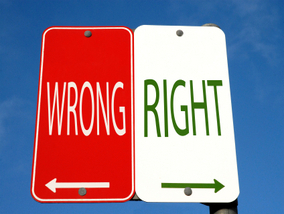
When we talk about right and wrong, we don’t have any high moral ground to stand on.  Good and evil are simple.  We have all kinds of reference points — Hitler and Mother Teresa are two obvious ones.  But ya got to work at right and wrong — every time — without fail.  That’s why we’ve created a sliding scale of mitigating circumstances.  It alleviated the personal burden we all feel — which brings us back to that philosophical parlour game.

Here’s how the scale works: stealing is wrong.  But if your children are starving, it’s not quite as wrong.  Except if you steal from a child who’s unable to defend her bread due to an injury.  However, if she’s from a rich family…. and the nuances go on and on into the night and the third bottle of wine.  We need this sliding scale, but, unfortunately, we’ve come to think that it’s real.  It’s not.  It’s just a device: an artificial “Get Out of Jail Free” meant to ease the burden of guilt we feel when we do something reprehensible, like throwing our trash on the ground.  In the cold, dark soul of four o’clock in the morning, we all knew that stealing is wrong.  That’s what separates good people from the evil ones.  Yet we also know that in certain situations, we will steal.  That’s what separates smart people from stupid ones.  That’s why we find it so difficult to talk about right and wrong — because many times the morality just doesn’t match the reality.

Right and wrong are absolutes.  We can fool ourselves with excuses, justify our actions to others or proclaim our “good person-ness” from the rooftops.  So what?  If you cross a moral boundary, you are wrong.  There’s no second opinion.  Judgement has already been passed because regardless of how our society tries to slip/slide around it, integrity is what you do when the cell phones are turned off and no one’s watching.

European Economic Reality: It’s Not Sexy

One of these days, the Germans are going to get fed up and quit forking over Euros to every Juan, Liam and Spiros who comes wandering by with a sob story.  Lately, Angie Merkel has been shovelling money off the prosperity truck like it’s Weihnachten; unfortunately, the German taxpayers haven’t been told they’re Santa Claus.  When they find out, there’s going to be hell to pay.  Meanwhile, across the Rhine, Sarkozy is robbing Peter to pay Papandreou by convincing the French private financial sector to bankroll his vision of stability in the European Union.  This isn’t very smart.  Remember, up until recently, Les Trois Grands (Credit Agricole, BNP Paribas and Societe Generale) were all government institutions, so if things start to go bad for the banks it’s going to be the Palais Bourbon who gets to bail them out – on the backs of les taxpayers francais, I might add.  I’m not pointing fingers, but something is rotten in Europe and this time it isn’t in Denmark.

The problem with economics is it’s not sexy.  A bunch of old men sitting around a conference table dividing up the spoils, just doesn’t make headlines the way a good riot does.  Bombs make better copy than balance sheets because, in general, people think economics is dull, complicated and just a little bit icky.  The stereotypical international banker is not somebody you want to spend an isolated weekend in the country with.  The result is most people don’t know how money works.  They believe it’s some magical thing that rich people use to get richer.  Not so!  International billions work the same way as your lunch money.

All economics is based on faith.  Here’s the beer league version.  You don’t have to push a wheelbarrow full of money around because you’ve got a credit card.  It’s a wallet-sized, unsecured short-term loan.  (By the way, despite rumours to the contrary, that’s all it is.)  McDonald’s gives you a Big Mac and fries because they believe the credit card company is going to give them money.  The company, in turn, pays McDonald’s because they believe you’re eventually going to repay the loan.  You get your lunch, McDonald’s get its money and you pay the accumulated bill at the end of the month.  Everybody’s happy.  The whole system is based on everybody’s rock solid faith in your ability to pay.  It’s that simple.

Chopped down to its core, international finance works the same way.  The world monetary system is based on everybody’s faith in the local taxpayers’ ability to pay.  Countries borrow money.  They repay it back over several years from the taxes they collect.  (That’s the only income they have.)  Again, everybody’s happy – as long as the system works.  When it doesn’t, things go bad — real fast.

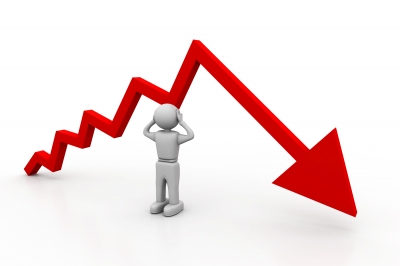
The situation in Europe these days is several countries have been basically buying too many Big Macs.  They’ve been using their national credit cards promiscuously — way beyond the ability of their citizens to pay.  For example, this current crisis in Greece stems from the fact that they owe nearly half a trillion dollars — with no foreseeable way to pay it back.  The banks have lost faith in the Greeks.  They want their money — yesterday.  This is where things get complicated because — if Greece goes bust — nobody’s going to repossess the Acropolis and call it square.  No, the money disappears: along with several huge banks, the financial structure of Europe and possibly the Euro itself.  The sub-prime mortgage crisis in America will be a surfer’s wave compared to that tsunami.

Enter Merkel and Sarkozy, who have a vested interest in keeping Europe afloat.  They’ve told the banks, “Okay, you don’t have faith in the Greeks anymore, but you still trust us.  We’ll guarantee the loans and we’re backing that up with our taxpayers.”  This is great – problem solved — except for one small flaw.  The EU has already done this twice.  In November, 2010 Ireland went bust (to the tune of 100 billion) and in May, 2011, Portugal did the same (with a 78 billion debt.)  Both times, the EU, led by Merkel and Sarkozy, stepped up and bailed them out with guaranteed loans.  French and German taxpayers woke up this morning on the hook for over 50 billion dollars in other people’s debts.  Not only that, but their banks have guaranteed the same amount again.  And that’s just in the short term.  There’s more to come later.  Trust is not an infinity commodity.  Even the stupidest of the profit-and-loss boys are getting gun shy about throwing more Euros at this mess.  But here’s the real kick in the ribs.  Waiting in the wings is Italy, up to their Armani suits in unsecured loans, and Spain (Europe’s fourth largesteconomy) equally in hock, with a 27% unemployment rate.  Their taxpayers couldn’t pay even if they wanted to.

Bluntly, the ship is about to hit the sand in Europe.  At some point, financial institutions are going to lose faith in even the Germans’ ability to pay.  Long before that happens, the Europeans are going to have to tighten their belts — buckles to the backbone.  The quaint idea that you can eat Big Macs all day on somebody else’s Euro is over.  The Europeans have been out to lunch for a long time, and now the bills are coming due.  They need to become financially responsible first thing tomorrow morning because one of these days the German taxpayers are going to wake up and say, “Was ist los?  I didn’t sign on for this.” And that will be the end of everything.

Vancouver Riot: Part II

Photo - Anthony Bolante/Reuters

There are several myths circulating in the aftermath of the Vancouver Riot.  Let me set the record straight.

1 – Some rioters have come forward to admit their guilt.
This is not true.  Some may have walked into the police station and admitted participation in last Wednesday’s disaster, but I doubt it — at least I haven’t heard of any.  The vast majority of rioters who’ve come forward so far have already been clearly identified on Facebook and other social media.  They were trapped by their own brazen behaviour.  When you’re photographed with the smoking gun, it’s best to admit the crime.

2 – Many of the rioters were just caught up in the excitement and hysteria of the moment.
No, they were the hysteria of the moment.  They committed antisocial acts of wanton destruction.  There are no mitigating circumstances.  Since when has misdirected adrenalin been an adequate defence for a criminal act?  “I stole a purse from The Bay ‘cause I was all excited,” just doesn’t cut it.

3 – Most of the rioters have expressed genuine remorse for their actions.
Maybe, but on Thursday morning many ordinary citizens went downtown with brooms and plastic bags to help clean up the mess.  I didn’t see any of the remorseful there.  In general, they were probably sleeping it off, perhaps resting up to be remorseful at a later date.

4 – Outing rioters on Facebook and other social media is vigilantism.
No, in our society, if you see a crime being committed, it’s your obligation to help identify the criminal.  Just because there happened to be hundreds of criminals  n the same place at the same time Wednesday night doesn’t make the situation any different.  If you see somebody set fire to your neighbour’s car do you call 911 or watch it burn?  If you have a picture, do you show it to the police or delete it?  If you know the person…etc. etc.

5 – The rioters are suffering from an overwhelming public backlash.
Wrong again.  The Wednesday night rioters are not the victims here.  They caused millions of dollars in property damage.  Certainly, that can be fixed and paid for, although I doubt very much if any of the over-exuberate youth are ever going to pony up the bucks.  The real problem is the reputation of every citizen of Vancouver has been ruined internationally.  We’re not going to get that back any time soon.  The public is justifiably angry and they should be.

Here’s the truth.  Hundreds — perhaps thousands — of people went nuts the other night.  They wantonly destroyed my property and my neighbour’s property as well.  If an individual had committed these crimes and been photographed in the act, he or she would have to answer for them — perhaps even be made to make restitution.  However, given the circumstances, I don’t think I’m allowed to recover the damages inflicted upon my neighbours and myself.  I think we’re just going to have to pay for those burned-out police cars.  Also, through no fault of my own, my exemplary reputation has been destroyed.  All the glamour and goodwill Vancouver generated internationally from the 2010 Winter Olympics has been ruined.  Again, if an individual had done this to me personally, I would have some recourse.  I could hire a lawyer and sue for slander and defamation of character.  Unfortunately, I can’t do that.  I just have to live with looking like an idiot.

The perpetrators of these crimes are being identified.  They are the focus of public scrutiny.  The public is angry, and rightfully so.  Those people who committed these crimes need to understand that we are all neighbours.  It’s not acceptable to burn your neighbours’ cars, break their windows or steal from them.  Nor is it acceptable to ruin your neighbour’s reputation just because you got caught up in the moment.