 Sunday is Super Bowl Sunday — the game that’s more than a game. I love the Super Bowl. I assemble all the “that-stuff-will-kill-you” faux food I can find, chill the sugary beverages, realign my ass groove on the sofa and settle in to watch what usually turns out to be just an average game — because every year the Super Bowl is never as good as the month of playoffs that precede it. Oh, well! The Super Bowl is still the biggest sporting event in the world. Sure, piles more people watch World Cup and the Tour de France or even some cricket championship in India, but that doesn’t matter. The Super Bowl is Numero Uno, the Big Kahuna*. The one everybody talks about. But it wasn’t always that way. It took a lot of refining to turn an ordinary winner-take-all championship game (which wasn’t even taped the first time) into a worldwide phenomenon where over half the people watching don’t even understand the rules.
The history of the Super Bowl can be divided into four distinct eras.
Squeaky Clean Disney — In the beginning, the Super Bowl wasn’t actually all that super. It was a championship game but no big deal beyond its domestic fan base – boys to men. There was lots of advertising, but mainly for the regular man stuff like cars and razorblades and aftershave. The halftime show was based on the college bowl game model — Disney kids and marching bands. Every once in a while, a recognizable name got thrown in there, but most fans took the halftime opportunity to go to the bathroom or the fridge for more beer. That was it, and it stayed that way until 1993 when Michael Jackson showed up.
Michael Jackson and Friends — The news that Michael Jackson would perform at Super Bowl XXVII shot the expected TV ratings through the stratosphere. Suddenly, everybody wanted their advertising front and centre, and they weren’t about to waste that placement on some lame old commercial. Unique Super Bowl ads had been around for a while, but Michael turned them into an art form. And he didn’t disappoint: Super Bowl XXVII was one of the most watched events in television history.
For the next ten years, the Super Bowl halftime show read like a Who’s Who from Billboard — Tony Bennett, Britney Spears, Stevie Wonder, Phil Collins etc. etc. Even U2 did a solo concert! The domestic TV audience began reaching for 100 million, and worldwide it went off the charts. Ads became bolder, flashier and funnier as modern Mad Men went after this audience. In 2003, The Dixie Chicks sang the National Anthem, the Tampa Bay Buccaneers knocked the snot out of the Raiders 48-21, and Shania Twain and Sting entertained everybody in sight. Market share and ad revenues were the largest in history. All was well with the world — or so it seemed.
Janet Jackson and “Man Boobs” — In 2004, Super Bowl XXXVIII threatened to be a complete snooze. New England was clearly a better team than Carolina. And the halftime show featured Janet Jackson, the aging sister of a spooky superstar, and Justin Timberlake, the lead singer of the non-threatening boy band ‘N Sync. However, as Gomer Pyle used to say; “Surprise! Surprise! Surprise!” Not only did the game turn into one of the best in history, but Janet and Justin put on a bit of a show themselves. Does the term “wardrobe malfunction” mean anything to you? Janet and Justin’s halftime presentation of Janet’s 38-year-old breast shocked a lot of people and scared the crap out of the NFL, CBS and the American federal government. Family entertainment had been assaulted; those two crazy kids had put billions of ad dollars in jeopardy. OOPS! The boys down at Super Bowl Central needed to fix things without going back to boring old “squeaky clean Disney,” but which contemporary entertainer could they trust? Hip Hop? Rappers? Not a chance! They came up with a brilliant solution – man boobs! They got male entertainers so old they wouldn’t dare take their clothes off!
For the next six years, Super Bowl fans were subjected to some of the greatest names in Geriatric Rock. The list is impressive: from Paul McCartney (who was born two years before D Day) to The Who (where half the original band was already dead.) Even Prince, the youngest of the crowd, was pushing fifty so hard he could see the pension plan from there. Combine that with Springsteen, The Stones and Tom Petty, and it looked like the nursing homes of Cleveland were having a 2-for-1 sale. But here’s the deal. It worked! The audience grew. It’s amazing how nostalgia and half-naked Go Daddy ads can prop up a mediocre sporting event. Then Madonna came along.
Safe Sex — Madonna may have been everybody’s bad girl at some point, but in 2012, chances were good she’d at least keep her clothes on. After all, she was old enough to be Tom Brady’s m-m-m — older sister. Unfortunately, nobody vouched for M.I.A., Madonna’s on-stage buddy, who gave over a billion people the finger during, “Give Me All Your Luvin’.” This time, the NFL went through the roof and sued M.I.A. for something in the neighbourhood of 16 million dollars. Ouch!
These days, the Super Bowl halftime show might show a lot of skin and have a few suggestive gestures, but with the NFL lawyers standing guard, it pretty much sticks to the safe sex of Bruno Mars and Katy Perry dancing with awkward sharks. Even Beyonce kept it clean enough to get invited back. And this is the way it’s going to be for the foreseeable future.
*Just to show you what a big deal the Super Bowl is, notice I didn’t mention “football” once!

 Personally, I don’t believe in astrological hocus-pocus. As the man said, “The fault, … is not in our stars,/But in ourselves, … .” However, I do love the concept.
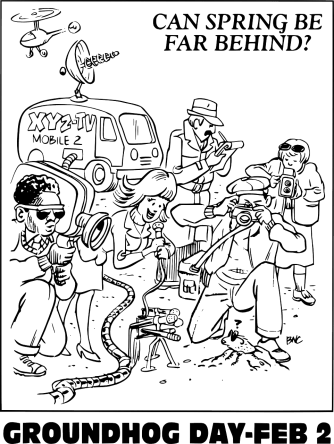 Today, in North America, it’s Groundhog Day. For the uninitiated, Groundhog Day is one of those folksy occasions when everybody from Malibu to Manhattan pretends we all still live in villages. The irony is it’s almost exclusively a mass media event, and although some of us might see it on TV, the vast majority mostly miss it and literally nobody I’ve ever even heard of has participated in person. Here’s the deal.
 WD Fyfe