Christmas At Pyaridge Hall

It was the kind of December morning Victorian novelists dream about.  Diamond frost sparkling over the trim English pastures, horses with steam breath puffing in the air, a slanted sun line on the stable roof, shiny with melt.  On the hill, past the white plank fences, the winter bare trees were pencilled against the too-blue sky.  And not that far beyond where the old stone Roman road curved behind the fruit groves, there was the village steeple, arrow sharp and tiny in the distance.  Emily could hear the Dilfords, mother, uncle and daughter, opening the paddocks and starting the tractor.  She wouldn’t ride today, or any time soon; it was difficult with the bandages, and anyway there was too much work to do.  Besides, she was tired – tired, bitchy and sore.  Her hand had hurt in the night with a black ache, clock-ticking sleeplessness that almost made her cry.  She could still feel it, the dull pressure of the bandages on her fingers that didn’t have enough courage to be pain but had settled in to irritate her.  And she was cold – just out of bed chilly through flannel pajamas and a thick duvet hugged around her shoulders.  She turned away from the window, looked at the cold stone hearth and shivered.

“Damn the insurance,” she thought, “Tonight, I’m going to have a fire.”  She swept the duvet off her shoulders and back onto the bed.  Then awkwardly, she pulled heavy green trousers over her pajamas and a red checked work shirt.  She struggled with the buttons, gave up after two and went down to breakfast.  Not quite the lady of the manor, but . . . .  She ran her fingers through her hair to smooth out some of the tangled sleep.  It would be warmer downstairs where the wheezing old Pyaridge’s boilers could reach, but there was no way she was going to endure another winter like this.  Something would have to go out of next year’s budget.  Next year’s budget?  She hadn’t paid for this year’s yet!  She ran her hand over the thick oak bannister like you would an old dog and continued down the big step staircase, through the high, wide entrance hall and into the breakfast room.

No matter what time Emily arrived for breakfast, it was there waiting for her.  In winter, porridge, eggs and toast, sometimes bacon, sometimes sausage, coffee and juice.  She knew if the salt and fat didn’t kill her the cholesterol eventually would, but it had been a war to get rid of the beans, tomato, mushrooms, wheat cakes and assorted other fried bits, so . . . .   Mrs. Tisdale ran the Pyaridge kitchen with an iron ladle, fed the entire estate on a budget that would embarrass Gandhi and hadn’t taken no for answer since Emily was 6 — which meant, after winning half the battle, it was an act of valor for Emily to just shut up and eat her breakfast, nice girl.  And she did that, every morning, alone at a huge table, in a room built for twenty.

In London, Dreyfus Sinclair didn’t usually eat breakfast unless he was travelling or Mrs. Flynn was in the mood to cook.  And since Mrs. Flynn only came in 3 days a week and was seldom in the mood, it was mostly just coffee and a newspaper under the tall windows in the loft over the river.  That day, there was a crawling mist on the Thames, so there wasn’t much boat traffic, and the lights on the far shore looked distant and scuffed.  It was a perfect day to sit back and contemplate the woes of the world.  Actually, Dreyfus didn’t much care about that, but he did enjoy the style and variety of Fleet Street journalism, so he had the concierge bring him a different/random newspaper every morning.  It made the read a little more interesting.  (Today was The Guardian, full of opinion.)  He thought about going to work later, but he wanted to write a few letters, and he enjoyed writing letters, so . . . .  Plus, he had that neatly-wrapped plastic package of clothes to deal with, and he wasn’t sure what he should do about that.  They had arrived yesterday back from the cleaners with a note that read.  “Our apologies.  Unfortunately, we were not able to remove the extensive bloodstains from the garments without ruining them, and the style and quality dictate that they would not be easily replaced in that event.  Therefore, we are returning them to you.  Regards …”

Friday – Part II

Autumn — Part 3

When you’re just past forty and ex-husband/childless, you take October seriously.  It’s time to haul out the big socks, buy a few books and start planning the excuses to avoid Thanksgiving with the family.  It’s time to shop – for dinner party wine and those old-fashioned Christmas cards because it’s fun to be the old-fashioned aunt.  It’s time to go back to the park – crisp-cold and quiet.  Walk home in the dark.  And make all-day Sunday soup that simmers the entire apartment until the guests arrive.  It’s time to hide the summer clothes and put a tea towel over the bathroom scales and think about yoga – in January.  It’s time to devour pages of Nordic detectives, deep into the twilight of an early afternoon.  It’s time to drink kick-off-your-heels tea and check what’s on TV.  It’s time to take your lunch in a thermos and go for drinks after work and fend off well-meaning blind dates.  It’s not that she didn’t like well-meaning blind dates; they were fun, too.  But when one turns into two and two turns into more, it’s better to move on before normal turns into a nuisance.  The truth was she had no intention of taking on the open-ended responsibility of making someone else happy, because she was already happy, perfectly content to be covered by her own life like a cozy knitted afghan thrown over her shoulders.  Content to choose her own friends, never wash anybody else’s underwear or negotiate what to have for dinner – especially on the nights when it was going to be sweatpants and ice cream and Rosamund Pike.  She was content to do what she wanted, when she wanted — without lame explanations or nagging regrets.    

Of course, she did have some regrets.  She’d gone to university like all the women in her family and had had high expectations.  She thought it would be nice to live in a retro-poor apartment with too many stairs and a cat named Sniffles.  Maybe have some adventures.  Maybe be seduced by a poet who would leave her broken when he went back to his own bohemian tribe.  Then collect all his verses and put them in a shoebox at the back of the closet for her children to find.  But instead, she’d settled for four years in a dorm room — plastic and new — and sex with a waiter, a boyfriend and Rachel’s brother Danny (but she’d married him, so that didn’t count.)  She did have a shoebox, though, but there were no secrets in it and no children to find it, so….  Sometimes, she thought she should regret the years of her marriage – but she never did.  It had been serious and it had been fun, and she hadn’t overstayed her welcome, moving on before she’d completely lost herself in their married routines.  Although she did wish she’d taken the bread maker – that would have been nice.  But she was young then and unaware that, after some months alone, on a chilly kick-leaf October morning, she’d fall in love with her own future, and, like a fairytale princess, live happily ever after.

Autumn — Part 2

Photo – Carolyn Bourcier

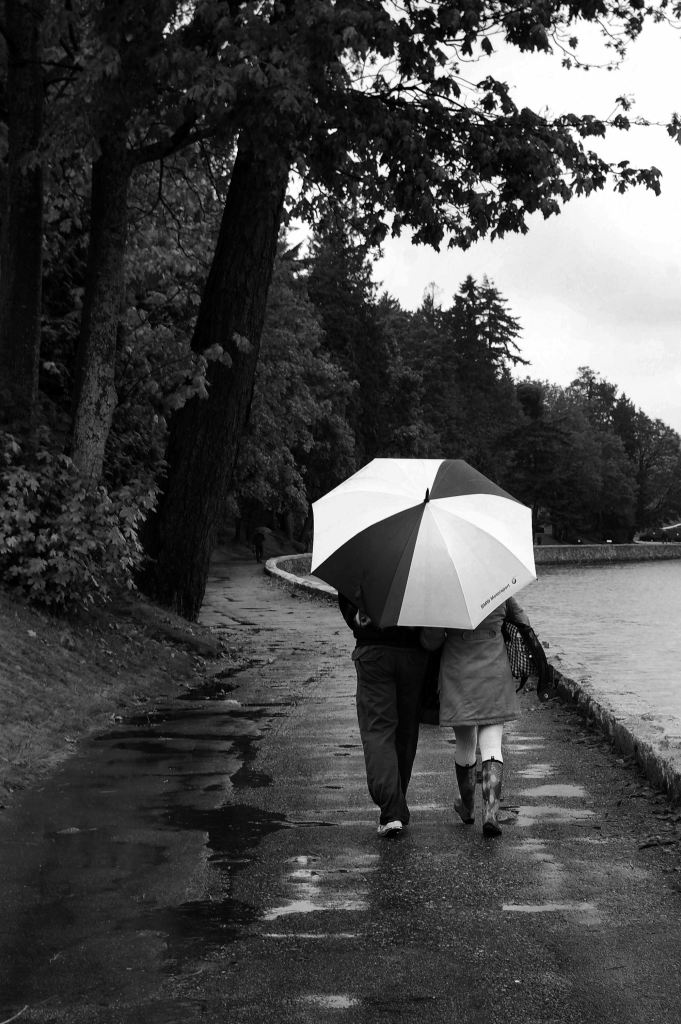
Somewhere in a slate grey morning, fog-deep in the quilts and pillows, they decided to be friends.  It was in the middle of her Vonnegut years, (so there was that) but mostly it was a hedge against the growing November darkness.  She secretly vowed to learn how to cook (but didn’t mean it) and he considered writing poetry (but didn’t do it.)  Mostly, it was buttoned-up coats and kicking leaves, and once, they got lost in their own town when they went walking without watching.  Sometimes, they dreamed of dusty old bookshops full of dusty old books with finger-worn pages and faded covers, and they wondered how romantic that would be.  But she had a library card, and it was three stops on the bus, so they spent their Saturdays curled in the bedroom, reading books they didn’t have to search for.  There was an old-fashioned restaurant, though, with bow-tied waiters and empty tables, that turned the lights on in the late afternoon.  It was on the way home, so they would stop there and have hot soup or old world meat pies.  Sometimes, they would bring their own candles and would order one dessert with two forks and drank wine — so they could explain things to each other.  And that was romantic enough for them.  Along the way, he taught her French (because that’s what he did) and she taught him numbers (because that’s what she loved.)  After a while, they decided they liked walking in the rain and, forever after, looked forward to cloudy days.  Once she went home for her brother’s wedding, and the sun shone large and cold every day, and he missed her and slept on her side of the bed.  She brought him back a piece of the cake with a squashed red rose on it.  She said she was sorry for squashing the rose, so he ate it to be polite.  One Sunday, they decided to go to church (just in case) and one night, for no reason they could remember, they ended up listening to French jazz in a damp basement club.  Occasionally, they would have other adventures as well, but they both knew they mostly preferred buttoned-up coats and walking in the rain – so that’s what they mostly did.  Even after she got over Kurt Vonnegut and got a job teaching mathematics; even after they moved to a bigger apartment; even after they were married and had children and bought a car and had to cut the grass and had regular vacations; even after the years scattered behind them like autumn leaves in the November breeze.  Even after all that, the thing they loved the most was buttoned-up coats and walking in the rain — because one slate grey morning, fog-deep in the quilts and pillows, they decided to be friends.