
Happy Birthday, Wikipedia!

wikiWhere does the time go?  I looked around the other day and discovered that Wikipedia was 12 years old.  I remember when it was a stumbling child.  People thought it was cute in those days: an amateur attempt at “all of us are smarter than one of us.”  Of course, real academics frowned on such antics: knowledge was their personal property, and one simply didn’t throw it around promiscuously.  However, even as their teachers scolded, tons of high school students — and more than a few undergrads — were salvaging their GPA with daring midnight raids on Wikipedia’s fact factory.  In the last decade those undergrads have grown up — and so has Wikipedia.  Today, both are shaping the society that a couple of years ago didn’t take either of them seriously.

Wikipedia is the latest attempt at gathering the world’s accumulated knowledge into one mighty force which, since knowledge is power, fears nothing.  The Egyptians tried it, a little over two millennia ago, with The Great Library at Alexandria.  It worked quite well for a couple of centuries, until one sultry night, in 48 BCE, it got in the way of Julius Caesar’s legions, and he burned it down.  Accumulated knowledge has always been at the mercy of fire and the ambitions of politicians.

From that time, despite what various apologists will tell you, it took us seventeen hundred years to try again.  In 1728, Ephraim Chambers, a printer in London, collected everything he and his friends knew to be true, and wrote it down.  The Chambers’ Cyclopaedia wasn’t the first of its kind, nor the best, but protected by the rule of British law and the guns of the newly minted Royal Navy, it not only survived, it grew.  Of course, not to be outdone by their nearest and dearest rivals, the French printed their own encyclopedia, Encyclopedie (Extremely long name) in 1751.  This, in turn, prompted the British to haul in the big boys; awiki1 couple of Scots named Colin Macfarquhar and Andrew Bell, who produced the Encyclopedia Britannica, in 1768.  For the next 250 years, even though there were 1,001 imitations, the Encyclopedia Britannica remained the Big Kahuna of “all ye know” in the world.  And its reputation as the “go-to” guy for “and all ye need to know” was such that the Nazis thought it worthy of incineration in the 1930s.  Had the Nazis spent more time reading books instead of burning them (thanks, Indiana Jones) the world’s knowledge may not have survived the mid 20th century.  Fortunately it did — and after World War II, Britannica (or something like it) migrated to every library and suburban school in the English-speaking world.  It was the greatest mass distribution of knowledge since Gutenberg and a serious blow to a lot of post-war know-it-alls.  Encyclopedias were everywhere, but they still weren’t necessarily everybody’s.  The world’s knowledge was still controlled by an exclusive club.

If you’re of an age, you remember the Encarta discs from the 1990s.  They made every computer in the world a fountain of knowledge, not only readily available, but portable.  Suddenly, everybody from nuclear physicists to primary school children could carry the world’s repository of information in their backpacks — and frequently did.  From there, it was only a few short digital steps to Jimmy and Larry and the final democratization of the accumulated wisdom of the world.

wiki2Jimmy Wales and Larry Sanger launched Wikipedia in January, 2001. It offered the world’s knowledge to the world, without restriction or restraint.  It was information “of the people, by the people, for the people.”  Twelve years later, the sum total of human experience is now available to anyone with a telephone.  Information is no longer the exclusive province of the few – jealously guarded and subject to attack.  Literally billions of people carry it with them, at school, on the bus and where they work.  It cannot be burned, stolen or hidden away.  It is the best defence against the next Adolf Hitler who comes along with a bunch of marching torches and a “better” idea.  The age of the flammable page is over.

Happy Birthday, Wikipedia!  You’ve come a long way, baby!

2013: Dull, If Not Boring!

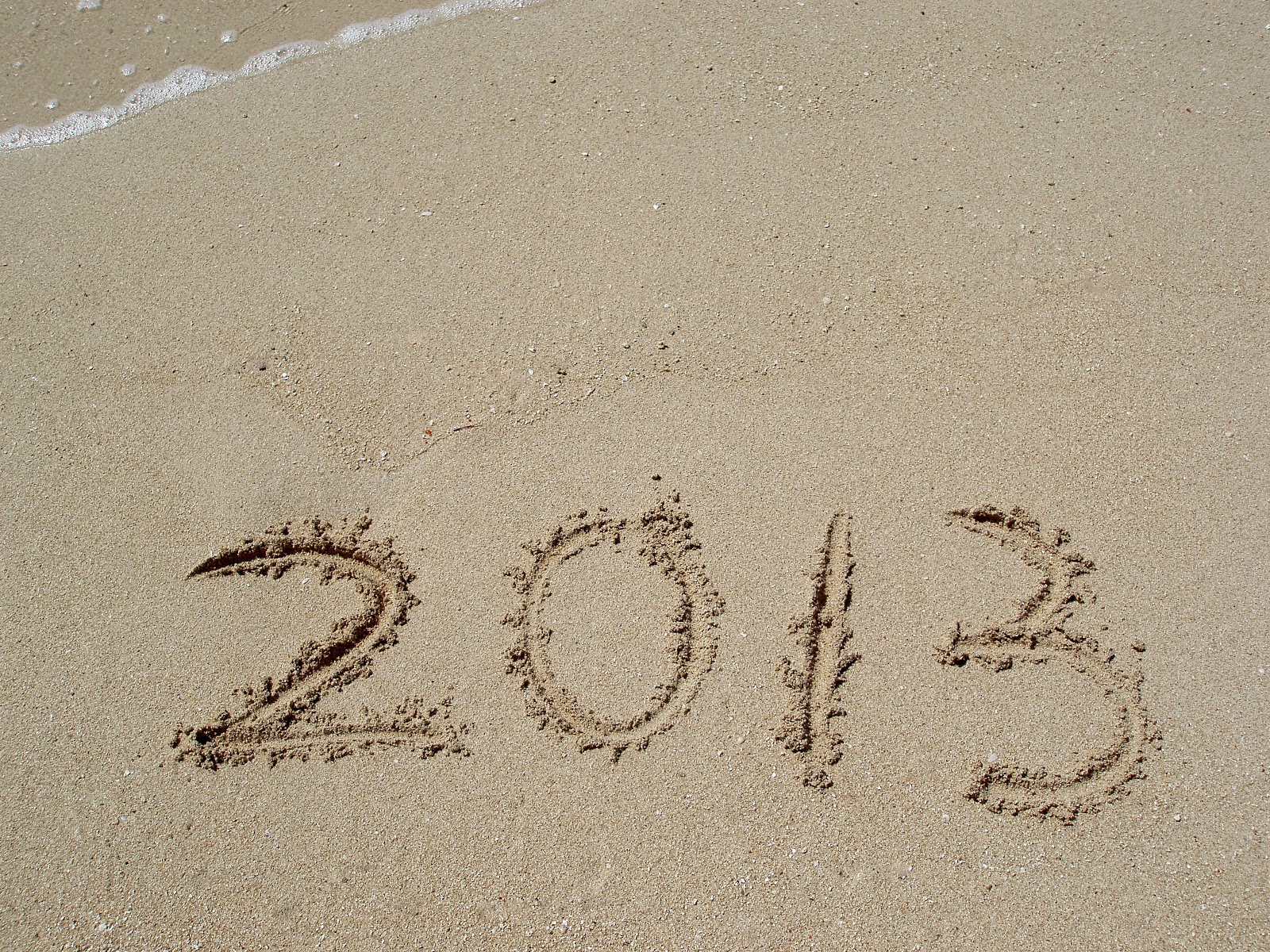
new year3The year is less than two weeks old, but I’m willing to go out on a limb and say 2013 isn’t going to be a very good year.  It’s not going to suck or anything; it’s just going to be dull, boring, historically dismissive.  It’ll be one of those years which a hundred years from now nobody’s going care about.  Kinda like 1489, or 1843 or 1771.  Those were years that, I imagine, were perfectly cool at the time but simply couldn’t keep their lustre compared to 1492, 1848 and 1776.  They just didn’t have the star power.

First of all, 2013 doesn’t sound right.  It’s got too many syllables or something.   It trips on the tongue.  Nineteen eighteen has cadence.  Ten sixty six has rhythm.  Forty four B.C. has an authority about it.  These are all years when big stuff happened.   However, take a look at twelve fifty seven or seven thirty one.  These are years that so closely resemble every other year that even nerdy historians don’t worry about what happened then because guess what?  Nothing did.  That’s going to be the problem with 2013.

Yeah, we’re going to have all the regular stuff in 2013: Easter, Father’s Day, Labour Day, Christmas etc., but we’re not going to have any of the big stuff.  There are no Olympics this year, no World Cup and most importantly, no American elections.  American politics are going to be dominated by budget negotiations.  Big snooze!  Budgets aren’t sexy, and besides now that Obama’s been re-elected, there’s nothing much at stake.  The political shine is off the rose and all those oh-so-committed (informed? engaged?) voters are heading for the exits.  The last thing any of them wants to do is play Survivor with fiscal responsibility; a subject most people think is about as exciting as eating lukewarm Kraft Dinner.  No, Springsteen and Oprah have put away their microphones for the duration, and political entertainment has left the building.

Speaking of entertainment; don’t expect 2013 to be a banner year at the movies,new year2 either.  Film makers are doing so many storyline retrofits I fully expect to see Holmes on Homes listed as technical advisor in most of the credits.  First, there’s The Lone Ranger with Johnny Depp, who is going to outshine Armie Hammer by a long shot and probably end up riding off into the sunset with Red (Helena Bonham Carter) leaving Lone to fend for himself.  Then, there’s Gatsby who was great when Redford portrayed him in the ‘70s; something about Oz which has James Franco playing a prequel to Dorothy (remember him in drag at the Oscars, hmmm?) and two more additions to the Star Trek and Superman franchises – like we need those.  Eventually, Hollywood is going to get boiled down to just one single movie with various sequels, prequels and equals regurgitated every year.  Oh yeah, I almost forgot, there’s another Die Hard this year, which, with any luck at all will be Die Hard: Once and for all.  Unfortunately, I think John McClane is going to go on forever — like those “Call Me Maybe” parodies on YouTube.

Of course, in 2013, there won’t be that YouTube menace Psy kicking around.  2012’s answer to The Starlight Vocal Band is gone, if not already forgotten.  Last time I looked, he was hanging out in Times Square on New Year’s Eve with Jenny McCarthy and MC Hammer.  If that isn’t a triple whammy kiss of death, I don’t know what is?  And don’t expect a 2013 equivalent of “gangnam style;” there’s only so much a discerning public can stand in one decade.

That’s probably the problem with 2013.  This decade is relatively new, and there’s a whole pile of stuff out there just quietly waiting to hit the fan.  When it does, we’re going to have a lot more than reinvigorated “Hammer time” to contend with!  Actually, this might be the calm before the storm.  So, to that end, I suggest you just sit back and relax in the relative peace and quiet of the next eleven months or so.  Gather your wits about you, because after that it’s going to be “Buckle up, Pardner!  Here we go again!”

Mayan Calendar: It’s Not the End of the World

mayanIn case you haven’t heard, as of this morning, we’ve got exactly one week until the end of the world.  According to every con man from here to Cozumel, December 21st 2012 is the Mayan equivalent of the Crack of Doom, and when the sun goes down next Friday, it ain’t comin’ up again.  This current End of the World (I’ve survived several in my lifetime) has been hanging over our heads for several years now – ad infinitum.  Basically, it’s been done to death and everybody’s got the T-shirt.  However, rather than letting this little sleight of apocalyptic hand go by unnoted, I’ve decided to rerun a piece I wrote eighteen months ago.  I changed a few things to update it, but it’s just a valid today as it was a year and a half ago.

Personally, I’ve got nothing against Mayans.  I’ve only met a few, and since I was always a tourist and their job was to make me happy, I’m in no real position to judge.  However, I would think that, like every other human group, they’ve got their fair share of good people, regular folks and jerks.  I say all this because I’m about to treat them badly; I don’t want anyone to think it’s anything more than journalist license.

The Mayans are an ancient smarty-pants civilization, discovered in the late 70s, when low airfares, sandy beaches and new hotels combined to bring loads of tourists to a place called Cancun.  Before that, the Mayans weren’t really known beyond a tight-knit circle of anthropologists, archaeologists and nerdy grad students.  Cancun and environs, popularly called the Mayan Riviera, soon became a must-have, all-you-can-drink young people’s destination.  When the spring break college kids sobered up, they went out on daytrips to see the Mayan ruins at Coba, Tulum and Chichen Itza.  Incredible examples of pre-Columbian Mesoamerican culture, these not so ruined ruins, blew the young folks away – especially since their previous contact with native America consisted of the Washington Redskins and the Cleveland Indians.  They discovered all manner of cool things about the Mayans — stuff like their written language, sophisticated social structure, detailed astronomical observations and cruel treatment at the hand of the conquering Spanish.  The fact that their culture included human sacrifice — lots of it — and had already collapsed under its own weight, long before the Spanish ever got there, was kinda glossed over by the tour guides.  Anyway, the sophomores among us took this knowledge home and wildly misinterpreted most of it, while congratulating themselves on their escape from the confines of their parent’s Eurocentric view of the world.

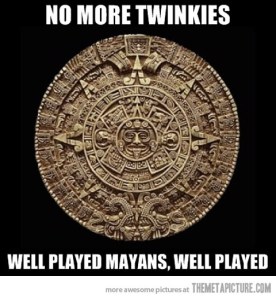
The most easily accessible tidbit of tourism was the Mayan Calendar.  For amayan3 while, it was the souvenir du jour and adorned the walls of most dormitories and studio apartments north of the Rio Grande – for years — sometimes upside down.  It was — and still is — a talking point, even though, without the name, most people haven’t the foggiest idea what they’re looking at.  However, it remains tangible evidence that the tour guides were right: the Mayans were way cooler than the Greeks and Romans (who had no idea what day of the week it was) and that, in turn, justifies a healthy disrespect for one’s own cultural roots.

In actual fact, the Mayan calendar is a complicated, extremely accurate piece of equipment.  I defy anyone without knowledge of astronomy, mathematics, Mayan history and conceptual logic to figure it out.  Besides, that plaster of Paris reproduction currently sitting in everybody’s basement is only one part of the intricate system the Mayans used.  You can’t just look at it — like you can the Playboy calendar — find Tuesday and figure out which day is garbage day.  Why?  First of all, the Mayans took time seriously.  It wasn’t used for trivial things like when’s the long weekend?  Secondly, it’s based on the numbers 13 and 20 which were sacred to the Mayans (even though they have no relevance to measurable time.)  Thirdly, the solar year was a minor unit in Mayan time, not the be-all-end-all we believe it is.  Finally, and most importantly, the Mayans thought of time as circular, not linear – that’s why the thing is round.  Give an ancient Mayan a timeline, our general graphic depiction of time, and he’d say “What the hell’s this?”

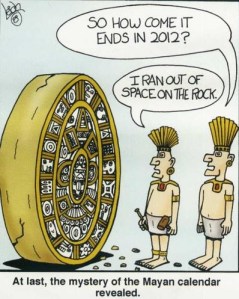
mayan4So what has all this got to do with the end of the world?  Lots!  Unlike western calendars which are infinity at both ends (an extremely complex concept, by the way) the Mayan calendar has a definite beginning (August 11, 3114 BCE) and a definite end — December 21, 2012.  And since we all know Mayans are Third World cool, with secret mystical knowledge of the universe, they must know something we don’t — like exactly when the world is going to end.  Thus, the Mayans — that uber-cool little civilization who couldn’t figure out why cutting virginal throats didn’t make it rain — are now the arbiters of human survival!  This was an absolute boon to soothsayers, charlatans and rogues — who now had an event to hang their shysterism on.  They no longer have to rely on sketchy Biblical prophecies, Uri Geller or Nostradamus.  They hitched their books, magazines, blogs and Discovery Channel documentaries to an actual thing – the Mayan Calendar.  Plus, they had a prequalified customer base from all the misconstrued Mayan crap that has been floating around for thirty years or so.  It’s was a license to fleece money.

However, before you give away the farm and spend the next seven days in abject debauchery, let me fill you in on one single, overwhelming fact that nobody seems to be mentioning.  You and I, and everybody else who’s seen Jurassic Park, know damn well that time did not begin on August 11th, 3114 BCE.  In fact, we have it on good authority that Lucy (Australopithcus) and her pals were walking (upright) across Ethiopia over 3 million years before that.  Obviously, something’s wrong here.  It’s like the biblical scholar James Ussher whose calculations pinpointed the time of Creation as Sunday, October 23rd, 4004 BC – not likely.  If those super-smart Mayans were 100% wrong on one end of their calendar, what are the chances they got things right on the other end?  Again — not likely!

I’m no anthropologist, but I don’t think the Mayans were any smarter than themayan1 rest of us.  In fact, I think, given the circular nature of Mayan time, the end of their calendar doesn’t mean the end of time; it’s just a practical way to start over.  All the rest of this current hooplah is just New Age nonsense at its finest.  And I also have the feeling the present day Mayans are laughing themselves stupid at all the fuss their ancestors caused.

However, if I’m wrong, see me in seven days and call me an idiot.