
St. Patrick’s Day: An Alternative History

Stuck between The Ides of March and St. Patrick’s Day, March 16th is probably the most neglected day on the calendar.  It shouldn’t be: after all, The Ides of March was really just a minor Roman festival before Brutus and Cassius decided that power came out of the pointy end of a dagger.  Frankly, if Julius Caesar had been feeling a bit frisky that morning and gone over to Cleopatra’s instead of to the Senate, we wouldn’t remember The Ides of March, at all.  Plutarch wouldn’t have written about it, and Shakespeare wouldn’t have borrowed it to add a little spooky to his play Julius Caesar.  As Katherine Hepburn once said, about an unrelated matter, “Such is the role of sex in history.”

This minor change (given the tenor of the times Caesar was going to get his one way or the other) would have made March 16th a bigger day: Saint Patrick’s Eve, perhaps; just as Hallowe’en is All Hallows’ Eve and December 24th is Christmas Eve.  Unlike the Ides of March, which needed an assassination to put it on the map, St. Patrick’s Day is one of the big boy holidays.  It is so connected to Ireland that even if Saint Patrick hadn’t become the kick-ass saint he was destined to be, the Irish would have made him up – which, for the most part, they probably did.

There is no doubt in anybody’s mind that Saint Patrick was a real guy.  His life is actually pretty well documented (for the time.)  At least two letters he wrote are considered authentic, which doesn’t seem like much but when you consider most everybody in the 5th century was an illiterate peasant, it’s a lot.  However, that’s where it ends.  Most of the juicier details of his life are actually just high-end speculation.  There are no snakes in Ireland and there are a lot of shamrocks but we have no documented proof that either had anything to do with Saint Patrick.  In fact, there is actually no record in the Vatican of his ever even being canonized.  He is the patron saint of Ireland by tradition alone.  Likewise, the stories of his exploits were probably just good press for a church that was fighting tooth and nail against some long-established pagan gods.

The early Christians weren’t stupid.  They knew that a single God was a hard sell to superstitious people who had always worshipped a pantheon of pagan deities.  So they turned a bunch of ordinary people — who had led virtuous lives — into saints.  These saints weren’t gods, but they were already in heaven.  Thus, they were able to perform miracles in aid of the living and could be invoked in prayer, just like the old gods of the forest that the people were accustomed to.  Then, the Christian church went one step further and made it all personal.   They invented the patron saint, who had a personal interest in you.  Whether through your occupation, your birthday, where you lived or some other circumstance, a number of saints were available just for you, to handle your earthly problems.  The local river nymphs didn’t stand a chance against that kind of firepower, and Christianity came to dominate Europe.  Interestingly enough, though, these days, even ahead of Saint Patrick, the universally accepted symbol of Ireland is the leprechaun.

For centuries, St. Patrick lounged around in the same secular/celestial neighbourhood as St. Andrew, St. David and St. George, first among equals in the regions they represented but not that well-known beyond the borders.  (For example, most non Scots get St. Andrews Day and Robbie Burns Day hopelessly confused.)  But then, in the 1840s, the potato crop failed and Ireland began to starve.  First, the old people died and then the children.  Mothers abandoned their babies rather the watch the inevitable.  Whole villages turned their backs on their homes and roamed the countryside, looking for anything to eat — including the grass that grew in the ditches.  Without hope and forsaken by the future, the Irish left Ireland by the thousands to go anywhere beyond this despair.  In the 19th century the Irish Diaspora was huge: an army of homesick exiles, driven from their land.  Isolated in their adopted countries, by their speech, their customs and their religion, they clung together, keeping their traditions alive.  It was here — in the Irish ghettos of New York and Boston, Melbourne and Montreal — that St. Patrick’s Day was born.  It had always been a religious holiday in the old country, but far from home, St. Patrick’s Day became a time to drink a toast, sing the old songs and try to remember that which had once been.  A day of Irish pride far from the graves of their families, it was the slender thread that could take their hearts home.
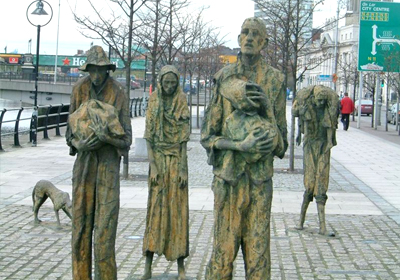
Today is March 16th, the most neglected day on the calendar, but tomorrow is St. Patrick’s Day, the party where everyone is Irish.  So, at some point in the festivities, pause for a moment, and raise your glass to St. Patrick, a virtuous man, good enough to be turned into a legend by the early Christian spin doctors.  Then, raise it once more to all those nameless Irish immigrants who carried him with them, around the world.

May yer neighbours respect ya
Troubles neglect ya
The angels protect ya
And heaven accept ya*

Happy St. Patrick’s Day!

*(Did you just read that in an Irish accent?)

Henry Ford and the Road to Obesity

Everybody knows we’re getting fat.  You can’t go anywhere without being reminded that our Western society is plumping up like a corn-fed chicken.  And it’s not just statistical anymore: some far away Body Mass mumbo-jumbo spread over an entire state and distilled into a percentage.  No, everybody knows somebody who’s carrying an extra twenty pounds (Sometimes, it’s them!) and most of us actually know a few people who are waddle-over-to-the-fridge-for-another-corndog obese.  Fat is breaking down the doors of our society and coming in for dinner.  Normal is becoming one more chin and one less visible belt buckle.  Everybody knows this, but nobody knows why.

The general consensus is our society’s problem with personal lard comes from junk food and video games.  While this is true, it doesn’t tell the whole story; to do that, we need to go back in history and look at who is actually responsible: Henry Ford.

Most of us know Henry Ford as the guy who invented the assembly line.  This is a good way to pinpoint him in history, but it’s not strictly true.  The automobile assembly line was invented by Ransom E. Olds; Ford just borrowed (stole?) the idea and made it work.  Olds went on to build Oldsmobiles, and Ford changed our society forever.  Here’s how it happened.

Throughout most of history, ever since Khufu the Egyptian decided he wanted a big funeral, there was only one way to make things: local craftspeople.  These were individuals (and, probably, their sons) who toiled away, usually at home, producing one item at a time.  This changed with the Industrial Revolution when factories and machines started doing the grunt work, but, in general, precision jobs, even into the 20th century, were done individually.  In 1913, Henry Ford (who, BTW, didn’t much care for history) changed all that by producing an inexpensive and reliable automobile on that assembly line he stole borrowed.  The economics is complicated, but, in a nutshell, Ford brought his labour costs down to the point where he could actually pay better wages.  In essence, he produced an automobile his own workers could afford.  It went like this: while Ford was selling his Model T for $360.00, over in Lansing, Olds was selling Oldsmobiles for $4,000.00 (the price of a decent house at the time.)  In fact, Ford made the Model T (or “Tin Lizzy”) so cheap you were a fool not to buy one.  Within ten years, there were 20 million automobiles on the roads of America, and nearly half of them were Model T’s.

So what has this got to do with fat people a hundred years later?  (I thought you’d never ask?)  This is where the dominos of unintended results start to fall, and once they get going, they move pretty quickly.

Before Ford’s transportation revolution, the majority of the workload in the world was done by a vast army of horses.  They pulled, hauled and lifted most everything, carried goods and people to and from the marketplace, plowed and harvested, and, on Sunday, took the family to church.  They were as ubiquitous then as the automobile is today.  However, as more and more people bought cars and trucks for work, pleasure and transportation, fewer and fewer people needed those horses.  They began to disappear, along with all the industries associated with them.  Things like livery stables, harness shops and the thousands of farms that once grew the hay, straw and oats needed to keep a four-legged army on the road every day: all went poof.  Over the next few years, millions of acres of fertile land went from producing fodder for horses to food for people.  The change was so rapid and our agriculture so efficient that, all over the country, growers, distributors and wholesalers found themselves with literally megatons of extra food on their hands.  They had to figure out a way to get rid of it without bankrupting everybody through oversupply.   Their solution was to add value to their products by processing them: the difference in price between a bag of flour and a loaf of bread is huge.

This also widened their market.  With rapid transportation, processed and preserved food could be shipped all over the country — with no loss to spoilage.  Suddenly, Georgia peaches were available in Milwaukee in cans, Florida oranges showed up in Chicago as juice and Nebraska corn became nachos in Arizona.  Bisquick™ biscuits might cost a little more than grandma’s, but they were way more convenient.  Frozen Birdseye™ vegetables didn’t taste quite as good as fresh, but it beat shopping every day.  Canned and frozen became the norm as we sacrificed taste and quality for quick and easy.

From there, it was only a matter of time (two decades and a World War) until the automobile itself became a link in the food chain.  In the 50s and 60s, young people with disposable income were spending their evenings cruising the suburbs a la American Graffiti.  The drive-in restaurant was the place to meet and greet the opposite sex and share a Cherry Coke™ and a cheeseburger.  In the great scheme of things, an Idaho potato might be worth about 10 cents on its own, but turn it into Mcdonald’s fries, and it’s worth a dollar; 45 cents worth of Texas hamburger became a $3.99 Big Mac™.  Raised on cake mixes, TV dinners and canned vegetables, young people didn’t hesitate to gobble up acres of fast food and wash it all down with buckets of soda pop.  It was the natural extension of value-added foodstuffs.

Today, automobiles allow us to live miles away from where we work, but on the long road home, there’s a cornucopia of drive-thru fast food, just waiting to eat dinner with our children — and we don’t even have to get out of the car!  Our long commutes mean very few of us pause to eat breakfast or have time to pack a lunch.  Therefore, after sitting in the car for an hour and at our desk for another two, by the time the cashew-carrot muffin comes around — healthy or not — we have two.  It’s easier and sometimes cheaper to eat the carefully preserved pre-chopped salad, feed the snack pak lunch to our kids and microwave the frozen lasagna for dinner than to buy a raw chicken and figure out what to do with it.  Actually, it’s incredibly difficult to even find unfinished food anymore.  Next time you’re in a grocery store, look around and compare processed food to fresh; it usually runs at a three-to-one ratio.

Of course, we’re getting fat, and, yes, Angry Birds™ and Pizza Pops™ are to blame. But history has a way of giving us unintended results, and if Henry Ford had been a farmer instead of an economic wizard, we might not have had either.

Leap Year: It’s About Time

Okay, ladies and gentlemen!  Brace yourselves — because there’s no way to sugar-coat it.  Today doesn’t exist; you are standing in a man made time warp.  What you think of as now has already passed, and the future won’t begin again until after midnight.  Deep, huh?  Don’t be scared, though; it happens every four years.  (Not really but it’s too complicated to explain*.)  It’s called a Leap Year, or Leap Day to be more precise, and we need it because the universe doesn’t care what time you want to go to work.

The Universe, Mother Nature’s boss, doesn’t get involved in the affairs of humans.  It’s got better things to do.  We humans, Mother Nature’s most precocious children, have never quite understood that.  We think that if we make a couple more scientific discoveries or sit naked on a mountainside for a couple of years, we’ll get this whole universe thing figured out.  It’s not likely, but nobody ever accused our species of being humble.  The Universe actually rolls on without us, asking neither permission nor forgiveness, and nothing we say or do is going to change that.  So every once in a while, without actually admitting it, we have to adapt or… well … nothing really, because, as I’ve said, the Universe doesn’t care.

Despite what old hippies and serious dope smokers will tell you, Time is not an artificial concept.  It exists, and people have always measured it.  Way back in the caveman days, there were only two times — dark and light.  This is an extremely accurate measurement which most species on this planet still use.  However, as our species got busier and busier, they discovered that minor Time (major time was beyond their grasp) had recurring themes.  The sun travelled across the sky, the moon got larger and smaller, and familiar clusters of stars moved in elliptical patterns.  All these things happened with incredible regularity.  Therefore, it was simple for primitive humans to figure out that there were usually twenty nine suns between each full moon.  Not only that, but our ancestors also found that if they persistently watched the night sky, the movement of the stars corresponded to the seasons.  For example, what we call Orion’s Belt first appears in the southwestern sky in early January, soon after the morning sun is lowest on the horizon.  Thus, by noting when Orion’s Belt first appeared in the sky and counting the number of suns until it reappeared, early skywatchers discovered a complete earthly cycle or a year.  These two rough and ready measurements (or something similar) are the basis of all early calendars.

Unfortunately, as our society got more and more sophisticated, these primitive tools didn’t keep pace.  There is an inconsistency between the months and the years that causes nothing but problems.  Essentially, 12 lunar months equal only 348 solar days — which leaves a 17 day gap in the celestial year.  As the years went on, the seasons were slowly getting out of whack.  No less a light than Julius Caesar saw this and devised a new system called The Julian Calendar that remedied most of the problems – for a while.  However, 1600 years later these problems were back — with some extra added attractions.  Not only were the seasons out of place again (they had moved twelve calendar days in the centuries since Caesar) but the highest holiday in the Christian calendar, Easter, whose timing is based on the Spring Equinox, was disappearing into seasonal winter.  Pope Gregory XIII decided rather than let the Universe figure it out, he would fix it.  After all, he was the infallible head of the Roman Catholic Church.  He set his minions a mission: devise a calendar that would work for all time and keep Easter in the spring (where it belonged.)  They came up with the Gregorian Calendar which added an extra day in February every four years (or so) to even out the imbalance.  Gregory’s new calendar was proclaimed in a papal bull on February 24th, 1582 and is now in general use.  Problem solved.

Which brings us back to the time warp that is today.  Today doesn’t exist because Gregory’s extra day was inserted for time already past.  Here’s the deal.  As our earth moves through the Universe, it takes 365 days, 5 hours, 49 minutes and 12 seconds to go from point A all the way around to point A again.  For simple calculations, we call that a year.  That was the amount of time a year took in 2009, 2010 and 2011.  Obviously, that time is gone.  However, in our burning need to realign the Universe, here we are with a whole extra day to make up for it.  Actually, if you want to be picky, the first 5 hours, 49 minutes and 12 seconds of today did exist, but the other 17 hours, 27 minutes and 36 seconds don’t.  They’re all in our past.  We’ve already lived those hours, minutes and seconds.  In the great metaphysical scheme of things, this is borrowed time.

So take the rest of the day off, kick back, throw a ball, read to your kids or just lie elbows deep in a pillow, contemplating the infinite.  If anybody asks, blame it on Pope Gregory.  He’s the guy who thought a little time management would be good for the Universe.


*A Leap Year is every year that is exactly divisible by four, except for years that are exactly divisible by 100; the centurial years that are exactly divisible by 400 are still leap years. For example, the year 1900 is not a leap year; the year 2000 is a leap year.