
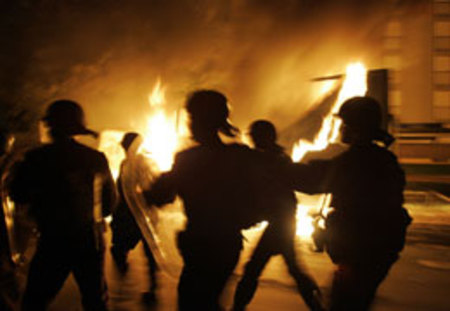
 I’m a child of the 60s: I love a good demonstration, and I’m an absolute sucker for a riot. No cheap perfume excites me more than that first whiff of teargas, and, as far as I’m concerned, the erotic beat of batons on riot shields is way more suggestive than any burlesque trumpet solo. But civil disobedience is a young person’s game, so, these days, I’m content to watch it all on TV. For a while there, my cup runneth over – Tunisia, Egypt, a couple of shots of Yemen, Iran? – I’m a happy guy. But just when I thought it was safe to kick back, munch some Doritos and watch Cooper Anderson Anderson Cooper and Wolf Blitzer shape American foreign policy and the Arab Revolution on CNN, some guy I’ve never heard of wants to screw it all up.
Here’s the situation. As usual, with government problems, it’s all totally complicated and scattered across at least three different departments. Nobody really knows what’s actually going on — or why — and there are several interpretations, but in simple speak, this is what’s happening.
 In Canada, we have a rule. It says that the news has to be true. Most people don’t know this. They think the truth comes naturally to journalists, or it happens by magic or something, or it’s just the way of the world. No, folks, none of the above — and that’s why we have a rule. It’s written down. It’s a good rule. Basically, it’s there, so guys like Neil Macdonald and Craig Oliver can’t go Glenn Beck insane and say Stephen Harper is Lucifer’s brother. They can insinuate it all they want, but they can’t report it as news — unless they can back it up with evidence of horns and a tail. Canadian news must be factual. It’s very simple. If it’s not a provable fact, it can’t be reported as news. In other words, opinion, hearsay, gossip and downright lies are not news, and they can’t be reported as such. I think everybody would agree that this is a wise rule that serves our country well.
Apparently, not so much, because — believe it or not — the junta  that controls the media in Canada, the CRTC (Canadian Radio and Television Commission) has recently decided to change the rule. There’s a whole bunch more blah, blah, blah, but, in essence, what they want to do is “amend” the regulation. This “amendment” would mean that the news doesn’t necessarily have to be true anymore — as long as the broadcaster thinks it’s true. So, as long as the media doesn’t knowingly broadcast something that is “false or misleading,” they can do as they please. (There’s some other crap about not causing people harm, but that’s like slapping someone you just shot in the face. Who cares?) The operative word here is “knowingly.” What it means is that something can be reported as the truth if the journalist believes it’s true; factual corroboration is no longer necessary. Hypothetically, if a journalist was told by several sources he believed to be reliable that Jack Layton was having an affair with Belinda Stronach, he can report it that way. Jack and Belinda can defend themselves later. My outrage at this little tidbit of news is real but I’m really outraged that so few journalists saw fit to report this to the Canadian public.
 One of the cornerstones of journalism — besides distinguishing fact from fiction — is journalists think they’re sexy. They all think they’re hard-boiled reporters, tracking down the big story, exposing corruption and injustice. They’re also bone-ass lazy. Sitting through a boring afternoon of CRTC hearings, while some nameless bureaucrat cuts the guts out of the public trust, is not what they’re going to do. Nor are they going to spend hours reading through transcripts, checking the facts. They’d much rather hang out with each other, awash in self importance, playing with their Blackberrys. And this is what bugs me. That nameless bureaucrat is about to give a free hand to the very people who shouldn’t have it. Journalists have one purpose on earth: tell the general public the truth. Their only job is to cut through the spin and tell me what’s actually going on. In recent history, they’ve gone just about as far away from that purpose as is humanly possible without leaving Earth’s orbit. So why would some faceless, nameless, brainless government stickperson water down the only rule that governs them?
The reason Wolf and what’s-his-lastname go in for endless analysis is that it’s easy. It’s not in-depth reporting; it’s off the cuff yakking, with some low-grade speculation thrown in. It’s fun.  But hard news isn’t. Hard news is wading through city council meetings, looking for the inconsistencies. Hard news is finding the one fact that doesn’t fit the spin and building a story from there. Hard news is doing all the work I don’t want to do because I’m buckled up with my Doritos, laughing my ass off at CNN trying to fill time between their commercials. Most importantly, hard news is reporting to the Canadian public that they’re not going to get any hard news anymore, so they might as well stick with CNN. Oh, and by the way could you name the nameless bureaucrat so at least I know who spoiled my evening’s entertainment?