Vulgar Is As Vulgar Does

18th Annual Critics' Choice Movie Awards - Press RoomThere are some days when, for whatever reason (too many headlines on an empty stomach, maybe?) it feels as if the barbarians have taken over our little garden spot.  It looks as though they’ve tossed their trash everywhere, trampled the flowers and peed in the fountain for good measure.  It’s on days like this that I wish I could just hole up somewhere and read novels.  Unfortunately, I can’t.

At the risk of giving the Oscars way more ink than they deserve, their antics are still holding our heads in the proverbial sewer – five days after the fact.  The Hollywood camp followers, never the brightest lights on the marquee, are keeping the pot boiling, and for some unknown reason  we’re all clambering to get a second crack at who did what to whom on Oscar night.  I have no idea why.  Remember most of these hangers-on are still in apoplectic shock over Seth McFarlane’s song and dance about boobs.  At the other end of the freeway, the rest of them are slobbering all over themselves because the seams on Anne Hathaway’s dress suggested she might have a couple of them hidden in there.  Somehow, I can’t take people who have the sophistication of a pubescent schoolboy seriously, even though it looks as if just about everybody else around me can.  But my gripe is not with these folks – at least not today.

Today, I’m pissed off at The Onion, the risen Messiah of the Chattering Class, and even though they apologized (here) I plan to hold a grudge.

Ever since The Onion deemed it necessary to call a nine-year-old child, Quvenzhane Wallis, a very adults-only nasty name, the prevailing wisdom is the guys and dolls from Chicago went too far.  Crap!  “Going too far” suggests you were on the right road and just didn’t know when to hit the brakes.  If these gangsters merely “went too far,” which epithet should they have used that would have been far enough and no further?  Personally, I can’t think of one.  However, I can tell you, definitely, that The Onion and their loyal readership have missed the point entirely.  While they are rattling on about “appropriate” and “acceptable,” some of us are wondering how (not why) did it all come up in the first place.  After all, The Onion is a big organization; it’s not a couple of guys smoking dope and watching the Oscars in the parents’ basement.  There must have been a general consensus of some sort.  How does a journey that ends in “too far” begin?  What are the building blocks that create an attitude that could ever say, “It’s open season on nine-year-olds”? These are the questions we should be asking– not whether the result was “appropriate.”

It’s obvious that — somewhere between Anna Paquin in ’93 and now — our society has become scuzzy.  We’ve turned into a bunchpower1 of cheap-shot artists who might have a biting wit but lack the wisdom to know where or when to use it.  Why?  In the last twenty years, we have spent so much time Big Brothering each other’s “appropriate” and “acceptable” language and behaviour that we no longer understand the need to govern ourselves.  It’s a matter of supreme indifference to us.  Mainly because we no longer care about the substance of our ideas, we’re simply scared skinny of what they might look like.  For example, you and I both know there are several “inappropriate” words that The Onion could have used in this situation, but they never came up on the panel.  Satire and parody be damned; they were “unacceptable.”

The Onion can be hilarious.  However, vulgar isn’t funny: it’s not satire and it’s not parody.  It’s just bad taste, tarted up as comedy.  Unfortunately, when, as a society, we no longer possess the ability to make that distinction, there’s something dreadfully wrong.  Therefore, as of today, The Onion can go hang.  They might have 7 million readers, but they’re going to have one fewer.  It’s a tiny gesture that those big-ass birds aren’t even going to notice.  But I’ll know.  The barbarians might already be trampling the flowers, but this is one posy who’s going to surrender slowly.

History According to Hollywood

oscar4Even though the 24-hour news cycle for the Oscars is over, a lot of movie critics still linger in the air like yesterday’s corned beef and cabbage.  They’re all busy grousing about Argo, the most brazen work of fictional non-fiction since James Frey fooled Oprah Winfrey – twice — on international TV.  Argo won Best Picture and scribblers from Tehran to Toronto are suddenly shocked and appalled at Hollywood’s libelous treatment of history.  Now, they’re wearing out Google trying to prove stuff like Robin Hood didn’t look the least bit like Kevin Costner (or, for that matter, Errol Flynn.)  Even the mighty Spielberg has been taken to task over “inaccuracies” in his “tell me how much you loved my movie,” Lincoln.  So far, the critics have discovered that America didn’t single-handedly win the war (any of them) Mel Gibson didn’t either and Krakatoa is not actually east of Java.  They’re spouting this stuff as if they’ve found the forbidden Bush files on the alien landing east (or was it west?) of Crawford, Texas.  Unfortunately, in all their fact-checking, they’re actually ignoring the single most important fact.  It doesn’t matter.  Movies are make-believe.

I realize that most people get their grip-of-steel grasp on history through the movies; after all, it’s not like anybody’s picked up a book in the last few decades.  However, I think it’s unreasonable to demand — or even expect — anything more than a modicum of historical accuracy from people whose single avowed purpose on this planet is to entertain us.  History is not boring (even though most high school teachers dedicate themselves to making it so.)  However, there really isn’t much entertainment value in the bubonic plague, for example, or the siege of Sevastopol or a thousand and one other historical events.  Unless you’re a connoisseur, these are not exactly page-turners.  Besides, I defy even the most accomplished historian to comprehensively explain these events to a room full of strangers, sitting in the dark, in less time than it takes to cook a rump roast.  And movie makers are not accomplished historians.

The problem is, history, already written, isn’t tidy.  It doesn’t have a beginning, middle and an end.  Like unruly hair, it has clumps that won’t lie down right, parts that aren’t straight, strands that refuse the comb — and it’s forever getting blown around by the current political wind.  For example, in 1943, Lillian Hellman was convinced by the American government to write a pro-Russian propaganda screenplay for the movie North Star.  Then, in the 50s, she was hauled before the congressional witch hunting HUAC to explain her sympathetic portrayal of the Soviet Union.  Go figure!

The other thing we need to remember is that filmmakers, even the documentary kind, do not set out to tell a story; they set out to tell their story.  There’s a difference.  If you look hard enough, you can find at least three distinct interpretations of any historical event.  The folks who make movies can use only one at a time.  That’s not to say that they necessarily have to distort the facts to accommodate the tale they choose to tell, but, in every case, they have to distribute them unevenly.   That’s the nature of filmmaking.

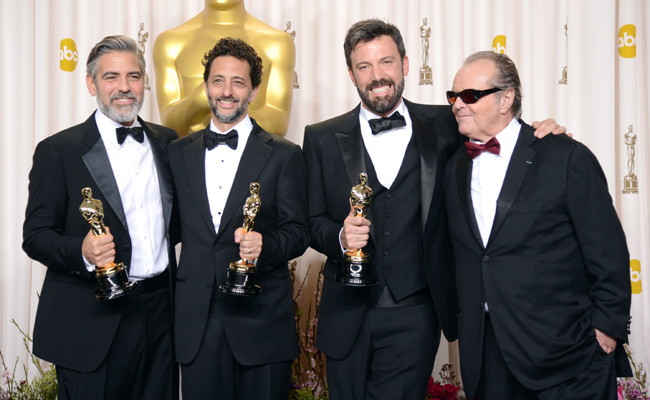
Visual entertainment has become such an integral part of our lives that we think it’s real.  And we get pissed off when we discoveroscar5 it isn’t and think we’ve been wantonly fooled.  We haven’t been.  Ben Affleck and George Clooney set out to make a “caper” movie.  They succeeded.  This isn’t the first time historical accuracy has taken a back seat to entertainment.  (If you want some serious grins, check out Billy Shakespeare’s Richard III.)  The folks in Hollywood might make a big show about how films are supposed to provoke thought and inform us, but in the end, it’s the same dog and pony show it’s always been — since les frères Lumiere first set up shop in Paris.  The critics can whine all they want about historically accuracy, but when you’ve got an Oscar in your hand, you aren’t going to listen.  The only cinematic mistake Ben and George made was choosing an event that was still part of our living memory.  Had they reached back a hundred years or more, the “ain’t it awful” crowd wouldn’t have had the information at their fingertips, and nobody would have said a word.

Bill Hickok and my BFF

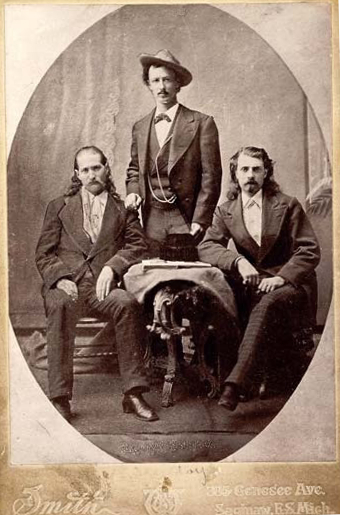
grouch1As you may have noticed, I spend a lot of time being grouchy in these pages.  It’s gotten so bad that a while ago one of my relatives said, “Hey, what’s the deal?  You’re not that crabby in real life.”  Actually, this is true — I’m not.  As Bill Hickok once said to Poker Jenny, “I am a man of comedy.”  (It should be noted that neither one of them saw the irony of the Navy Colt pistols stuck in Hickok’s sash.)  Unlike Hickok, though, I don’t have a quick temper.  Hickok did (which accounts for the pistols.)  However, like Wild Bill I enjoy my time.  I think the 21st century is tres cool, especially here in North America.  We live in a wonderful world   I might carp and bitch about it but that’s only ‘cause I’m worried we’re not going to “know what we got ‘til it’s gone.”

For example, right at this very moment (it’s after midnight) I can wheel on down to the local McDonald’s grab a couple of Happy Meals™ (Hey! Don’t forget my free toy!) come home and watch Dude! Where’s My Car? in HD.  Why?  Just because I want to.  This may sound frivolous because it is.  However (and this is the important bit) this is the very same society which will, if I choke on the extra pickles, send a couple of paramedics over to my house at top speed to save my life; with, I might add, enough time left over to watch Ashton Kutcher ride off into the sunset with… Demi Moore?  Not bad, considering there are some parts of this world where pickled anything is a luxury, Happy Meals™ are the stuff of legend, and the only time the paramedics show up is when the boys over at the UN finally get off their asses.  Life is good in our neighbourhood.

I don’t have enough time to list all the good stuff our society has on offer.  Nobody does; there’s far too much.  Suffice it to say that the operative word is benevolent.  Despite what out of power politicians and professional malcontent activigrouchsts tell you, our society is not the enemy.  In fact, it’s probably our best friend.  It allows us the freedom of choice to metaphorically indulge ourselves in Happy Meals™ any time of the day or night, and then, when they try to kill us at two o’clock in the morning, it comes running to the rescue.  We can be as fat, dumb and lazy as our minds and bodies will allow, squander our resources on techno-junk and even endlessly dis our social institutions – to their faces.  Our society doesn’t care.  It doesn’t get all pissed off and send in the jackboots like they do in other parts of the world.  It just keeps chugging away, fixing the street lights, repairing the sewers, trying to educate our young people and protecting us from ourselves and others who would do us harm.

I realize it’s a long way from this place to Utopia and our social, economic and political problems are multiplying faster than Norwegian rats in a New York sewer.  However, let’s be honest: what other time and place on this planet has what we’ve got?  For my money, our biggest problem is we’ve settled on the inconceivable (but very convenient) notion that society itself is the bogeyman.  We take all that we’ve built for ourselves for granted — as if it happened by accident.  We fail to understand that the institutions we ignore or malign, depending on our mood, are the very things which give us the time and leisure to do so.  But there I go being all grumpy again.  I suppose, like Hickok, Friend Cody, Texas Jack and the rest, I simply can’t abide a bunch of all-hat cowboys badmouthing my BFF.