
As we used to say, back in the day, this is going to blow your mind. We got lied to about evolution. Hold it! Before you let fly the anti-Christian fireworks, I didn’t say anything about a man in the sky who created the heaven and earth in six days and then took Sunday off to watch a ballgame. Nor did I mention Gaia, the Earth Mother, the Mighty Manitou nor Thor the Thunderer. I said we got lied to about evolution and we did.
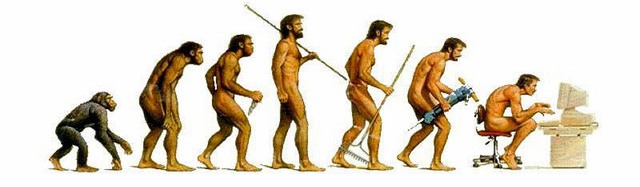 Everybody knows the story of Darwin. There are some people around who don’t believe it, but, in general, Darwin, like Freud and Nietzsche, is one of the good guys. The problem is what people actually know about Darwin’s Theory of Evolution and natural selection would fill a mouse’s ear. Most of our “common knowledge” is nothing more than hearsay. It runs like this: living species adapt to their environment and those who adapt best, survive and even thrive; those who don’t, end up gathering dust in a museum. While this is basically true, the underlying theme is this process is beneficial. Unfortunately, Darwin didn’t say anything about that. In fact, it probably never occurred to him. The whole “evolution is good for you” school of thought came from a pile of other Victorians, Edwardians and Nazis, who wanted to seal the deal on imperialism, once and for all. They thought that between the authority of God Almighty and Charles Darwin, they had all the bases covered. They could justify their right to govern the world as they pleased, exploit it to their hearts’ content, and tell anybody who didn’t like it to take a hike. The 19th century liberal education system we still live with today was slanted in that direction, so as Josef Goebbels might have said, if you tell a lie loud enough and long enough, people tend to believe it. Thus, pretty much anybody who has a reasonable opinion about evolution in this century will tell you, to quote Martha Stewart, “It’s a good thing.” Crap!
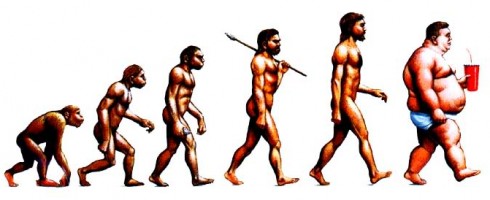 First of all, evolution does not come with a moral component. It is neither good nor bad– and mostly indifferent. Faster lions don’t get extra points for catching the gazelle – they get to eat. If they eat well, they get to mate and pass their “faster than a speeding ungulate” gene sequence on to their offspring, who begin the process again. On the same hand, speeding gazelles don’t get any extra points either, just for surviving. They get to spend a romantic afternoon with a fast female from the next herd, listening to the lions burping up Uncle Chester. Nature, in its wisdom, takes its course and the “faster than a hungry lion” gene is also passed along. The evolutionary race on this planet is never-ending; by definition, it’s evolving.
Second, Darwin’s theory only applies to a self-contained natural environment where “Faster! Higher! Stronger!” makes a difference. Once a foreign element is introduced into Darwin’s theory, all bets are off. Just ask the Dodo bird or the Passenger Pigeon. They were poster children for evolutionary success, except — oops, they’re all dead. Evolution comes to a screaming halt when faced with a speeding bullet, or any other man-made catastrophe. Darwin’s theory doesn’t cover “Smarter! Richer! Sneakier!” When faced with that, natural selection becomes nothing more than after-dinner conversation.
Of course, despite the lies we’ve been told about evolution, Darwin was right. The fellow who gets the lion’s share of the food and the females will naturally pass his genes on to the next generation. The problem is our species no longer relies on “Faster! Higher! Stronger!” for its success. Nor do we live in a self-contained natural environment anymore. Physical attributes might still work for lions and gazelles on the African veldt, but they’re not quite so handy for humans in London and Chicago. We are techno-termites who live stacked in sky-reaching urban conglomerates where food is hunted by credit card and females attracted by poetry and sports cars. The skills we needed to get this far on the evolution track are now useless. In fact, their intrinsic value, given the current human condition, is actually questionable.
 Meanwhile evolution doesn’t care. Good, bad or indifferent, it just keeps pumping away, rewarding the genes that survive and discarding the ones that don’t. The problem is the shotgun was never factored into the evolution of the Passenger Pigeon, and it’s doubtful that any of our astonishing technical accomplishments will figure prominently in ours. The very things that have made us the dominant species on this planet may not be rewarded by a benign universe. In fact, when we understand what Darwin was actually telling us, it looks as though our species might just be evolving itself out of business.



 WD Fyfe