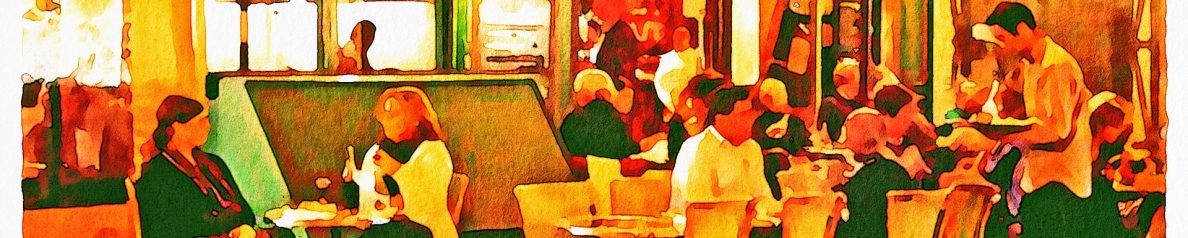
Autumn — Part 1

Photo — Carolyn Bourcier

Yesterday, I felt the smell of autumn in the air — like an unexpected someone from the past with time on her hands and memories to tell.  Because we remember autumn, she and I — fresh days and school books and sacred secrets so tender you could cut them with a glance.  Long afternoons dark with broken hearts and lingering poetry no one will ever read.  And she and autumn spoke as though the years were stored in cardboard boxes, dusty, glue-dried and sagging.  Then, at the end, she said she’d missed me and kissed me on the cheek in the glove-cold street of the autumn afternoon, because …

Autumn is the long notes of the last jazz piano when the café is closed and only the serious remain, sitting like abandoned angels unable to fly.  And there, somewhere in the final tales of lingering whiskey, they wonder if second-hand love could possibly redeem them.

Autumn is a park bench moist with morning, waiting like a reluctant traveller who’s been left behind.  And there’s a puddle, quiet with reflection and a footprint and floating leaves leftover from the wind.  And the worn letter plaque tells no one but the sky that Arthur Wilson liked to walk his dog.

Autumn is stone empty streets slanted with light from the windows of strangers.  But you keep walking because you don’t know if they’re warm with conversations, or silent with despair.

Autumn is a movie, old and familiar, when the outside night is bony and brittle and full of the dark.  So you pour the wine in the kitchen and break the chocolate onto a plate.  And you cozy into your one-light twilight and wait for the melancholy.

And autumn is a black-and-white San Fran foggy night, heavy with crime.  He’s turned his collar high so only his eyes can see her, standing in the silhouette shadows, sinister with deceit.  And he knows (because he always knows) that she will walk away, and the sound of her footsteps will be his only souvenir.

Definitions For Our Time!

Aside from fire and Velcro, language is the most useful tool humans have ever produced.  Once we went beyond grunting and growling, we were able to communicate complex ideas with a precision that made us the dominant species on this planet.  Unfortunately, these days we’re not playing nice with our words, and they’re losing their effectiveness.  We’ve taken to manipulating the language to try and give words extra meaning that they don’t deserve – and it’s failing miserably.  Here are a few contemporary words (we’ve all heard thousands of times – a day) that are supposed to carry a connotative punch – but they don’t – because we all know what they really mean.

1 — White Privilege – A bunch of privileged white people calling other white people “privileged” as if they did it on purpose just to be assholes.

2 — Twitter – A virtual stick that we beat people with until they agree not to disagree.

3 — Instagram – An historical record of just how culturally shallow we are in the 21st century.

4 – Facebook – Instagram for old people.

5 — Woke – “I live on a higher plane of consciousness than you do.”

6 — Virtue Signaling – This is how you know I live on a higher plane of consciousness than you do.

7 — Hate – Criticism you don’t like. “She said these jeans make me look fat.  She’s always been a hater!”

8 — Support – Criticism you do like.  “She said these jeans made me look curvy.  She’s always been supportive!”

9 — Brave – We’ve been using this word for everything from telling our daughters we’re gay to wearing pink chiffon, yoga pants and a hoodie.  Essentially, we’ve devalued the currency of this term so completely nobody even hears it anymore. (Remember what happened to “hero”?)

10 — Clicktivist – There is no IRL equivalent to this made-up cyberword.  The closest I can find is smug.

11 — Gluten Free – What we’ve been doing to safeguard our health — instead of finding a cure for cancer.

12 — Content Warning – The latest lame-ass attempt to keep the cybermob quiet.  We use it because — in the great tennis match between the eagerly offended and the immediately placated — the offended crowd upped the ante and declared that “trigger warning” itself was actually a trigger.  Go figure!

13 — Conversation – As in “We need to have a conversation about that.”  And it means: I’ll do the talking, and if you don’t shut up and agree, I’ll go Twitter (see Item #2) on your ass.  Not to be confused with “dialogue” which is too yesterday to be taken seriously.

14 — Issues – Problems that can’t possibly be solved.  A handy way to maintain perpetual victim status.

15 – Giving Back – The stuff rich people do when they are a) “woke” (see item #5) b) “virtue signaling (see item #6) and c) have some time on their hands.

16 – Awareness – Wasting time stating the obvious.  Does anybody know anybody who isn’t aware of inequality?

17 — Authentic – Social media sincerity that takes a ton of careful planning.

18 — Shaming – No, I’m not going to go there.

19 – Toxic – I don’t like this, and I’ve decided that nobody else should like it either.

And finally the one that demonstrates just exactly how easily the language can be manipulated:

20 – ‘Splaining – Add any prefix you want (man, age, size, eco, etc.) and you can get pissed off about it.

The Prankster And The Plural

english

Ever since I learned to read, English has been my renegade lover.  She is a rapiered pirate with a pistol in her belt and a stiletto on her sleeve.  She moves like a tango, cool-eyed and serious — the scent of the Trade Winds tangled in her hair and the salt of the sea still lingers on her lips.  But when she speaks you must listen carefully – her words are full of wit and unexpected – because she is a prankster, a trickster, a conjurer of jests that make her giggle and clap and crinkle her eyes.

“Would you like some more?” she says, the temptress not even hidden in her voice.
“It’s very easy,” she says, sly as the fox.
“All you have to do,” she says, looking away, “Is add an ‘S’ and you will have two, four, ten, even a thousand — if you like.”

And then you try it, and she has you trapped because it’s her game and she made the rules.

We all know the plural of house is houses, but what about mouse — cuz the plural ain’t mouses.  It’s mice, like lice is the plural of louse.  And it works the same way with a word such as noose.  Though the plural is nooses, you can’t do that with tooth, cuz more than one tooth is never called toothes. They’re teeth just like geese is the plural of goose.  Then it all goes to hell when there’s more than one moose!

But let’s get serious.  No, moose doesn’t get a plural.  Why?  Who knows?  But they’re like several other animals – sheep, swine, deer, bison, shrimp, etc.  One sheep, two sheep, ‘nother sheep, ‘nother sheep; it just doesn’t change.  It’s as if these particular animals were bad or something.  My theory is they pissed Noah off when they were late for the Ark, and he lobbed off their ‘S’ as punishment.  Either way, it’s clear: the “add an ‘S’ rule” doesn’t always work.  Especially since some singular words sound like plurals right from the beginning, and nobody bats an eye.  Look at scissors, pliers and binoculars.  They all get the extra ‘S’ before they even need it.  And some of those singular plurals start off as pairs.  Not like a pair of socks (which is two) but like a pair of pants — which is only one.  And I’m not even going to speculate how we arrived at a pair of pajamas.

Then there are other badass words that don’t care if they’re singular or not.  They just use the plural and strut around like a bunch of linguistic anarchists — words like criteria, media, data and our old favourite, graffiti.  This crew has been wrong for so long everybody thinks they’re right.

Plus there are some pretentious words that don’t bother with the ‘S’ and choose to use an ‘I’ instead because – OOWW! — they’re from the Latin, dontcha know!  These are words like fungus and focus and octopus and cactus.  Personally, I avoid these words because anyone who drops “foci” or “cacti” into a conversation might as well wear a sign that says “Pompous Ass.”  FYI: for all the other pompous asses in the neighbourhood, the plural of hippopotamus is NOT hippopotamiHippopotamus is a Greek word, so the Latin rules don’t apply.  On the other hand, the octopus (also a Greek word) is a smart little cephalopod and snuck into the Latin section when no one was looking.

And from here it just goes nuts.  It’s as if the English language got totally wasted one night on Jamaican rum and was dancing around, naming things.  The plural of dice is die.  The plural of thief is thieves.  The plural of aircraft is – heh, heh, heh – you don’t get one.  More than one child is children — figure that one out – although it happens again with ox and oxenMan becomes men and women don’t get a choice.  Then, just as she collapses on the sofa, laughing, she says, “Oh yeah!  And the plural of person is people.”

So, if you’re studying English as a second language and she’s sitting slumped in a chair with her boots on the table, cleaning her fingernails with a dagger — just do as you’re told!  It’s easier that way.