Are You Happy?

happy

One of the things I love about Americans is that, when they set up their government, they took the trouble to guarantee the right to life, liberty and (this is the best bit!) the pursuit of happiness.  They didn’t go nuts and say Americans have the unalienable right to BE happy; all they said was they have the legal right to try.  Not everybody does that.  For example, in my country, the government doesn’t give a damn if I’m happy or not.  They’re far more concerned that I keep my mouth shut when I’m pissed off.  Anyway, happiness is a relatively recent invention.  Before those good old boys from Virginia came along, survival was the biggie.  Singing in the sunshine and laughing every day took second place to making it through the winter, the war, the plague, the drought, the fire, the flood, the famine or any of the other 1,001 calamities that used to regularly wander by.  However, now that happiness is on the menu, everybody wants a slice, and nobody’s sure if their piece is quite big enough.  Here’s a quick and dirty guide to find out whether you are happy or not.

Do you own a rocking chair?  It’s scientifically proven that rocking chairs release enough endorphins to fill a room.  Add a sleeping baby or a cat on your lap and you’ll practically drown in the stuff.

Do you have a pet?  Dogs are better than cats: cats are better than fish: a platypus is the best, but even a well-loved houseplant will change you from a miserable self-centred bastard into a caring, sharing person of quality.  Thinking about something other than yourself will always make you a happy person.

Do you live west of the Vistula River?  For some reason, Europeans are happier than the rest of the world.  I don’t know why.  It must be the wine.

Do you have lunch money?  Money will not make you happy, but if you don’t have any — uh — you’re kinda screwed.  And constantly getting screwed will definitely make you grouchy.

Do you get earworms?  Ohrwurm in German.  (Those people have a word for everything.) These are those stupid songs that get stuck in your head and won’t go away.  Yeah, they’re annoying, but washing the dishes to “Barbie Girl” by Aqua isn’t all that bad.  My personal favourite is “All About The Bass.”  And, quite frankly, it’s impossible to be depressed if your brain is playing “Call Me, Maybe?”  (Are any of these in your head yet?)

Do you procrastinate?  The truth is procrastinators are cockeyed optimists.  They actually think that sometime in the future, they’re going to get their act together and clean out the closet or vacuum behind the refrigerator.  They probably won’t — but believing in a better future is one of the key components of happiness.  Therefore, procrastinators, by definition, are happy people.

Do you laugh at stuff that’s not supposed to be funny?  This is the stuff that catches you off guard and you giggle — even though you know you really shouldn’t.  Stuff that’s inappropriate.  Stuff that buttoned-down people might even find offensive.  Stuff that you really can’t repeat to anyone except your most trusted, trusted friend.  Here’s the deal: being silly in the face of all the pompous ass seriousness in our oversensitive world is a sure sign that you’re happy.

But I’ve saved the best for last:

Are you in love?  If you’re in love, you’re happy — full stop.  Unlike “relationships” that you have to “work at” so hard they eventually just turn into a total pain in the ass, love is the real meal deal.  If you look across the breakfast table and can’t think of any other place you’d rather be, then you’re in love.  And folks, if you do that often enough, you’re not pursuing happiness anymore: you’ve caught it.
 

May 68 (plus 50)

may 68 1

Fifty years ago is a long time: it sits in that twilight zone between living memory and history.  Old people can conjure it up — if they have to — but young people can only see it on YouTube.  And every year, the shadows those images cast get a little greyer, a little thinner and a little harder to recognize.

Fifty years ago (March 22, 1968) Daniel Cohn-Bendit and seven of his friends walked into the administration offices at the University of Nanterre in Paris and refused to leave.  Six weeks later, all hell broke loose!

May 1st, 1968 was the high-water mark of the 60s.  Television and the Tet Offensive had turned the world against the Vietnam War.  In America, that popular opinion was chasing Lyndon Johnson out of the White House, and when Bobby Kennedy announced he wanted to live there, it looked like the second coming of Camelot.  In Europe, Alexander Dubcek’s communist reforms in Czechoslovakia were cleverly outmaneuvering the Soviet Union in a warm and glorious Prague Spring.  Che had become the infallible martyr of the revolution, and Mao’s Red Guards hadn’t gone crazy yet.  The world was young and arrogant and optimistic and excited and on the verge of … nobody knew what … but it was Dany le Rouge and his buddies who lit the fuse.

The events of May 68 in Paris are well-documented.  Here’s the quick and dirty version.

On May 2nd, after a series of running battles between students and police, the French authorities closed the University of Nanterre.  On May 3rd, the students at The Sorbonne organized a sympathetic protest.  Somebody called the cops (les flics) who showed up and took charge.  On May 6th, 20,000 students (or more) marched on the Sorbonne to take back their university.  The police were waiting for them.  Shouts and threats, a push, an arrest, a bottle thrown and suddenly it was “Aux barricades!” and the war was on!

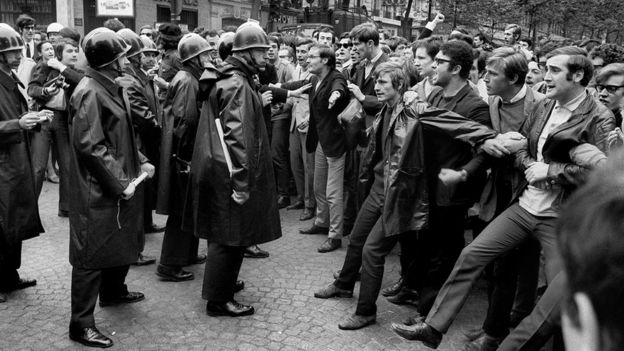
The narrow avenues of the Quartier Latin are ideal for urban conflict (In 1944, General Leclerc’s tanks carefully avoided the area) and the students took full advantage.  They blocked the streets with burning mattresses, furniture, trashcans and overturned cars.  They taunted the feared CRS riot police into chasing them and pelted them with rocks, bottles, flaming bags of dog merde and Molotov cocktails.  The cops responded with water cannons, teargas and bone-cracking batons to the head and groin.  Who controlled the streets?  The students or the police?  Night after night, the two sides battled it out in the alleys of the Rive Gauche.

On May 14th, workers at Renault in Rouen went out on strike in solidarity with the students.  Within a week, 100 factories were closed or occupied, and 10 million workers were on strike.  The government offered huge wage increases (35%) but the workers pushed their own leaders aside and refused to go back to work.  Many of them joined the students in the streets.  Shops closed, banks closed, even the ubiquitous Parisian cafes locked their doors.  Transportation ground to a halt, and government services ceased to exist.  France was on the verge of collapse.  On May 29th, worried that the mob might storm the Elysee Palace (shades of The Bastille in 1789) De Gaulle flew to a French military base in Germany to negotiate the loyalty of the army.  On the morning of May 30th, half a million people marched in the streets of Paris, chanting “Adieu, De Gaulle!”  That afternoon, De Gaulle addressed the nation.  Defiant as ever, his only concession to the seething chaos was to call an election — but he refused to resign, threatened to declare a State of Emergency, and hinted that the army was ready to march on Paris.  That night, a million people (or more) poured down the Champs-Elysees in support of the government.  They chanted “Vive La France!” and sang La Marseillaise.  The city, the country and French society were all divided neatly in two.  The next stop was civil war.

Luckily, it was the Communist Party leaders who blinked.  Painfully aware of the bloodbath that erupted the last time French troops entered the capital (Paris Commune 1871) and eager to take a chance on gaining real power in the coming election, they pulled their people off the streets.  A couple of days later, the student unions followed suit.  The cops backed off.  The crisis was over.

May 68 has entered the mythology of history.  Most historians will tell you that May 68 tossed the old order (which we’ve lately been calling ‘the greatest generation’) under the bus and brought about a seismic change to European society that eventually spread around the world.  I agree.  However, change is not, by definition, always beneficial.  Look around you!  In the 21st century, university students are content to click their dissatisfaction on Facebook, throw Twitter tantrums over cartoon characters and call each other “brave” and “awesome” for demanding “trigger warnings” on disagreeable discussions.  They’ve become just another demographic in the consumer society their grandparents desperately wanted to dismantle, and their only power is purchasing power.

And what ever happened to Daniel Cohn-Bendit (Dany le Rouge?)  He’s a pro-market, pro-European Euro MP, living large in Brussels — a minor company man of the political establishment.

But one other thing happened in France in 1968.  A politician was born and, these days, she’s having a bigger influence on the world than any of the soixante-huitards are.  Her name is Marine Le Pen . . . .

May Day (2018)

may day

I’m old enough to remember when May Day smelled of wool socks and carried a hammer.  The marchers wore clean clothes back then, carried red banners and were awkwardly polite.  Around the world, Brezhnev strutted his missiles and Castro raged volumes into the bright Caribbean sun.  In those days, “The Internationale” still had those goofy lyrics.  Yes, I’m older than Billy Bragg, but once, he and I — and maybe a hundred other people — stood stock-still and sang his new version of that old song.  Most of them had clenched fists.  This was in the way-back- time when communism still had a future and not just an imaginary past.

Those of us who grew up in the cause de jour 60s remember when communism went from industrial worker in a soft cloth hat and baggy pants to celebrity outlaw in camo-green and black beret.  Somewhere between the Gulf of Tonkin and the Tet Offensive, communism became cool again.  Academics sprouted beards and spouted doctrine.   Marx and Lenin fought it out with Trotsky and Mao in college pubs and coffee shops.  Workers marched, and students told them why.  Those were heady days: late-night basement meetings and manifestos.   Old, boot-faced men who had worked on the Dnieper dam or fought in Spain spoke in mildewed halls.  Grey-haired girls who had given their youth to the movement went first into the police barricades.  “They won’t hit me; I’m a grandmother!”  But they did.  And all the young, smooth-faced converts were eager to worship their newfound economic religion.  They were all together then.  Yet, with all the talk and more talk, the workers of the world never did unite under anything more than their national flags.  Communism was cool, but it wasn’t very effective.

May Day was special, though.  Ideological differences were put aside, and for one brief, shining moment, the workers did march shoulder to shoulder — their grievances with each other forgotten in the face of a common enemy.  Normally, they ended up at the old Cambie pub for a pint after the speeches were done.  Doctrine be damned: walking was thirsty work!  These were the folks who took the early bus, ate their lunch out of metal kits and bought sturdy shoes at the Army and Navy store.  Office staff and salespeople might get a three-day Labour Day long weekend in September, but May the First was the sore shoulder workers’ day, and they kept it sacred.

May Day, like much of the Western communist movement, came out of a combination of American action and European philosophy.  It commemorates the Haymarket Massacre in Chicago in 1886.  During a labour demonstration, everything went horribly wrong when somebody (who has remained nameless to this day) tossed a bomb at the police.  The cops opened fire.  Several people were killed, and there have been serious accusations ever since.  Three years later, at the Second International in Paris, the French delegation read a letter from Samuel Gompers.  (Sam was the head honcho of the newly-formed American Federation of Labor.)  It outlined American Labour’s plans to organize rallies and marches for the third anniversary of the massacre.  The French proposed that on May 1st, European workers march in solidarity with their American brothers (Sisters didn’t really count yet.)  The motion was passed, and organized labour has been taking to the streets on the first day of May ever since.  Actually, May Day is an official holiday in over 80 countries.

In the 21st century, May Day, like communism, has fallen on hard times.  There are still the big rallies in all the European capitals.  But Moscow doesn’t parade their missiles through Red Square anymore, and Fidel is gone.  God only knows what the workers in Pyongyang have been forced to do, and whatever happened in Beijing … well… that’s just false advertising, isn’t it?

In North America, May Day has always been more about organized labour than labour itself.  Union members come out to listen to their nabobs try their best to resurrect the 19th century, when the battle lines were clearly drawn.  However, it’s getting harder and harder for union leaders to convince the rest of us that organized labour is in a life-and-death struggle with capitalist greed.  These days, union dues buy sports franchises, and pension plans are used to fund hotels and tourist destinations.  Organized labour carries stock portfolios worthy of JP Morgan Chase and BNP Paribas.

May Day has come a long way from the Haymarket in Chicago, and so has communism.  Both were born as a downtrodden backlash against the Industrial Revolution; both rose to become an emblematic certainty of a better future, and both have faded away as their usefulness declined.  A few people still march, but they will be carrying Smart phones, not lunch buckets.  Their brand-name jeans will be made in Asia, and when it’s over, they’ll drive away in Toyotas and Kias.  It isn’t Animal Farm yet, but it’s getting pretty close.

_______________________________

Originally written in 2012 with a few minor edits.