Friday the 13th: A Silly Superstition

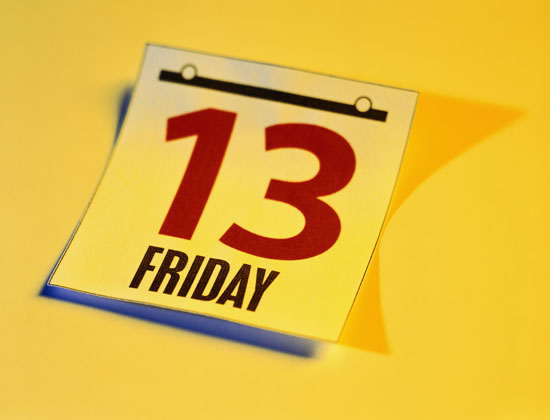
Today is Friday the 13th, and even though I’m the last person in the world to willingly tempt the Fates, it’s my duty to set the record straight.  There is no room for superstitions in our modern society.  Science and technology have banished them from our world and driven them out into the limitless ethereal — where they frolic with dragons, trolls, banshees and goblins for all eternity.   Luck, good or bad, is nothing more than a random set of circumstances.  The gods do not control our lives (frankly, they’re not interested) and haphazard actions do not set the tone for the rest of the day, week or year.  This is fact; let me demonstrate.

If you’re living on a farm near Memphis, Tennessee right now, you’re probably experiencing a run of bad luck.  The Mississippi River has decided your farm needs to be moved to the Gulf of Mexico and there’s not a whole lot you can do about it.  I don’t care how many pennies you found and retrieved, how many rabbit’s feet you have on your key ring or how many times you didn’t walk underneath that ladder, your luck isn’t going to change in the near future.  Conversely, if your name is Mark Zuckerberg, you could hire an army of black cats to cross your path and never worry about it.  You could spill salt, leave your umbrella open in the hall and break the mirror on the Hubble telescope — all in the same day, if you want — and it wouldn’t matter.  You’re likely the luckiest guy on the planet.  Point proven: case closed.

I think all reasonable people can agree that superstitions are absurd, and our lives are not governed by foolish folklore and old wives’ tales.  There are strict physical laws in our universe that can be tested and proven.  These laws were set down by the gods and Mother Nature in a time before time and they (and they alone) dictate the scope and skein of our lives.  All the rest of it is just silly hocus-pocus, left over from a time when primitive humans did not have the extensive knowledge that we have today.  This, too, is fact; let me demonstrate.

You should never hang a new calendar before January 1st.  This angers the gods and they will visit their displeasure upon you for the entire year.  It’s best to leave the new calendar in its original package until after breakfast on the morning of January 1st; then, hang it, when you’re safely into the New Year.  This is prudent behaviour, handed down through the generations, learned and tested many times through the millennia.

Likewise, you should never propose or drink a toast in water.  The gods demand that offerings to them should be made with strong spirits.  Anything less shows disdain for their power.  The gods will not look kindly on your invocation if you don’t treat them properly (quite rightly) and, depending on how pissed off they get, they could actually reverse your plea.  “To your health” could become a very dangerous proposition, indeed. 

Furthermore, never, under any circumstances, step on a spider.  Mother Nature will not tolerate this.  She will make it rain.  And not some wimpy April-showers-bring-May-flowers rain, either; she will literally kick your ass with water.  I’m not saying, and I don’t know who, but take a look at Manitoba and tell me somebody didn’t screw up on the arachnid front.  The current state of the Canadian prairies is tangible evidence that the laws of the universe must be adhered to.

Most importantly, don’t be smug.  The gods particularly hate smug people.  For example, Tiger Woods thought he could get away with it, didn’t he?  The guy hasn’t made a decent putt since Elin hit the wrong button on his cell phone and heard what’s-her-name leaving him bimbo-mail.  Similarly, Mel Gibson hasn’t made a respectable movie since Payback in 1999.  And Donald Trump, the definition of smug, has been saddled with that hairdo since before he was famous.  The list is almost endless.  The toe-sucked ex-duchess of something, Sarah Ferguson, wasn’t invited to the Royal wedding, was she?  So be careful, the gods hate smug so thoroughly that even an idle word can rain havoc down upon you.  The only way to try and reverse a random act of smuggery is to immediately touch wood and call upon the fox, cleverest of the supernatural animals, to help trick the gods.  Maybe, just maybe, it might work, but for safety’s sake it’s best to remain humble.

Finally, the gods love sports and fair play.  Nothing pleases them more than to see athletes and fans brandishing totems or following rituals to beseech their favour.  The gods will reward the faithful and punish the transgressors ruthlessly.  There is no other realm of human endeavour that so clearly shows the delicate and detailed balance of the universe, or the benevolent power of the gods.  The New York Yankees are living proof.  They win because the gods smile upon them — and their fans.  I, myself, have an old and ratty Yankees’ t-shirt which I wear during the playoffs to honour the Baseball gods.  This is not some childish “lucky charm” but a strong talisman that insures continued success.  On the other hand, the gods hate the Red Sox.  This is a known fact.  They also hate the Dallas Cowboys, the Detroit Pistons and Kobe Bryant.  However, they reserve their special, nasty junkyard-dog-hate for the Toronto Maple Leafs who they have cursed, for all eternity, for being smug.  These are all facts.

So let’s forget about all these ridiculous superstitions – black cats and broken mirrors?  As we have seen there is overwhelming evidence that the universe is controlled by real physical laws, not fairytales and folklore.  And the gods do not interfere in our lives unless you make them angry.  With that in mind and a reasonable amount of caution, you should pass a pleasant Friday the 13th and wake up Saturday, happy and unscathed.

“Funky”: Kiss of Death and Yuppies in the ‘Hood

There are few words in the English language that carry the destructive power of “funky.”  Way back in the day, “funky” (or “funk” as it was called then) was a musical term.  It was urban black.  It was loose.  It was uncontrolled and it was cool.  It meant something, although most people couldn’t describe it; they just knew it when they heard it.  So much for the history lesson.  Today, funky is the kiss of death.

In every city in North America, there are brilliant little neighbourhoods.  They exist on the fringes of the bigger, more famous areas.  They’re middle ground territory, neither rich nor poor and mostly overlooked in the urban sprawl.  They have houses and apartments, restaurants and shops.  Sometimes they have schools or a theatre or maybe a gas station, but definitely a couple of corner stores and at least one old-fashioned cafe.  These are great little places and people live there — all kinds of people — grandmas and students, bosses, workers, the guy who owns the bakery, Jamal, Eddie and Suzanne.  They’re not some 50s wonderland, filled with Andy of Mayberry characters, but enough local people know each other, or recognize the guy across the street, to make them real neighbourhoods.  They’re what urban planners dream about.

These neighbourhoods go unnoticed for years.   They go about their business and never bother anybody.  Then, one day, somebody wanders by (sometimes it’s a real estate agent, sometimes it’s a journalist, sometimes it’s just somebody with a big mouth) and calls them “funky.”  As in: “3 bdrm, TLC, close to transport, all amenities, funky old-world charm” or “My companion and I dined on authentic Portuguese squid, with plenty of funky atmosphere, for half the price of an expensive downtown restaurant.”  These people think “funky” is a term of endearment.  It‘s not; it’s a death sentence.  It’s a neighbourhood killer because, in actual fact, “funky” is a polite word for gentrification.  It represents the time period between when the first upwardly mobile couple moves in and the last original inhabitant is driven out. 

There are any number of ways for this to happen, but they all basically follow the same pattern.  Brooke and Meghan* buy a house in an area that’s less than ideal, maybe even a little rundown, because they can’t afford the big prices in the tonier parts of town.  They make up for their shabby address by putting on the brag about how great their neighbourhood is.  How urban cool it is.  How it just reeks of diversity.  How Bratislav cuts his own cheese and Nahoud bakes his own biscotti.  In short, how “funky” it is.  Eventually the word gets around: that it’s not such a comedown to live east of Main Street or south of Central, and other people start buying inexpensive addresses.

Any wave in the real estate market, however small, is battle stations red alert for property developers.  They’ve long since figured out that there’s a boatload more money to be made selling thirty brand-new condos, sitting on top of four retail outlets, than there is reselling four single-family homes.  They buy the lots, tear down the houses, vertically sub-divide and parcel it all out as urban living.

In turn, concentrated population increases attract the big boy franchisers — like throwing blood into the shark bait waters off the coast of Australia.  If there be condos; there be McDonald’s, 7-11 and Starbucks.  There might not be a WalMart (urban professionals don’t like them) but at this point, it doesn’t matter.  Wai Chow’s Golden Chopstick or Bayview Meats can’t compete with Earl’s, East Side Mario’s or Flying Wedge.  These people are willing to sign long leases for big money, and local shopkeepers just don’t have that kind of coin.  They’re forced to close and the cycle continues.

Back in “the hood,” Brooke and Meghan, those two crazy kids who started the whole process, aren’t helping matters much.  They aren’t actually living in the neighbourhood.  They might physically be there, but so what?  They don’t work there.  Their kids don’t go to school there.  They don’t ride the bus or shop on their way home.  In fact, they never consistently patronize the local merchants, at all.  They drive in and out of the neighbourhood every day for months, perhaps years, basically waiting for their generic world to catch up to them.  Their furniture is Ikea, their home renovations are Home Depot, their toilet paper is Costco and their gadgets are Future Shop.  When the bakery and the drugstore close, they play “ain’t it awful,” but it never occurs to them that they are the ones who don’t buy doughnuts or have their prescriptions filled.  And as every new Brooke and Meghan move into the neighbourhood, the problem accelerates.  Local merchants can’t pay their ever-expanding rents or taxes on an ever-decreasing customer base, and the developers pick them off, one by one.  At this point, Brooke and Meghan discover the new Starbucks or whatever and start actually hanging around, meanwhile, telling everybody they and their neighbourhood (it’s become their neighbourhood now) are uber-cool.  More people move in; more people move out.  Years pass, life goes on and the city digests the remnants of what was once a nice, vibrant place to live.  More corporations; less local ownership. Civic officials shake their heads and wonder what the hell went wrong.  They consult city planners and urban geographers to see how to artificially create socially and economically mixed neighbourhoods.  They fail.

 Just a bit of advice: if anybody calls your neighbourhood “funky,” run!  It’s a trap.

*Brooke and Meghan’s names have been changed to protect the guilty.

Unexplained Laws of the Universe

Certain laws govern our universe: nature abhors a vacuum, two bodies can’t occupy the same space at the same time, and, of course, the most famous, Murphy’s Law: anything that can go wrong, will go wrong.  These are physical truths that simply can’t be changed by our modern science.  In other words, we have to live with them.  However, there are also a whole pile of things whose sole purpose is to frustrate us and drive us crazy.  These are the things that work the way they do, even though there’s no reason why they should.  I’m not talking about all those funny things that kids wonder about on a stoned Thursday afternoon.  Why doesn’t glue stick to the inside of the bottle?  How come they make cars that can go twice as fast as the legal limit?  Why don’t psychics ever win the lottery?  I mean real stuff that always seems to happen for no apparent reason — what I call The Laws of Consistency.

For example, there is the Law of the Line.  When you go to McDonald’s (or any other fast food place, for that matter) the menu is always above the counter, right there in front of you.  It’s big, it’s bold, it’s backlit and it’s got pictures.  It’s been there since the first McDonald’s opened in Illinois in 1955. Yet, somehow, when you’re standing there waiting, the guy in front of you acts like he’s never seen it before in his life.  Of the billions and billions served at McDonald’s in the last half century, he’s not one of them – nor are any of his friends.  It’s like they’ve all come from an Amish Colony in darkest Sumatra and this is the first time they haven’t had to grow their own food.  They’re overwhelmed with the possibility of meat and absolutely baffled by pickles.

The Law of the Line is a constant.  The same thing happens at the ATM.  The day you have 12 cents in your pocket and 30 minutes for lunch, the woman in front of you is trying to teach her four year old how to electronically renegotiate the mortgage.  Again, at the grocery store, the person ahead of you always argues about the price of beans or better still, buys two items, neither of which has the barcode.  At Starbucks, the person at the counter wants the strangest concoction known to humans — which usually involves double grinding the beans and airlifting vanilla in from the wilds of Jalisco, Mexico.  And don’t even worry about government offices or Motor Vehicles because every single person standing there has at least two DUI’s and is about to license some home-made contraption held together entirely by duct tape.  The only time the Law of the Line doesn’t work is when you’ve got a four-and-a-half-hour layover on a Sunday afternoon at the airport in Provo, Utah.  The one day there’s nothing to do and you couldn’t kill time with a shotgun.

Then, we have the Law of the Price.  The Law of the Price is insidious and constant only by virtue of its inconsistency.  It works like this.  The thing you want to buy never goes on sale.  The thing that is on sale is kinda close, but not really.  It’s the wrong colour, or the wrong height, or doesn’t quite match or doesn’t really do the thing you want it to do – but it’s cheap.  So you’re standing in the store with the thing you don’t want to buy, that’s cheap, and looking at the thing you do want to buy, which costs twice as much. Now, you’re screwed.  If you buy the thing you don’t want — on sale — you’ve spent the money, you’ve got something you don’t really want and you’re never coming back to buy the thing you really wanted in the first place.  On the other hand, if you buy the thing you really want, you’re going to spend a potful of money you don’t want to spend.  Either way, you’re not going to get the thing you want for the price you want to pay.  It just doesn’t happen that way.

Even if, by some miracle, the thing you want to buy actually does go on sale, it’s never a good sale.  The sale price is still more than you want to spend — but not by much – just enough to make you think about it.  Then, when you finally decide to bite the bullet and buy the thing you want to buy, there’s always some little extra crap you need to make it work properly — things like cables or covers or batteries, or gloves or a scarf.  These things never cost that much individually and you need them, so you buy them.  Suddenly, a relatively expensive but affordable purchase is, with tax, 200 bucks over budget, the store guy’s writing it up and you’re looking at Kraft Dinner for the next month. 

There are all kinds of other Laws of Consistency.  There’s the Law of Las Vegas: everybody wins money in Vegas but you.  There’s the Law of the Second-Hand Deal:  anything you buy second-hand breaks within three weeks – guaranteed.  The Law of the Computer Triumph: the computer you just bought yesterday is magically obsolete the minute it comes out of the box.  It goes on and on, and I don’t think I even have to mention the Law of Auto Repair.

These are consistent laws of the universe, and there’s no reason they exist; science can’t explain them, religion can’t ease their pain and no human institution can stand up against their unholy power.  They have no basis in physical reality, but we’ve all been there/done that.  So the next time you lose a filling and discover that your dentist is having a baby and her replacement looks like the villain from a Nazi movie, remember it’s not your fault; it’s just a law of the universe.