
 Even though the 24-hour news cycle for the Oscars is over, a lot of movie critics still linger in the air like yesterday’s corned beef and cabbage. They’re all busy grousing about Argo, the most brazen work of fictional non-fiction since James Frey fooled Oprah Winfrey – twice — on international TV. Argo won Best Picture and scribblers from Tehran to Toronto are suddenly shocked and appalled at Hollywood’s libelous treatment of history. Now, they’re wearing out Google trying to prove stuff like Robin Hood didn’t look the least bit like Kevin Costner (or, for that matter, Errol Flynn.) Even the mighty Spielberg has been taken to task over “inaccuracies” in his “tell me how much you loved my movie,” Lincoln. So far, the critics have discovered that America didn’t single-handedly win the war (any of them) Mel Gibson didn’t either and Krakatoa is not actually east of Java. They’re spouting this stuff as if they’ve found the forbidden Bush files on the alien landing east (or was it west?) of Crawford, Texas. Unfortunately, in all their fact-checking, they’re actually ignoring the single most important fact. It doesn’t matter. Movies are make-believe.
I realize that most people get their grip-of-steel grasp on history through the movies; after all, it’s not like anybody’s picked up a book in the last few decades. However, I think it’s unreasonable to demand — or even expect — anything more than a modicum of historical accuracy from people whose single avowed purpose on this planet is to entertain us. History is not boring (even though most high school teachers dedicate themselves to making it so.) However, there really isn’t much entertainment value in the bubonic plague, for example, or the siege of Sevastopol or a thousand and one other historical events. Unless you’re a connoisseur, these are not exactly page-turners. Besides, I defy even the most accomplished historian to comprehensively explain these events to a room full of strangers, sitting in the dark, in less time than it takes to cook a rump roast. And movie makers are not accomplished historians.
The problem is, history, already written, isn’t tidy. It doesn’t have a beginning, middle and an end. Like unruly hair, it has clumps that won’t lie down right, parts that aren’t straight, strands that refuse the comb — and it’s forever getting blown around by the current political wind. For example, in 1943, Lillian Hellman was convinced by the American government to write a pro-Russian propaganda screenplay for the movie North Star. Then, in the 50s, she was hauled before the congressional witch hunting HUAC to explain her sympathetic portrayal of the Soviet Union. Go figure!
The other thing we need to remember is that filmmakers, even the documentary kind, do not set out to tell a story; they set out to tell their story. There’s a difference. If you look hard enough, you can find at least three distinct interpretations of any historical event. The folks who make movies can use only one at a time. That’s not to say that they necessarily have to distort the facts to accommodate the tale they choose to tell, but, in every case, they have to distribute them unevenly. That’s the nature of filmmaking.
Visual entertainment has become such an integral part of our lives that we think it’s real. And we get pissed off when we discover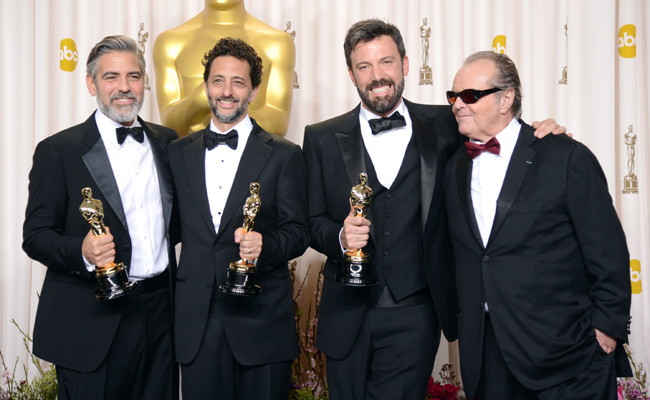 it isn’t and think we’ve been wantonly fooled. We haven’t been. Ben Affleck and George Clooney set out to make a “caper” movie. They succeeded. This isn’t the first time historical accuracy has taken a back seat to entertainment. (If you want some serious grins, check out Billy Shakespeare’s Richard III.) The folks in Hollywood might make a big show about how films are supposed to provoke thought and inform us, but in the end, it’s the same dog and pony show it’s always been — since les frères Lumiere first set up shop in Paris. The critics can whine all they want about historically accuracy, but when you’ve got an Oscar in your hand, you aren’t going to listen. The only cinematic mistake Ben and George made was choosing an event that was still part of our living memory. Had they reached back a hundred years or more, the “ain’t it awful” crowd wouldn’t have had the information at their fingertips, and nobody would have said a word.


 WD Fyfe