Big Word Day

big-wordWhat this planet needs is Big Word Day.  One day a month (I suggest the first Monday) when we’re allowed to use those big godawful words that make us all sound like pompous asses.  Then, at midnight, everybody has to go back to talking (and writing) like regular people.  Big Word Day would not only clear the air of pretentious language, it would shorten business meetings, reduce government bullshit and keep corporations from drowning us in doublespeak policies, warranties, guarantees and disclaimers.  (What’s the difference between a warranty and a guarantee, anyway?)  I know big words are tempting and I’m as guilty as the next person, so I understand why we like to sound as if we just stepped off Oxford Common — but it’s getting out of hand.  We don’t buy things anymore; we purchase them.  We don’t help; we facilitate.  We don’t think; we conceptualize. And — horror upon horrors — we don’t talk; we verbalize.

The big problem with big words is people don’t think that way.  We think in broad abstractions that get translated into words when we speak (or write) so we can communicate meaning.  For example, when I write “John saw a girl” unless you’re a Himalayan holy man who’s lived alone in a cave for 50 years, you see the girl, too.  Your girl and John’s girl might not look the same, but the meaning is clear.  This is because my words are a direct translation of my thoughts.  However, when I write, “John observed a girl” things get a little muddled.  Suddenly, because of nuance and connotation, John isn’t passive anymore.  The girl is still the object of the sentence but John is definitely more involved.  He’s deliberately doing something.  Hey!  Wait a minute!  Who is this guy?  What is he, some kind of stalker?  You see, the meaning has changed.  This might be a bit of an exaggeration (after all, I haven’t clarified whether John had binoculars or not) but my point is it’s more difficult to translate words into meaning when they’re carrying extra baggage.  And big words all carry tons of baggage.

Don’t get me wrong; big words are important.  English is a precise language with surgical accuracy, so I don’t want to get rid of big words altogether.  I just think, these days, they’ve slipped the leash and I want to corner them and get them under control again.  Big Word Day would do that.  It would force us to quit utilizing big words all the time and only use them when they’re necessary.  Plus, and this is the good bit, jerks with an intellectual chip on their shoulders would have to shut the hell up most of the time — and that alone would be worth it.
My Sisters Were Wizards

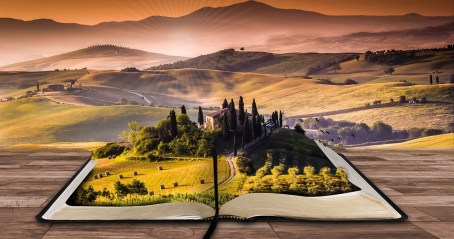
When I was a kid, my sisters were wizards.  They had magic words that could turn a pillow-high, cozy warm brass bed into the March family living room.  They had incantations that produced beautiful horses, stinking French sewers and one sad little dog named Greyfriars Bobby.  They could conjure people and places at will, and on one occasion, they harnessed the wind from a stay-home-from-school bitter Saskatchewan storm to propel our ships out of danger.  They cast spells that bewitched me so completely that, long before I was allowed to cross the street by myself, I could travel through the puny barriers of time and space with ease.  And it was there that my sisters abracadabra-ed their friends for me — Black Beauty, Travis and his dog Yeller, Hans Brinker and the queen of long, lazy summer afternoons, Nancy Drew.

sisters1

The source of my sisters’ sorcery was the Mayfair Public Library.  It was a cavernous basement with high little citadel windows and dim, humming electric light.  It was a place of holy quiet, brown with wisdom and heavy with wooden shelves.  It was guarded by ferocious matrons in sensible shoes.  They kept their eyes on little boys who might be loud — or sticky — but, by then, I knew how powerful and precious books were, so I sat quietly and kept my eye on them.  I remember thinking, “I’m a little boy now, but someday… someday, I will decipher your runes and, like Lochinvar,* I’ll come and I’ll take what I want and know your magic for myself.”  I knew I would do this.  I knew it because my sisters were never jealous witches, concealing their art.  Tired of me pestering them to read to me, they were already showing me that the tiny symbols in the books made sounds and the sounds made words — and the words, taken together, made power.

Today I am a wizard.  I have spent a lifetime studying the alchemy of words — reading and writing them.  I still smile when they are used well in delightful new combinations and still cry when they are abused.  I will never tire of their wonder.  I do this because once upon a time, in a time that doesn’t exist anymore, five magical sisters loved their little brother so much they taught him how to read.

*My sisters knew Lochinvar personally and, two years in a row, two different sisters memorized his adventures — so I did, as well.   Even now, I still have a stanza or two.

8 Reasons Why I Love The French

franceLast weekend, Kim Kardashian was robbed — at gunpoint — in Paris.  What an unfortunate situation!

Here are 8 reasons why I love the French.

Food — The French do food the way the Russians do paranoid — it’s in their DNA, and they’re good at it.  They can detect the perfect onion at 10 kilometres and can toss a salad with their mind.  Their touch ripens fruit, and animals beg to be cooked in French kitchens.  In France, making kids eat their vegetables is a reward, not a punishment.  And you could run Texas mud through any French restaurant and come out the other side with a gourmet meal.

Women — French women are conspicuously sexy.  I suppose the men are, too, but from my side of the sexual equation, I don’t care.  And that’s the point: French women don’t care.  They’re totally comfortable with their sexuality, sensuality and all their other alities.  They don’t flirt; they don’t vamp; they don’t tease.  They just stand there and dare you to take them to bed.  Think of it this way: the French are the only nationality who has a kiss named after them.

Politics — French politics is played in that magical place where Downton Abbey meets Game of Thrones.  For example, the current Minister of Ecology is the ex-partner of the current President of the Republic. (They had 30 years and four children together, but thought marriage was too bourgeois.)  They became exes (just before an election where she ran for president) when she tossed him because he was having an affair with a journalist.  Since then, he become president, dumped the journalist and is currently having an affair with an actress.  Donald Trump and Hillary Clinton are a bedtime story in comparison.  And I haven’t even mentioned Jacques Chirac, Nicolas Sarkozy, Madame Le Pen or her niece.

The French don’t have issues; they have wine — I suspect that the French are just as neurotic as the rest of us, but you’d never know it.  Their idea of therapy is “un verre de vin rouge” and if things get really rough, it’s “la bouteille, s’il vous plait.”

All the cool words we stole from them — savoir faire, esprit de corps, nouveau riche, menage a trois, forte, c’est la vie, bon vivant, de rigueur, beau geste, chic — and on and on and on.  These words are perfect and mean so much more than their translation.  That’s why we stole them.

Cartoons — French cartoonists are the last bastion of free thought on this planet.  They don’t give a donkey’s derriere about politically correct, and that’s the way it should be.  It’s called satire and French cartoonists practice it as a full contact sport.  They believe that if they don’t offend at least one person every day, they’re not doing their job.

Waiters — They’re not “servers” in France and don’t pretend to be.  Treat a French waiter properly and he/she will open up a whole world of delicious for you; piss them off, and you’re in for a long evening.  I was once in a restaurant in Paris and asked the waiter if I could have the steak medium.  He politely took the menu back and told me to go somewhere else.

Paris can’t be explained.