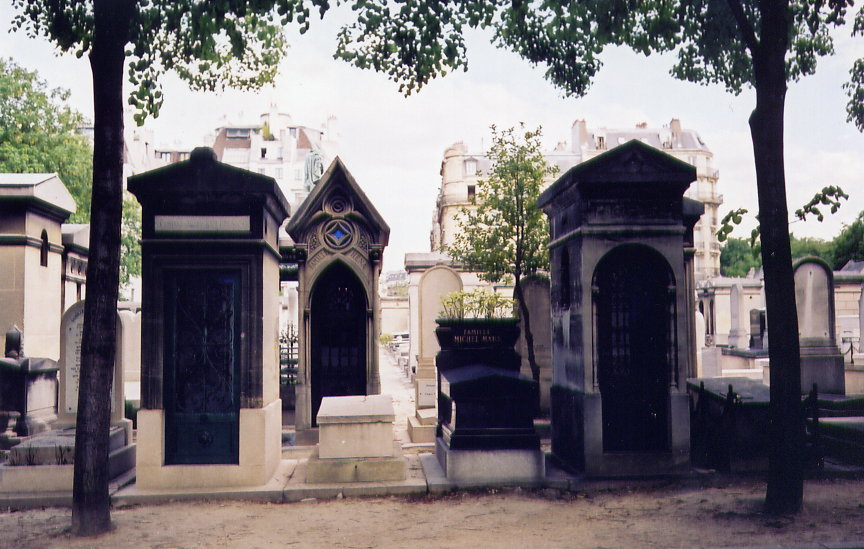
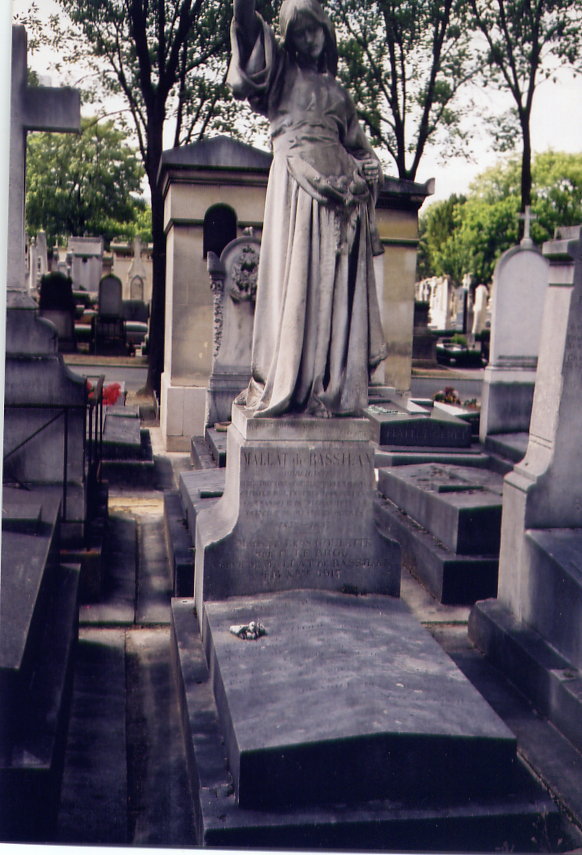
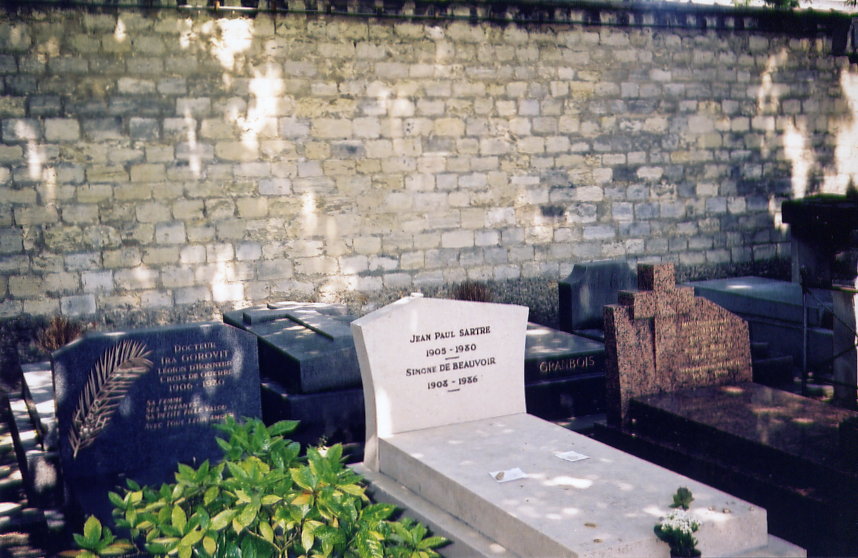
Montparnasse Cemetary
–
–
–
–
Montparnasse Cemetary
–
–
–
–
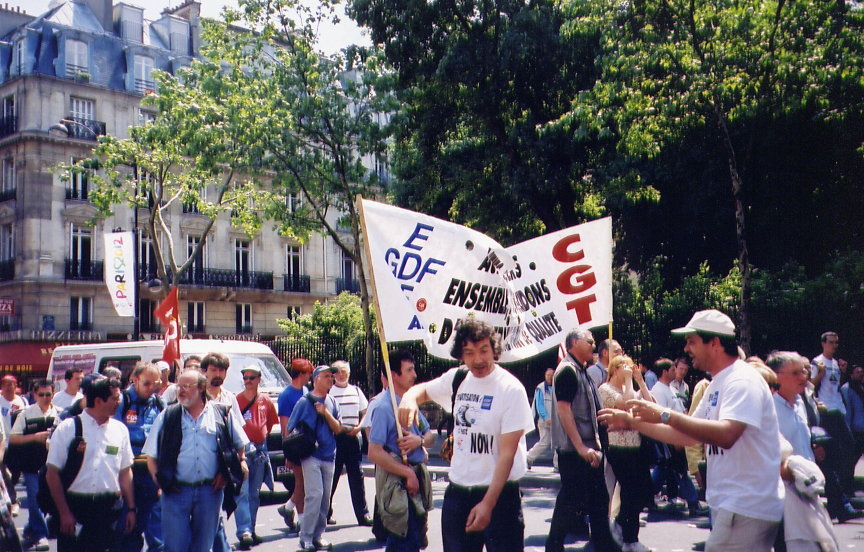 Today, we’re going to the graveyard to pay our respects to Baudelaire. It’s a long way from the river, but we’re going to walk. The best way to see any city — especially Paris — is to hoof it. For one thing you’re never too far from a friendly bistro and medicinal wine. For another, unlike North American towns, Paris is an outdoor kinda place. Parisians take to the streets at any provocation. They’ve been doing it for years, and they’re good at it. Civil disobedience has been a Parisian pastime since Marie Antoinette decided to introduce the peasants to Betty Crocker. In fact, the reason Paris has such wide beautiful boulevards is Napoleon III (the real Napoleon’s nephew) didn’t want to find out how good Parisians were at controlling the streets. Napoleon hired a guy named Haussmann (BTW, he was never actually a baron) who redesigned most of Paris so a paranoid Emperor could get his troops from one neighbourhood to another faster than the locals could shout “Aux barricades!” Monsieur Haussmann succeeded beyond anybody’s wildest expectations. In the 1860s, he pulled down half the city. This was before urban development had a name, so the only pause in Haussmann’s destruction/construction plan was the time it took for him to tell the residents to move. Literally thousands of families were turned out into the streets which Haussmann immediately demolished. In a few years, Paris, the medieval market town, was gone, and Paris the modern European capital you see today, had been built. You can still get a feel for the old Paris, though, on the Left Bank close to the river in the Latin Quarter. The streets there are still narrow, dark and winding. There are even a few places where you can find the old cobblestones.
Ironically, Napoleon III never got to enjoy the city he created. He was deposed when the citizens of Paris decided their Emperor had lost one too many wars and took to the streets in 1870. Apparently, broad boulevards work just a well for angry mobs as they do for soldiers.
 Sitting in Le Jardin du Luxembourg in the early afternoon, eating ham and cheese, you’d never know there was an economic war going on. The clouds are puffy, the air is clean and nobody cares whether the Euro is going to survive the summer. Politics in France is never played in the sunshine; it’s an evening entertainment. It rattles on into the late night with red wine and the last of yesterday’s cheese. Only students, a couple of streets away at the Sorbonne, can indulge themselves in the afternoons. Unlike me, they’re interested in the Euro today, probably because they’ve seen the Eiffel Tower plenty of times and it doesn’t fascinate them anymore.
I still can’t imagine how Eiffel thought it up, never mind built it. Yesterday, I was told if you stand just so and look just right, you can see the Tower and the box it came in. So I stood just right and looked just so and couldn’t see anything more than three French waiters laughing themselves stupid. Finally, one of them took pity on a serious tourist, said, “Montparnasse!” and pointed to Pompidou’s black erection on the left. (I think they’ve pulled this joke more than once.)
Most Parisians I’ve talked to (which isn’t many) don’t like Tour Montparnasse. They say it’s too black, too tall it’s just too there all the time. The other running joke is that it has the best view in Paris because when you look out from the 59th floor, it’s the only place in the whole city where you can’t see the damn thing. Interesting, but I like Montparnasse, and I think Parisians should give it a chance. Besides, I know something most people don’t. The Eiffel Tower was built for the 1889 World Exposition; however, back in the 1880s, when the city of Paris was planning the big event, one of the stipulations they made was that all structures built for the Exposition had to be easily dismantled — including Eiffel’s Tower. It was given a twenty year permit and was scheduled to be demolished and turned into scrap in 1909. That’s why the entire tower is bolted together.
The Montparnasse Tower isn’t anywhere near as iconic as Tour Eiffel, but maybe in a hundred years waiters won’t be making jokes about it. From the way those guys were laughing, though, I doubt it.
 WD Fyfe