
 There’s been a lot of talk lately about right and wrong. This is totally odd, because most people are uncomfortable with the concept. It makes them uneasy, as if something rude just happened. They would prefer to look the other way or wander off. When the topic is unavoidable, they tend to dance around it or cleverly disguise it, calling it ethics or morals or some other such euphemism. It’s as if they’re desperately hoping parlour game philosophy will make it go away.
There is no place in our society for right and wrong anymore. It’s like those old, heavy TVs nobody wants. They work perfectly well, but most people wouldn’t be caught dead with one in their living room. It’s not our fault, though; the essence of right and wrong demands a judgement call. Someone has to be wr-wr-wr not right. Unfortunately, we’ve been taught from the cradle not to be judgemental. It’s something to be avoided at all costs. But right and wrong still exist, regardless of whether we like to talk about it or not. For example, walk down any street in North America and you will eventually see a Starbuck’s cup. The person who put it there is wrong – full stop. There is no reason to litter. Unless that Starbuck’s cup was on fire or you were being chased by wolves (both highly unlikely) there is no situation that would force you to throw it on the ground. The person who did it, did it deliberately. He or she made a personal choice to despoil the common environment. That’s wrong. There’s no way around it.
Of course, most people would like the local litterer to be evil – it makes things a lot easier. The battle between good and evil is honourable; it has a long history, and it’s always been a two-sided coin with plenty of heroes and villains. Evil people do sinister things, like littering; good people do not. Hitler was evil. Mother Teresa was not. It’s cut and dried and ready for polite conversation.
The choice between right and wrong is quite different. First of all, it has no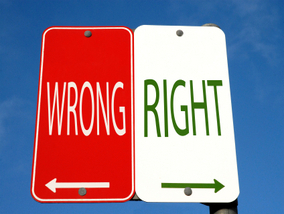 history; each choice we make is brand new. Every Starbuck’s cup has the same potential for ending up in the gutter as the recycle box. In all depends on a personal decision. Secondly, there are no heroes — only villains. We don’t get extra points for doing the right thing. That’s what we’re supposed to do. We only lose points if we do the wrong thing – like throwing our crap in the street. Third, regardless of how we act, we’re not morally superior to the litterer the way we are to Hitler. Chances are good the person who so casually dropped that cup does not have fangs or green saliva. They’re probably quite likable, nice to children and puppies, and have never committed genocide.
When we talk about right and wrong, we don’t have any high moral ground to stand on. Good and evil are simple. We have all kinds of reference points — Hitler and Mother Teresa are two obvious ones. But ya got to work at right and wrong — every time — without fail. That’s why we’ve created a sliding scale of mitigating circumstances. It alleviated the personal burden we all feel — which brings us back to that philosophical parlour game.
Here’s how the scale works: stealing is wrong. But if your children are starving, it’s not quite as wrong. Except if you steal from a child who’s unable to defend her bread due to an injury. However, if she’s from a rich family…. and the nuances go on and on into the night and the third bottle of wine. We need this sliding scale, but, unfortunately, we’ve come to think that it’s real. It’s not. It’s just a device: an artificial “Get Out of Jail Free” meant to ease the burden of guilt we feel when we do something reprehensible, like throwing our trash on the ground. In the cold, dark soul of four o’clock in the morning, we all knew that stealing is wrong. That’s what separates good people from the evil ones. Yet we also know that in certain situations, we will steal. That’s what separates smart people from stupid ones. That’s why we find it so difficult to talk about right and wrong — because many times the morality just doesn’t match the reality.
Right and wrong are absolutes. We can fool ourselves with excuses, justify our actions to others or proclaim our “good person-ness” from the rooftops. So what? If you cross a moral boundary, you are wrong. There’s no second opinion. Judgement has already been passed because regardless of how our society tries to slip/slide around it, integrity is what you do when the cell phones are turned off and no one’s watching.





 WD Fyfe