
 Recently, while waiting for the cable guy to hook up my new HDTV, I took a moment to quit doing the man/guy thing of feigning interest in all things electronic and passed the time reading the Manufacturer’s Warnings. It was an interesting read. It cautioned me against doing all manner of dumb stuff to my new TV, like hitting the screen with a sharp object or operating the unit underwater. While I can imagine going Elvis on a bad hockey result, I don’t know why anybody would want to watch the news in the pool. How silly!
Of course, stupid product warnings have been around since the mid 1970s, when corporations started telling people their coffee was hot and not to drink the Drano. They have accelerated since then to the point where just about anything you buy, these days, comes with a checklist of “thou shalt nots” longer than the Ten Commandants. For example (and these are just a few simple ones)
“For external use only” – on a hair curling iron
“Caution: Do not spray in eyes” – on deodorant
“Do not use orally” – on a toilet bowl cleaning brush
“Choking Hazard: This toy is a small ball” – written in two languages on a
small ball
And there are a lot more out there that get a lot more complicated.
There is a collective idea that we have these stupid wa rnings because our society is under siege from bloodsucking lawyers who will do anything to initiate lawsuits. This is not true. Yes, our society is under siege from bloodsucking lawyers (this, by the way, is a general comment, not directed at any particular bloodsucking lawyer.) However, we have stupid warnings on products because people are stupid. I’m not talking about high profile Darwin Award stupidity; just everyday ordinary incredible acts of Dumb and Dumber. You know for a fact that there’s some fool out there who will give the aforementioned small ball to a two year old and wonder how in the hell he got it in his mouth. And this is not unusual behaviour. People on bicycles, weave in and out of traffic, wearing nothing more than shorts, an iPod and a helmet, as if the helmet were a shield of invulnerability. I’ve seen a guy staple up outdoor electric lights while they are plugged in. People who are driving, race red lights while eating pizza, attach Ikea furniture to their roofs with twine and I’m not even going to mention texting the spouse to see what to pick up for dinner.
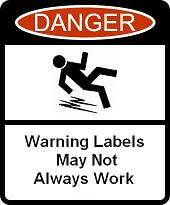 Get them out of their cars and they don’t get any smarter. Recently, a family was doing some spring gardening, using a device called the Weed Wand. The Weed Wand is an advertised alternative to the chemical warfare we’ve been using (and most cities have been banning, thank God) to control weeds. What it is, is a snout attached to a handheld propane tank that shoots flames directly at the weeds and kills them by cremation. (I’m not making this up; this is a real product.) Guess what? They set the house on fire! These are ordinary people, but their actions do beg the question: who buys a flamethrower — even a small one — to tidy up the driveway? When asked about it, the guy said, “In my opinion, it’s not a safe product, and we certainly weren’t using it in a reckless fashion…. I don’t think products like that should be on the market.” You can read all about it here but my point is – it’s a flamethrower!
The problem is our society is basically benevolent. We have eliminated most of the dangerous elements in our world and control as many of the hazardous ones as possible. However, in our zeal to make a risk-free society, we’ve created a couple of generations of people who think this is the natural order of things. They believe the world is a safe place. They wander around as if nothing on this good green earth is ever going to hurt them. Then, when something does, they think there’s been a malfunction somewhere. I’ll grant you that they might not be as stupid as I think they are but they sure act like it.
The reason corporations put all those idiot warnings on their products is — sure as hell — somebody somewhere is going to find a way to poke themselves in the eye, lob off a finger or operate the unit underwater and electrocute themselves. Then they’ll scream bloody murder that the manufacturer didn’t warn them about the dangers and run for the lawyers. Sometimes, I wonder if our well regulated society has beaten the self preservation gene out of our species. I’m not saying we should return to the days of dog-eat-dog/devil take the hindmost, but every once in a while, just a touch of common sense wouldn’t hurt.








 WD Fyfe