
History, Bitter & Twisted October 21

Arrivals:

1772 – Samuel Taylor Coleridge, a very serious scholar, mostly remembered today for a couple of poems and a fondness for opium.  Actually, Coleridge and his friend “Wordy” Wordsworth were the poetic beginnings of the Romantic Age – “the spontaneous overflow of powerful feelings.”  Coleridge wanted to see the world without reason and enlightenment.  He wanted a poetic overthrow of the Industrial Revolution and a return to the magical, pastoral time of his youth.  Besides his most famous poems “Kubla Khan” and “The Rime of the Ancient Mariner,” Coleridge also wrote tons of other poetry, philosophy and literary criticism.  The thing that amazes me is that he did all that while sucking back a bottle and a half of laudanum every week.

1833 – Alfred Nobel, who spent the early part of his life trying to find a safe way to blow things up.  He succeeded in 1867 when he invented dynamite, but not before he’d accidentally blown up his brother, Emil.  Naturally, the military loved dynamite and used it extensively throughout the 19th Century — making Nobel a very rich man.  However, Nobel didn’t want to be remembered as “The merchant of death,” so, in a clever attempt to fool history, he left most of his money to The Nobel Foundation and The Nobel Prizes for Physics, Chemistry, Medicine, Literature and Peace (Economics was added later.)  Except for nerds, very few people care about most of the prizes, but Peace and Literature get an annual discussion about how political they’ve become.  This was especially true in 2009, when Barack Obama won the Nobel Prize for Peace because he wasn’t George Bush.

1805 – In general, actual battles don’t mean very much to history; they’re just a way for lazy people to teach it.  However, there are a few battles that do mark an epoch or that change the world.  Trafalgar is one of those.  On a calm, cool autumn day, off the coast of Spain, British Admiral Nelson caught French Admiral Viileneuve and the combined French and Spanish fleets in open water.  Even though he was outnumbered and outgunned Nelson attacked “straight ahead.”  At the end of the day, the British fleet had achieved an overwhelming victory.  It was Britain 22 – France 0.  This was the beginning of Pax Britannica and nobody would challenge British power again for nearly 100 years — until a bunch of farmers, called Boers, decided that the British Empire wasn’t all that tough and took them on in a dirty little war in South Africa.

Departures:

1969 – Jack Kerouac died of the extensive use of alcohol in St Petersburg, Florida.   If Ginsberg started the Beat Generation, it was Jack Kerouac who personalized it.  On the Road is the soul of the Beat Generation, and Kerouac is its high priest.  He wrote the entire novel on one continuous sheet of paper in about 3 weeks, in 1951.  It wasn’t published until 1957, and, even then, it was heavily edited.  The publisher Viking chopped many of the more descriptive (read “explicit”) parts out and changed most of the names.  It didn’t matter, though, because within minutes of its hitting the streets it was a best seller and Kerouac was being called The Voice of a Generation.  In truth, Kerouac has become the voice of many generations. There isn’t an undergraduate alive who hasn’t thought about it – just droppin’ the books and gettin’ out On the Road.

1984 – Francois Truffaut, one of the few French film directors who is actually any good.  Most of the rest of them wander around in black and white, making their actors look miserable and speak in sub-titles about how crappy life is.  Truffaut, on the other hand, had something to say and said it in such a cinematically unique way that he started a whole new movement in French film making – La Nouvelle Vague.  His early movies like The 400 Blows and Jules and Jim influenced directors on both sides of the Atlantic.  His only film in English, Fahrenheit 451 (1966) was done in a strong New Wave fashion and holds together very well in the 21st Century.  Before Truffaut began directing his own movies, he was an outspoken film critic and was banned from the Cannes Film Festival.

History, Bitter & Twisted October 20

Arrivals:

1632 – Christopher Wren always wanted to get his hands on St. Paul’s Cathedral.  In 1661, he worked on some repairs there, and in 1666, he envisioned a new dome for it.  Chance and a clumsy baker came along, and later that year, the cathedral burned down — along with the rest of London.  Although I don’t think Wren was happy about the Great Fire of London, it did give him his big break.  He immediately submitted a design to rebuild the whole city on a European model, with wide boulevards and spacious piazzas.  Charles II took one look and realized that Wren’s design would, first of all, cost too much and secondly, take way too long – people were homeless now.  However, Charles did ask Wren to rebuild the city’s churches.  He designed and built over 50 of them, but he always held out for a crack at St. Paul’s.  Finally, in 1670 he was given the money and the go-ahead.  It took Wren 5 designs, 3 kings, 1 queen, and 41 years to complete the Cathedral.  It was worth it.  Fortunately, in the 20th century, it survived the bombing of London in World War II.  Unfortunately, after the war, when nobody cared about beauty, St Paul’s got crowded in by a bunch of rectangles and cubes.  Fortunately, it still dominates these petty intrusions, as Wren’s masterpiece.

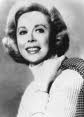
1927 – Long before there was Dr. Phil and his 3-ring media circus, there was Dr. Joyce Brothers, the woman who invented Pop Psychology.  Brothers got her start on a local New York TV station, doing an afternoon advice program in 1958.  The format was simple: Brothers would take questions from the audience and answer them.  The show was such a success (Brothers actually gave good advice) that it was syndicated on both TV and radio.  She also wrote a newspaper column and a monthly column for Good Housekeeping Magazine.  Never afraid to promote herself, Brothers has appeared on tons of talk shows been a regular on TV game shows like Match Game and Hollywood Squares and made cameo appearances on pretty well every sitcom known to man.  She has a Ph.D. in psychology and got her start on TV when she won on The $64,000 Question game show.  Her category was boxing.

1973 – The Sydney Opera House was formally opened by Queen Elizabeth II.  The opera house is to Sydney what the Eiffel Tower is to Paris and Big Ben is to London. It is one of the most recognized structures in the world.   It is also an essay in what happens when we let government bureaucrats off the leash.  The original design for the Opera House was accepted in 1957.  The completion date was scheduled for Australia Day, January 26th, 1963, and it was supposed to cost 7 million dollars.  Construction started in 1959, and all hell broke loose.  Apparently, nobody in the government had told the architect, Jorn Utzon what they actually wanted, so the design had to be changed several times.  In 1965, a new government was elected, and construction was put under the authority of a whole new department.  So things had to be changed again.  Then it turned out that the original construction was not strong enough to handle the redesigned structure, and that had to be changed.  Tension between the architect Utzon and the construction committee continued until he finally resigned in frustration.  He went on to call the whole affair “Malice in Blunderland.”  Then the new team redesigned most of the interior, wasting more time and money.  Things went on like this for several more years.  In the end, the Sydney Opera House cost $102 million — 14 times the original estimate — and was over 10 years late.  Luckily, the place is absolutely fantastic, so nobody seems to mind.

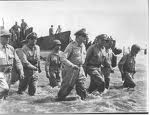
1944 – Douglas MacArthur made good on his promise and returned to the Philippines.  Early in World War II, when the Japanese army overran the Philippines, General MacArthur had been ordered to escape and go to Australia to lead the counterattack.  He was not pleased, and with the simple phrase “I shall return.” Indicated that he was going to come back and kick somebody’s ass.  After 3 years and several extremely bloody campaigns, he did.  MacArthur was an incredible general and an even better showman.  He understood the public’s need for a hero and worked hard on his image, including meticulously taking the metal bands out of his hat so it looked ruffled and casual.  Similarly, the famous footage of him striding towards the shore at Leyte was filmed twice for dramatic effect.  He also filmed the Japanese surrender on board the USS Missouri, in 1945.    

Departures:

1890 – Sir Richard Burton, a 19th century adventurer who joined the army early, went to India and then promptly “went native.”  Unlike most imperialists of his time, he thought “native” cultures were viable, dynamic and interesting.  He adopted local clothes (which made a lot more sense than Oxford wool) learned the language and studied the religion.  He travelled throughout India and the Middle East and even disguised himself as a Moslem and went to Mecca.  During his lifetime, he attracted a great following, mostly due to his adventures but also because he was seen as exotic.  However, this brought him into conflict with Victorian society who thought that he’d “gone a little too native.”  He also published number of books that were blatantly sexual — The Kama Sutra, for one.  His friends and supporters called these “extensive studies” but most everybody else called them porn.  Oddly enough, even though he was publicly frowned upon by polite society Queen Victoria knighted him in 1886.  His most famous journeys were with John Speke, searching for the source of the Nile.

1926 – Eugene Debs, the only man in history who ever ran for President of the United States five times – once even from his jail cell in the Atlanta Penitentiary.  Debs was a socialist before it was cool.  In his day, in fact, it was so un-cool to be a socialist that he went to jail for it.  Debs spent most of his life (when he wasn’t in jail) as a union organizer.  He was an organizational genius and a brilliant orator but he got caught in the ideological wars that have always plagued the socialist movement.  As a result, he spent twice as much time and energy dealing with internal squabbles as he did building the labour movement.  In 1918, he gave a speech criticizing America’s entry into World War I and urging men to resist the draft.  He was arrested, tried and sentenced to 10 years in prison.  In 1921, President Harding commuted Debs’ sentence (he was not pardoned as is generally believed) and he was released.  And even though socialism was still not all that acceptable, over 20,000 people welcomed him home.

History, Bitter & Twisted October 19

Arrivals:

1937 – Peter Max, a 60s going on 70s artist who put the psycho in psychedelic.  Max’s work uses strong colors, bubble letters, sunshine and rainbows.   Like most artists of the period, he uses American clichés as a backdrop for his art.  He is deeply influenced (“rip-off” is such a 60s word!) by Andy Warhol and he must have seen the Beatles’ Yellow Submarine at least 8 times.  Today, Max’s art seems horribly out of date but he’s still flogging it — mostly to government officials and old company executives who think it’s still cool.  Eventually there will be another 60s revival, and ordinary people will reclaim Max’s art.

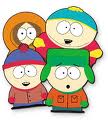
1969 – Trey Parker, one half of the geniuses behind the mega-funny TV series South Park.  Parker and his creative partner, Matt Stone have done a lot of other things but none of them is as funny as South Park – except maybe Team America: World Police, which died at the box office.  South Park is so funny that it has angered many members of “Politically Correct,” a special interest group for people born without a laugh track.  They claim that Parker, Stone and South Park have a Hidden Right Wing Agenda.  I’ve seen the show, and they might be right.

1453 – French troops recaptured the city of Bordeaux, and so virtually ended the 100 Year War.  This was a war that had everything.  It even lasted longer than it was supposed to –116 years (a great trivia question, by the way.)  It had great battles, Crecy, Poitiers and Agincourt (where the obscene middle finger gesture comes from.)  It had fascinating personalities: Edward the Black Prince, John the Fearless, Henry V, running around calling everybody his “Band of Brothers” and shouting “Once more into the breach,” etc. etc.  And everybody’s favourite heroine, Joan of Arc, answering God’s summons to save France and, (when the English burned her at the stake) ending up looking remarkably like Ingrid Bergman.  It started out with glorious knights, in full armour, hacking away at each other in chivalrous individual combat and ended with rows of cannons, dramatically blasting away, in indiscriminate wholesale slaughter.  It would have been a brilliant war except for a couple of minor problems.  One — it started as a family feud when Edward III of England and Philip of Valois both wanted to oppress the French peasants at the same time — not a real good reason to have a war.  Two – it lasted so long that the original arguments between the original combatants were long since gone and forgotten, and you had people’s great-grand-children shooting at each other, for no apparent reason.  And finally three – it irreparably changed the face of warfare.  It’s all well and good to have a couple of hundred noblemen dressing up and playing Capture the Flag, but when you field huge professional armies that spend year after year butchering the civilian population for money and sport – that just gives war a bad name.

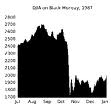
1987 – The stock markets of the world unexpectedly crashed on what has come to be called Black Monday.  And they didn’t just collapse, they dropped like they’d fallen down a well.  It was the largest percentage drop in world history (even bigger than the Stock Market Crash of 1929.)  Wall Street alone lost over 20%.  People lost millions in a matter of minutes.  Even the big boys, Gates and Buffett, took a kicking.  Immediately afterwards, economists gathered in Washington, DC, to figure out the cause and future prevention of such a terrible occurrence.  They yipped and chattered, hemmed and hawed and rattled around for about a week and a half, then announced that they had no idea what the hell just happened but they sure hoped it wouldn’t happen again.  It has — several times.

Departures:

1745 – Jonathan Swift, yet another witty Irishman.  Everybody knows that Swift wrote Gulliver’s Travels about Lemuel Gulliver’s adventures in the land of the Lilliputians (little people) and the Brobdingnagians (giants) but most people never get past that.  Actually, Gulliver travelled to several other strange lands including Laputa, a flying island, Glubbdrubdrib and Japan.  On his final voyage, he goes to the land of the Houyhnhnms where graceful and noble horses rule a race of filthy, stupid men called Yahoos.  When Gulliver’s Travels was published, many people believed that there was a Gulliver and that he did actually travel to those places.  I’m not sure that Swift ever clued some of them in.  Swift also wrote A Modest Proposal in which he advocated poor people selling their children to rich people for food – an interesting concept in 1729.  Once again, many people thought Swift was serious.

2008 – Mr. Blackwell! Has it come to this?  Richard Blackwell was a very successful fashion designer who made extensive use of television and journalism to promote his designs.  He wrote a fashion column and a couple of books.  His House of Blackwell designed clothes for Jane Russell and Nancy Reagan among others.  He was very good at what he did.  But what is he remembered for?  Blackwell’s Worst-Dressed List, an annual mean-spirited charade that served absolutely no purpose.  The thing ran for over 40 years and just got bitchier and bitchier as it went along.   People ate it up, enthralled with celebrity women getting impaled by Blackwell’s nasty barbs.   It was insult humour for the masses at its best.  Who am I kidding?  I loved it, too.