
Voluntourism: Another Do-Good Blunder

volunteer2Apparently, for the last several years, in the upper reaches of Western society, the elite among us have been moiling away doing good works.  This is not new: the crème de la crème have always shared their largesse with the rest of us, but in the old days it was kinda ad hoc, and, therefore manageable.  These days, however, volunteerism has become a multinational business (like the oh-so- evil Walmart) and it’s getting out of hand.  I realize calling down charity is like attacking a unicorn — nobody’s going give me a thumbs up on this one — but when something becomes a destructive force, what am I supposed to do?

So, ladies and gentleman, I give you the latest in a series of do-gooder blunders: voluntourism.  This little puppy is so wrong — on so many levels — I don’t even know where to start — perhaps, a definition?

In essence, voluntourism is a thinly disguised guilt-free vacation.  Rich people can indulge themselves, eat up tons of fossil fuels and other resources and justify it by “giving back” (a vague feel good term that means absolutely nothing.)  The vast majority of voluntourists are well-meaning high school and college kids who can afford to “give back” because they don’t have to sling burgers or mochaccinos on a daily basis to pay for their education.  The voluntourism experience looks good on a CV; thus giving the voluntourist a rung up on the education and career ladders over their poor bugger peers (who couldn’t afford a semester off in sub Saharan Gabrungi.)  Plus, it gives them something to brag about until the first child goes to preppie preschool.  Everybody’s happy — except some of us are a little happier than others.

At the other end of this libero-colonial adventure, the target destinations either adapt to their newfound benefactors or they go under.  I can’t think of a better way to screw up a struggling local economy than introducing a pool of high quality unpaid labour into the mix.  Suddenly, the neighbourhood workforce (in pretty much every area except aid administration) is facing stiff competition from a gang of gungho kids from Indiana.  These boys and girls have resources at their disposal that the local folks can only dream about, and they’re undercutting shipping, handling, materials and labour by 100%.  Think about it: how long volunteer5would even a mighty Mcdonald’s franchise last if I opened a burger joint down the block that gave away Happy Meals for free?  Even when the voluntourists actually work with the locals, they’re still stealing jobs.  These are jobs that an embryonic micro-economy can’t afford to lose.

The only defence against this economic genocide is, if you can’t beat ‘em, join ‘em.  Many local institutions have had to become part of the Western charity food chain in order to survive.  Frankly, there’s no advantage to solving problems and flying right if the minute you do, the voluntourists move on, the money dries up and you’re left worse off than when you started.  In fact, there are some very clear advantages to not poking your head above the poverty line.  So when the voluntourists show up and want to build yet another school, your best bet is to shut up and let them do it.  If nothing else, some local somebody is going to make a shekel or two feeding, housing and looking after these contemporary bwanas.  Besides, they might tell their friends what a good time they had sorting out the natives, and next season’s crop of Lady Bountifuls will be assured.  “It’s the Circle of Life/And it moves us all.”

I’m not against charity, volunteerism or giving my fellow human beings a helping hand.  I just can’t abide a bunch of people blundering around the world paving the local roads to hell with their good intentions.  The grinding poverty on our planet doesn’t need charity; it needs jobs — local jobs that feed the local economy.  Those people who want to help the downtrodden places in our world need to commit to more than just a vacation full.  They need to bring business with them when they come, open a local volunteer6bank for microloans, or start an export clothing business, a bicycle repair shop, or just a simple bed and breakfast.  Unfortunately, these things take time and commitment, and the positive results need years to take root.  Voluntourists have to get back to their own lives.  They have things to do that don’t include slogging it out in a minor village in Cambodia or Rwanda for five, ten or twenty years.

I don’t care how you slice it: voluntourists are tourists; that’s all they are.  The interesting thing is, since tourism adds a lot of dollars to any local economy, everybody would be a lot better off, if they just acted like it.

Confessions of an Addict

2 pints2They say that the first step on the road to recovery is admitting you have a problem.  Well, here goes!  My name is WD, and I’m an addict.  Hard to believe, but it’s true.  Despite what you see, I’m stuck in a secret cycle of abuse.  Oh, I’m good at hiding it, denying it.  I only use it to relax – unwind.  I can quit anytime I want to.  But no, I can’t.  I’ve tried.  I’m an addict.  For me, one is one too many and even a whole series is never enough.

I guess my story’s the usual one.  It all started innocently enough; just a few school boys having a bit of a vicarious adventure.  I don’t remember who tried it first, but by the end of the summer, all my friends and I were doing it every weekend.  For a while, it was all we could talk about.  Fortunately, the habits of the young are fickle, and when school started, most of my friends drifted away to homework and hockey practice.  However, I remained, every weekend, watching black and white back-to-back reruns of Richard Greene’s Robin Hood and Roger Moore in Ivanhoe.  Soon, an hour a week simply wasn’t enough, and I began experimenting on my own – searching for a bigger thrill.  It was then that I discovered … Doctor Who.  I remember thinking, I’ll just try it and if I don’t like it, I can always change the channel.  But I didn’t.  I watched it all, even the credits, in the gathering twilight of an autumn afternoon.  It was a wonderful excitement, exhilarating and confused.  I was too young to truly understand what Time Lords were or the symbiotic relationship Who had with the Companion, but I wanted to know.  I wanted to open my perceptions to the sophisticated storylines, explore the language, and fill my senses with the ideas that I never found on regular TV.  I didn’t know it then, but I think I was already addicted — to British Television.

From Doctor Who, it was easy to graduate to watching The Saint.  After all, Roger Moore was just Ivanhoe in a tuxedo – wasn’t2 pints3 he?  No, he was more than that — stronger, with deeper plots and worldly situations.  Then it was The Avengers.  Just as my pubescent friends were discovering the hidden fantasies of Barbara Eden’s belly button, I had Diana Rigg all to myself.  For a teenage boy, Emma Peel had a dizzying depth of character, compared to Anthony Nelson’s do-as-you’re-told Jeannie or the submissive Samantha Stevens.  She was my fee verte and I was a slave to her.  Sated with suggested sex, mystery and espionage, when The Prisoner was broadcast in the early 70s, I was unable to resist.  I wallowed in its nonlinear drama, letting it wash over me, week after week, until — hauntingly unresolved — it ended, and left me empty and cold.

I should have stopped then – gone cold turkey — but I was ready for the hard stuff: Monty Python’s Flying Circus.  Speedball comedy with a walloping high so potent that even today I find myself laughing outrageously in its ethereallic flashbacks.  The Pythons opened my mind to non sequitur, the absurd, the tilted storyline, bizarre characterization and oh, so much more.  I don’t know how many traditional motifs I abandoned that winter.  It’s all a blur to me now.  But at the end of it, I knew I was never going back to American sitcoms.  I was hooked.

Since those heady days, I’ve spent the last forty years trying to recapture the roll-off-the-sofa/pee-your-pants-funny the Pythons delivered.  Through Fawlty Towers, Black Adder, Yes, Minister, Red Dwarf, Ab Fab, The Office and so many others, I’ve spent my life seeking bygone high.  And it’s not just comedy; it’s drama, too.  I eat British mysteries like a starving man at a barbeque.  The only thing that saves me from utter degradation is I have always had a violent allergic reaction to Jane Austen.  Without that I’d be up to my eyes in costume dramas and Downton Abbey.

Today, British television is easy to find — if you know where to look.  My dealers have always been PBS and The Knowledge Network, but I’ve recently found other ways to feed my habit.  Last fall, I watched all ten seasons of MI5, in less than three weeks, on Netflix.  These nights, when the world is asleep, I turn on YouTube and watch full episodes of Two Pints of Lager and a Packet of Crisps, Cracker, The Inbetweeners and even grainy bits of Jimmy Nail’s Spender.

My name is WD, and I’m an addict.2 pints

4/20: A Capitalist’s Dream

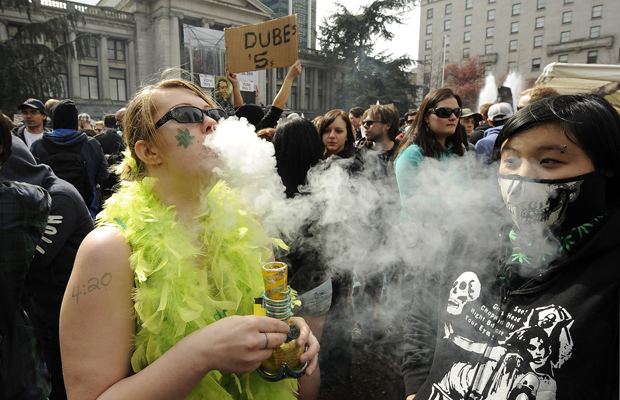
grassOnce again, the world has survived 4/20.  Despite dire warnings, our civilization didn’t collapse in a hail of exhaled smoke last Saturday, Bob Marley didn’t rise from the dead and Satan isn’t rolling a FatBoy (or whatever they’re called these days) on a throne of broken skulls and pure evil.  However, even as the suburban kids and the 60s-going-on-70s grey hairs are putting away their inner Jesse James for another year, I’m struck by just how bourgeois the once mighty marijuana counterculture has become.  The telling feature is the 4/20 inner circle password isn’t exactly secret anymore.  It’s so seriously mainstream, it wears Mom jeans, drives a Prius and has a bad boy Celtic knot tattoo.  There’s something just a little sorry about the gangstas at the annual 4/20 rally covering their faces with bandanas to avoid corporate disapproval rather than prosecution.  Of course, these days, smoking dope is tantamount to breaking Dad’s ten o’clock curfew rule.  The cops really don’t care who smokes what anymore (tobacco has more prohibitions) and unless you combine your recreational drug use with kidnapping and/or arson it’s practically impossible to get arrested.

There’s no real harm in the solid middle class playing one-day-a-year outlaw on April 20th: knock yourself out!  However, ever since high school, I’ve thought it was hilarious that these bad-to-the-bone counterculturists are missing the one great irony.  The world of marijuana is, in fact, the last bastion of radical right-wing laissez-faire capitalism — and it works.

I don’t think anybody needs a primer on capitalism; it’s been the bogeyman since Western youth got the two Lennons (Lenin?) mixed up — back in 1965.  It’s the system that sophomores love to hate.  However, many of the same people who wouldn’t be caught dead endorsing the free market have been indulging in it up to their rolling papers for at least three generations now.  Let’s take a look, shall we?

Marijuana is a huge international commodity.  Yet unlike all other agricultural products on this planet, it is devoid of government interference, intervention and/or regulation.  There are simply no governmental rules set up for the cultivation and sale of marijuana.  Therefore, there are no agricultural subsidies, no marketing boards, no tariff barriers, no packaging regulation and no other bureaucratic etceteras getting in the way of the dedicated business person.  In fact, as a commodity, the marijuana industry is governed, in its entirety, by the free market forces of supply and demand.  Not only that, but the price and profits of the industry are completely controlled by how efficiently the marijuana entrepreneur brings his product to market and how 4/20 at the University of Coloradoeffectively he handles his (or her) competition.  But wait: there’s more!  Taxation, the Holy Grail of all left-wing social planners and the bane of all free marketers is – OMG! — nonexistent.  The marijuana entrepreneur is not forced to share his profits with anyone.  If all this isn’t greedy bastard capitalism at its very best, I don’t know what is!

Now, here’s the kicker: not only has the marijuana industry survived for these many decades without government intervention, it has thrived.  The retail price has remained relatively low, the profit margins have remained relatively high and the market is stable.  Plus, at a time when the entire world is playing chicken with economic collapse, marijuana remains a growth industry.   Looks to me as if there’s some pretty convincing empirical evidence that, in fact, capitalism works.

So for all those “capitalism is worse than crap” wannabe economists out there: you might want to take a closer look before you run your mouth.  And for all those “I’m so baaad” middle-class muffins praying for the legalization of marijuana: careful what you wish for.  Once the government gets a hold of 4/20, the price will go up, the quality will go down and they’ll probably turn it into (3X – 2)/(6X + 8) — just to complicate things!