
It’s Spring! Thanks, Mother Nature!

Thank God it’s spring.  This isn’t just a calendar page turn or a set your watch an hour ahead, this is the real meal deal.  Mother Nature is changing her clothes, and Father Time is watching.  We mere mortals are only a small part of what they both have in mind, but just like every year since protoplasmic slime came out of the water, it’s going to be spectacular.  Spring is to love what winter is to bundling up and reading novels.  As of today, the birds and the bees are back, and they’re feeling frisky.

Unfortunately, the spring solstice doesn’t carry the kind of punch it used to.  These days, it’s mostly living on its reputation.  We all know it’s spring, but, unless you’ve embraced the New Age, three millennia after the fact, who cares?  In a world of canned-air malls, thunderdomed sports stadiums and concrete canyon streets, Mother Nature could take a month off and nobody would notice.  While this is strictly true, ignore Mother Nature at your peril because she has a way of slapping the ego out of the most arrogant among us.  Primitive humans knew this; that’s why they treated the spring solstice with such respect.

Way back in the day, winter in the northern hemisphere was nothing to be trifled with.  Our species never physically adapted to the cold the way some of the other animals on this planet did.  However, despite our natural tendency to freeze to death, we insisted on living in climates that were inhospitable for four months of the year.  The only recourse for this stupidity was to outsmart Mother Nature using the tools available – fire and the skins of more practical animals.  We hid in caves during the worst of the winter weather and only came out for food and firewood.  Obviously, we survived long enough to understand that, regardless of how brutally Mother Nature tried to kill us, eventually she would relent and treat us like her special children again.  This was cause for celebration.

As we evolved beyond beetle-brow tough to early human clever, we must have realized that these constantly changing seasons were not random.  They had a pattern.  When winter was over, the leaves came out.  From there, only a Neanderthal wouldn’t put two and two together and realize, once the leaves started to fall, winter was coming back.  (That’s why there are no more Neanderthals, BTW.  Just sayin’.)  With that in mind, it wasn’t a Cro-Magnon leap to figure out that, with a little planning, we could gather food and firewood during the good weather when they were plentiful, store them away, and a smart caveman could sit out the winter in relative comfort.  Thus, instead of hanging out in the cave, shivering and getting skinny, Grog the Caveman had some leisure time to figure out a few other things.  For example, he’d notice all the signs of spring that we don’t care about any more.  Things like, when the kids started falling through the ice in the river it wouldn’t be that long before the good eating birds would come back.  Or don’t worry about the bear in the next cave, because he’s going to be asleep until the snow in the meadow melts.  This was important stuff that affected Grog’s survival.  The more he knew about when spring was going to show up, the more likely it was that he would be around to see it.

Unfortunately, climatology hadn’t been invented yet, and so Grog filed all these various things he was discovering under “Mother Nature: Whims and Idiosyncrasies.”  It made sense to Grog that Mother Nature was real.  He saw her all around him.  She made the flowers bloom, the wind blow and the angry black clouds blot out the sun.  So it followed that, when spring finally did come and Grog and his family were still around, he should be polite and say thanks.

These days, we don’t much care for Mother Nature.  For the last two hundred years or so, we’ve been fighting it out with her for supremacy on this planet.  There are those who say we’re winning and those who say we’ve already lost.  Unfortunately, the majority of us don’t seem to give a damn, one way or the other.  Our egos are so secure we no longer thank her — or anybody else — for our existence.  However, on days like today, when spring is in the air and all’s well with the world, I tend to get a little caveman humble.  I can see something in the crow building a nest and that sprouty green sprig that’s probably a weed.  Even in the city, there’s an early morning smell that isn’t diesel fumes.  Something is happening again this year, and it’s going to fantastic.  We should all be thankful we get to experience it all again.
Food for Nukes: Another Bad Idea

There comes a time in every person’s life when they just want to get back into bed, turn the heating pad up to 9 and stay there for a week or two.  It’s that terrible time when you realize everything sucks and nobody’s even trying anymore.  Last week was one of those weeks; the only thing that saved it was St. Patrick’s Day.  It’s amazing how much stupid can be crammed into seven 24 hour days.

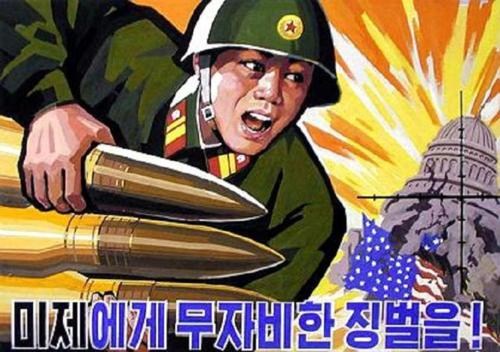
When the headlines catch you under the chin, the only thing you can do is roll with the punch.  In a not-so-surprising move, North Korea announced that it was going to test a long-range missile.  Big deal!  The North Koreans have been rattling their sabres ever since Joe Stalin sent the Red Army south of the Yalu River in 1945.  In 1950, the Asian Cold War caught fire when North Korea invaded South Korea and President Truman sent Twenty-Star-General Douglas MacArthur to slap some sense into Kim il-Sung — this current guy’s grandpa.  After three years of back and forth fighting (encapsulated for most Americans by 251 episodes of M*A*S*H) everybody was pretty much back where they started.  The two Koreas then settled in and have spent the last six decades picking at each other like two kids in the back seat of a cross country mini-van vacation.  In other words, this current Kim isn’t exactly breaking new ground in the dictator department.

North Korean long range-missiles are a problem, but they’re not the problem.  Buried inside the news item is America’s response.  Apparently, if North Korea tries to test this long-range missile, America will stop shipping food to the northern Hermit Kingdom.  Whoa!  Let me get this straight!  America’s been shipping food to North Korea???  Which Brainiac in the State Department thought that up?  And when did this diplomatic sleight-of-hand become accepted foreign policy?  I cannot believe this.  It’s so astounding I’ve run out of rhetorical questions.

Check it out!  North Korea, a nation notorious for internationally jerking people around, is sitting on a pile of plutonium (Where did they get that from?  West Edmonton Mall?) and America is shipping them tonnes of food every month so their people don’t starve.  I am not opposed to feeding hungry people, really I’m not, but it strikes me as counterproductive to be sending food to a nation that has been spending billions on a nuclear weapons program.  Hold it right there, Kim Whatever-Your-Name-Is!  How about ponying up some bucks for a couple of orders of Kimchi and rice for the general population?  Not only that, but the nuclear weapons program North Korea’s been building — on the starving peasant plan — is pointed directly at two of America’s most important allies in the region: Japan and South Korea.  This doesn’t scan — not even in Cloud Cuckooland.   But wait!  There’s more!  There’s firm evidence that the North Koreans have been exporting their nuclear technology to such world class malcontents as Ahmadinejad in Tehran and everybody’s favorite bad guy, Bashar al-Assad in Damascus.  I’m sure somebody in the State Department must have heard of these boys.  They’re the ones who want to make Tel Aviv glow in the dark.  The logic here escapes me.  It’s like picking up the tab for lunch so the guy you’re sitting with can buy a gun to mug your best friend.

I don’t know what went off the rails in the talks between America and North Korea last month in Beijing.  American statesmanship isn’t always the brightest light on the diplomatic Christmas tree.  However, it’s a good thing nobody told the American people what their State department was up to.  There might not be that many folks in New Orleans or Detroit etc. who have ever heard of Danegeld*, but they know a protection racket when they see it.  There can’t be a lot of Americans — who are about to pay their taxes in less than a month — very pleased to hear that they’ve been buying dessert for North Korean nuclear technicians.

The problem with extortion is it gets easy.  It’s easier to throw money at the problem than do the hard work to fix it.  Unfortunately, the problem remains.  As Rudyard Kipling once wrote:
“That if once you have paid him the Danegeld,
You never get rid of the Dane.”

Sending food to North Korea is one of the Top Ten stupidest things I’ve ever heard of.  Benjamin Franklins are not going to get rid of North Korea’s nuclear capability.  However, what they are doing is propping up a repressive regime and giving Kim and his military buddies time and space to go nuclear adventuring around the world.  It makes me wonder is there’s anybody even driving the bus anymore.

*For those unfamiliar with 10th century Nordic history, Danegeld was a special tax levied on the people of England and France.  It was collected and paid directly to the Vikings so they would play nice and take their rape and pillage somewhere else.  It went on for generations.


St. Patrick’s Day: An Alternative History

Stuck between The Ides of March and St. Patrick’s Day, March 16th is probably the most neglected day on the calendar.  It shouldn’t be: after all, The Ides of March was really just a minor Roman festival before Brutus and Cassius decided that power came out of the pointy end of a dagger.  Frankly, if Julius Caesar had been feeling a bit frisky that morning and gone over to Cleopatra’s instead of to the Senate, we wouldn’t remember The Ides of March, at all.  Plutarch wouldn’t have written about it, and Shakespeare wouldn’t have borrowed it to add a little spooky to his play Julius Caesar.  As Katherine Hepburn once said, about an unrelated matter, “Such is the role of sex in history.”

This minor change (given the tenor of the times Caesar was going to get his one way or the other) would have made March 16th a bigger day: Saint Patrick’s Eve, perhaps; just as Hallowe’en is All Hallows’ Eve and December 24th is Christmas Eve.  Unlike the Ides of March, which needed an assassination to put it on the map, St. Patrick’s Day is one of the big boy holidays.  It is so connected to Ireland that even if Saint Patrick hadn’t become the kick-ass saint he was destined to be, the Irish would have made him up – which, for the most part, they probably did.

There is no doubt in anybody’s mind that Saint Patrick was a real guy.  His life is actually pretty well documented (for the time.)  At least two letters he wrote are considered authentic, which doesn’t seem like much but when you consider most everybody in the 5th century was an illiterate peasant, it’s a lot.  However, that’s where it ends.  Most of the juicier details of his life are actually just high-end speculation.  There are no snakes in Ireland and there are a lot of shamrocks but we have no documented proof that either had anything to do with Saint Patrick.  In fact, there is actually no record in the Vatican of his ever even being canonized.  He is the patron saint of Ireland by tradition alone.  Likewise, the stories of his exploits were probably just good press for a church that was fighting tooth and nail against some long-established pagan gods.

The early Christians weren’t stupid.  They knew that a single God was a hard sell to superstitious people who had always worshipped a pantheon of pagan deities.  So they turned a bunch of ordinary people — who had led virtuous lives — into saints.  These saints weren’t gods, but they were already in heaven.  Thus, they were able to perform miracles in aid of the living and could be invoked in prayer, just like the old gods of the forest that the people were accustomed to.  Then, the Christian church went one step further and made it all personal.   They invented the patron saint, who had a personal interest in you.  Whether through your occupation, your birthday, where you lived or some other circumstance, a number of saints were available just for you, to handle your earthly problems.  The local river nymphs didn’t stand a chance against that kind of firepower, and Christianity came to dominate Europe.  Interestingly enough, though, these days, even ahead of Saint Patrick, the universally accepted symbol of Ireland is the leprechaun.

For centuries, St. Patrick lounged around in the same secular/celestial neighbourhood as St. Andrew, St. David and St. George, first among equals in the regions they represented but not that well-known beyond the borders.  (For example, most non Scots get St. Andrews Day and Robbie Burns Day hopelessly confused.)  But then, in the 1840s, the potato crop failed and Ireland began to starve.  First, the old people died and then the children.  Mothers abandoned their babies rather the watch the inevitable.  Whole villages turned their backs on their homes and roamed the countryside, looking for anything to eat — including the grass that grew in the ditches.  Without hope and forsaken by the future, the Irish left Ireland by the thousands to go anywhere beyond this despair.  In the 19th century the Irish Diaspora was huge: an army of homesick exiles, driven from their land.  Isolated in their adopted countries, by their speech, their customs and their religion, they clung together, keeping their traditions alive.  It was here — in the Irish ghettos of New York and Boston, Melbourne and Montreal — that St. Patrick’s Day was born.  It had always been a religious holiday in the old country, but far from home, St. Patrick’s Day became a time to drink a toast, sing the old songs and try to remember that which had once been.  A day of Irish pride far from the graves of their families, it was the slender thread that could take their hearts home.

Today is March 16th, the most neglected day on the calendar, but tomorrow is St. Patrick’s Day, the party where everyone is Irish.  So, at some point in the festivities, pause for a moment, and raise your glass to St. Patrick, a virtuous man, good enough to be turned into a legend by the early Christian spin doctors.  Then, raise it once more to all those nameless Irish immigrants who carried him with them, around the world.

May yer neighbours respect ya
Troubles neglect ya
The angels protect ya
And heaven accept ya*

Happy St. Patrick’s Day!

*(Did you just read that in an Irish accent?)