Muammar Gaddafi: Dead and (soon to be) Gone

For the next couple of days, expect the 48-hour news cycle to spin the life and times of Muammar Gaddafi every which way but loose.  Most of them will start off in a Bedouin tent in 1942 and end up somewhere in the desert between ruthless and brutal.  It will be a journalistic tour de force on how many times they can say “evil” without actually saying it or repeating themselves.  However, assuming (for argument’s sake) that there is an afterlife for such people, does Gaddafi get to sit at the head table?  It’s hard to know, but personally I don’t think so.

It’s true, Gaddafi wasn’t the guy you’d ask to pick up your kids after school while you go to the dentist, but in actual fact, as evildoers go, he wasn’t exactly Top of the Pops.  Basically, he was just a pain in the ass.  He spent most of his dictatorship spouting off and doing stupid stuff like funding every European terrorist who showed up with a sob story.  Every once in a while, he’d push the envelope a little too much and stick his nose into the terrorist business for real.  In 1986, he did it once too often and Ronnie Reagan launched his F111s and slapped the snot out of him.  After that he calmed down considerably until Reagan left the White House.  In 1988, he tried it again with the Lockerbie bombing, and when nothing happened, he got his groove back.  Then in 2003, when George W. told the 7th Cavalry to set their GPS for Baghdad, he finally saw the writing on the wall, got out of the nuisance business real fast and became downright cordial.  Just ask Tony Blair.

Of course, I don’t know much about his internal nastiness.  Like most people, I’m taking it on faith that he was indeed brutal and ruthless.  After all, the deserts of Libya are huge, and if somebody’s screaming in the back of beyond, it won’t necessarily get reported in the New York Times.  Besides, when you’re a dictator sitting on an enormous pool of oil, international criticism is usually limited to what kind of funny clothes you wore to the UN Afterparty.  Oil has a way of sliding the moral scale.  I’m sure Gaddafi was a bad man to cross, though.  It’s no coincidence that, in forty years, the opposition to his rule amounted to nobody.  Even Libyan expatriates were scared skinny of the guy, mainly because he tended to shoot at them whenever he got the opportunity.  In 1984, his “revolutionary committees” took a few potshots at local demonstrators in front of the London embassy, and a police constable, Yvonne Fletcher, was killed.  Yet, to be fair, I imagine Caligula killed more people while Agrippina the Younger was heating up the pasta than Gaddafi ever thought of murdering.
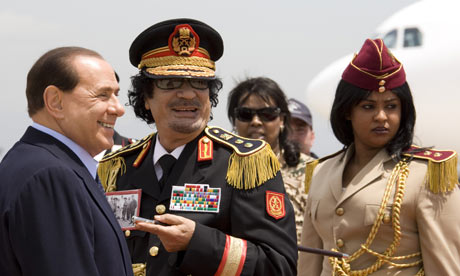
Don’t get me wrong: I’m not trying to let Gaddafi off the hook.  The fact remains that he was a cruel tyrant who repressed the soul of his people for forty plus years.  His rule resulted in numerous deaths and wanton destruction — both in Libya and around the world.  He ruined the lives of thousands of people without a moment’s regret, and despite the millions paid in compensation with no evidence of remorse.

However, as we figuratively and literally drag him through the gutter, let’s remember he’s just the flavour of the week.  He’s the name we know: the one who’s on the front page.  There have been plenty more where he came from.  Some of us are old enough to remember Ceausescu’s handiwork in Romania or Erich Honecker in the GDR.  Even as we speak, there are rulers in this world who could have taught Gaddafi lessons in Repression.  We may have heard of Kim Jong-il but do we even know the names of the rulers of Myanmar?  Or Turkmenistan?  And then there’s good old what’s-his-name in Damascus who’s been shooting dissidents as if there’s a bounty on them (and I’m not even sure that there isn’t one.)

In the great scheme of things, Muammar Gaddafi was nothing special.  Without oil, he was nothing more than a petty dictator with an odd taste in clothes and a big hat.  Let’s not waste too much time nor too many superlatives on the guy.  I’ll venture to guess that in less than a decade he’ll be swallowed up by the sands of Libya and very few of us will even remember his name.


Those Were the Days, My Friend!

Somewhere in the night the “good old days” moved.  They turned 40 going on 50 and died.  History does that.  It telescopes out, maximizing its view, and then when it gets just beyond most human memory, it disappears.  I tend to think of it as the vanishing point, that point in time that we can’t actually remember anymore but which radiates all the well defined lines of our contemporary world.  We know it’s back there, and without it, we have no perspective, but we have no idea what it looks like.  It’s the point in every generation when living memory is replaced by historical record.

Despite what Mad Men and Pan Am try to tell you, we have no more in common with the early 60s than we do the Vikings.  Their world was a time of barbarians.  Their morality was close to home — family first.  They distrusted anyone over the horizon and stuck to their own clan.  The weakest among them either kept up or went under.  They drank and wenched and flung themselves at each other in fits and starts of passion.  Honour was satisfied with blood.   Thought required action.  They lived in a desperate, suspicious time.

I’ll bet for a minute there you thought I was talking about the Vikings; I wasn’t.

Nostalgia has a way of creeping up on us.  As John Knowles said in A Separate Peace (or was it Herman Raucher in Summer of ’42) we all have our own time and we never leave it.  However, after a while, our time becomes blurry with everyone else’s.  Today, it’s hard to imagine that somewhere Astronaut Neil Armstrong, the Ohio boy who left the first footprint on the moon, was a contemporary of Astronaut Anthony Nelson who finally married Jeannie the Genie in I Dream of Jeannie.  It’s difficult to reconcile that, in those days, we had the intelligence to go to the moon but not the sophistication to show a woman’s bellybutton on TV.  So we slide events around in our memory, and even people who were there have to Google things to get the time line right.  There’s no such thing as documented memory.

Today, the 80s are the “good old days” and the 60s are ancient history.  It was a time when Reagan and Thatcher ruled the earth and Presidents went riding with Queens.  The Soviet Union was in its last dying convulsions with four Premiers in five years and Mao was already dead.  There was a truce in the Cold War, and although total nuclear annihilation was still a possibility (a lot closer than we knew) we were much more afraid of AIDS.  Terrorist attacks were isolated, always somewhere else (places like Lockerbie and Beirut) and the killing was manageable.  A lot of people learned how to spell Chernobyl and Bhopal.

Cocaine replaced marijuana as the substance abuse of choice among the well-to do, and we still thought we could win the war on drugs.  Madonna was more-or less like a virgin, or so we thought and we didn’t know half as much as we needed to know about Michael Jackson.  Lucas and Spielberg hadn’t yet sold their collective souls and the franchise movie demons were still babies.  Mick Jagger and the Stones replaced Buddy Holly and the Crickets on Golden Oldies radio.

IBM and Commodore controlled the personal computer industry until Steve Jobs and Steve Wozniak changed the rules with Apple and a hardwired mouse.  People (they weren’t called gamers yet) had a choice between Pac Man and Donkey Kong.

Mexican debt exceeded its ability to pay, but everybody else was making the mortgage, and for the first time in history, trans-Pacific trade eclipsed trans Atlantic.  Most people thought Wall Street and Donald Trump were the good guys.

Someday, rather soon actually (more than half the kids born after the Fall of the Berlin Wall don’t know who Gorbachev is) these new “good old days” will become history.  People will wonder whether Seinfeld was before or after Miami Vice.  They’ll look at photographic film cameras in a museum and wonder how people took videos of the riots.  They’ll laugh at the size of the telephones and the computers and the internal combustion cars.   Generation-i will roll their eyes at the primitive world their parents grew up in.  And — heaven help us! — this world around us, called 2011, will be the “good old days.”

Hawkeye Pierce and the Rise of the Smart Ass

I blame MASH; not the book or the movie: the television series.  If it hadn’t been for it overstaying its welcome, we wouldn’t be fighting for our lives against the pandemic of pompous asses that have plagued us ever since.

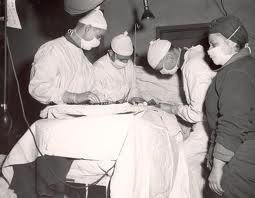
Most people don’t know that MASH the entertainment franchise is based on MASH: A Novel about Three Doctors written by Richard Hooker (H. Richard Hornberger.)  It was a cute little comic novel based on the real-life mayhem at a Mobile Army Surgical Hospital during the Korean War and originally published in 1968.  This was right around the time that Mobile Army Surgical Hospitals in the Vietnam War were up to their elbows in real casualties – almost literally.  Therefore, even though it wasn’t a New York Times bestseller (at the time) it enjoyed a certain success; enough to attract the attention of Hollywood.  Within a year, a mediocre industrial film director named Robert Altman got hold of a screenplay from the book and filmed M*A*S*H with Donald Sutherland and Elliott Gould.  It came out in 1970.  Altman absolutely lucked out with a combination of nouveau cinema camera techniques and worldwide anti-war enthusiasm.  It also didn’t hurt that the movie was black dog hilarious for the time.  It won the Palme d’Or at the Cannes Film Festival and a handful of Oscar nominations.  Interestingly, it’s only Oscar was for Best Screenplay, written by Ring Lardner Jr.  Television executives have never been accused of not cashing in on a good thing, so MASH, the television series, premiered on CBS two years later — on September 17th, 1972.  Nobody paid much attention to it at first, but then it was rescheduled behind Norman Lear’s All in the Family (the Amos and Andy of the 70s) and a star was born.  His name was Alan Alda.

Before 1972, Alan Alda was a permanent TV guest star and a recurring panellist on I’ve Got a Secret and What’s My Line? – two TV programs that are difficult to explain to a 21st century audience.  His only starring role was as George Plimpton in Paper Tiger (a movie I’m sure has only been seen by me and nobody else I know.)  However, Alda is a good actor and when he landed the role of Hawkeye Pierce (Donald Sutherland in the movie) he must have thought he’d died and gone to celebrity heaven.

He probably didn’t realize how long heaven was going to last.  MASH was on television for eleven years — nearly four times as long as the Korean War itself and about twice as long as it should have been.  I’m sure that more wounded soldiers came through the fictional 4077 MASH unit than actually fought the war – on both sides.  In the end, only Hawkeye and Hotlips (although nobody called her Hotlips anymore) remained out of the original cast, and they were treating industrial accidents from the local Hydunai factory.  Most importantly though, Alan Alda singlehandedly not only destroyed a perfectly good bit of television comic relief but made it socially acceptable to be an utter know-it-all jerk.

Here’s a bit of background.  The book and the movie make clear that Benjamin Franklin Pierce is a good doctor.  He finds himself trapped in a hell-hatched netherworld where doctoring is fast-tracked into something called “meatball surgery” — a lot of blood, stress you could hit with a hammer, and no end in sight.  Pierce and his buddies, however (like young people everywhere) think they can make the best of a bad situation by adding large quantities of alcohol and an active libido.  They believe this will somehow balance the absurdity of war.  The result is a bunch of antics about the Korean War that we’re never going to read in the history books but that probably happened, all the same.  (I’ve heard similar tales out of Vietnam.)  The important point is, never, at any time — in neither the book nor the movie — does Hawkeye Pierce start shooting his mouth off about macro-vision moral values.  He’s just trying to get himself out of the war in one piece, with his sanity still intact.

Back to 1972!  In the beginning, Alan Alda’s Hawkeye was recognizably the same guy from the movie, if not the book.  For example he never delivered Pierce’s signature “Finest kind” line with any believability.  But somewhere after the second season, it all went to his head and he started playing Pierce like a morally superior Groucho Marx with a knife in his hand.  He became a wiseass, and a mean one at that.  Not only that, but he was always right.  The guy ran around like he was the smartest person in the Korean theatre of war, and he was always willing to tell you about it.  There was no problem — medical or otherwise — that he didn’t have the inside scoop on, and it became increasingly apparent that he thought he was surrounded by idiots.  It got so bad that Trapper John got fed up and cleared off without even a “See ya later.”  (FYI Trapper was killed by Adam Cartwright’s grandson, who assumed his identity and took over his medical practice in San Francisco.)  He was replaced by B.J. Hunnicutt, a perfectly bland second banana, who oozed smarm so thick you could cut it with a scalpel.  Pierce may not have chased everybody off the show, but there were more casualties among the actors than there were in the operating room.  The only supporting cast left at the end were Klinger — a TV invention — and Father Mulcahy
— who had to forgive him.

That wasn’t the worse of it, though.  For at least the last six seasons and maybe more, Hawkeye Pierce acted as if his superior understanding trumped all other ideas and observations.  The show was written so that every week Pierce showed up the blaring inadequacies of everyone around him and made fun of them while he was doing it.  There was no moral question he didn’t have an answer for and no social injustice he couldn’t mend; meanwhile solving serious medical emergencies as an afterthought.  And all of this was delivered with a smart ass insult!  The guy didn’t just take the moral high ground: he landscaped it, built a house and settled in for the duration.

Before Alan Alda, Hawkeye Pierce was the type of guy you wanted to be around.  He was good at what he did and fun in the off hours.  After Alda, Pierce became the quintessential pompous ass, and since he was beamed into millions of living rooms every week (and still is) it’s now socially acceptable.  We’ve all met them.  He’s the guy (and they’re usually guys) who shows up with this whole “Bite me!  I’m smarter than you are.” attitude.  He always has all the answers even though you didn’t ask any of the questions.

Poor Benjamin Franklin Pierce became the prototype of our contemporary oh-so-superior man and unfortunately, since then, they’ve been mass produced.