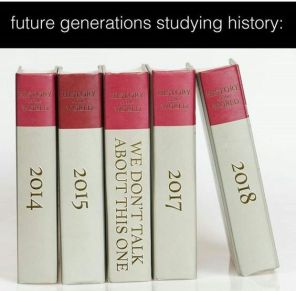
Let’s face it: 2016 was a crap year! Tons of cool people died. Evil bastards all over the world made a point of putting the dick back in dictator. There was war, disease, famine, pestilence — you name it; we had it — and Ben Affleck was Batman! Personally, this year can’t end fast enough. However, I am an optimist, so let’s take a look at a few good things that happened in 2016.
1 — The millennials are now one year closer to getting run over by the reality train.
2 — We finally got rid of Alex Rodriguez.
3 — We have at least three more genders to fit into public toilets.
4 — It’s been 12 months since we’ve heard from Charlie Sheen, Shia LaBeouf, Al Gore, that monumental jerk Letterman and What’s-Her-Name, the stupid blonde chick.
5 — French thieves.
6 — Gawker went broke.
7 — After 41 years of confusion, the British discovered they weren’t European, after all.
8 — The media finally confessed and admitted that half the stuff they’re calling news is actually just make-believe.
9 — The Cubs won the World Series, and Bob Dylan got the Nobel Prize for Literature. (There’s no way 2017 can be any weirder than that.)
And finally, but most importantly:
10 — Politically Correct got an incredible kick in the cojones when reality TV star Donald Trump didn’t kowtow to those social media bullies. The PC Reign of Terror might not be over, but every blow struck against those Intellectual Nazis is important.
BTW, you know what kind of year it’s been when a guy like me is congratulating Donald Trump for anything.
John Glenn died yesterday. For my generation, he was one of the good guys. He exemplified a lot of what we’ve forgotten about the 60s. I wrote this in 2012 on the 50th anniversary of John Glenn’s space flight. It is still relevant today. (I’ve edited it for brevity.)
Fifty years ago today, we took a guy from Ohio, sat him on top of 100,000 kilos of high octane fuel, lit the match and shot him straight out of our oxygen-rich atmosphere into the void of space. And the only reason we did it is because we could. We had the technology to throw man and machine off our planet entirely — so we did. John Glenn didn’t have to put his polyester suit and plastic helmet on that morning and climb into Friendship 7. He wasn’t an essential component of the mission. In fact, he was actually considered extra weight by Von Braun’s aeronautical engineers. He was, as Chuck Yeager called him, “spam in a can.” Nor was he the ground-breaking first person in space: Soviet cosmonaut, Yuri Gagarin beat him there by ten months. He wasn’t even the first American: Alan Shepard and “Gus” Grissom got there first. However, John Glenn is the one we remember because he was part of the Big Idea.
The Big Idea is that magical phenom that galvanizes a people and motivates them to reach for the stars – in this case, literally. It grabs our imagination and brings our best qualities forward to achieve what might even seem to be impossible. It’s a vision of a better future. It ignites the human spirit. It can be as simple as The March of Dimes to end polio or as large as the Interstate Highway system. But the one common denominator of the Big Idea is people believe.
Six months after John Glenn orbited the earth and returned home safely, President John Kennedy stepped up to the podium at Rice University in Houston, Texas and told America what the Big Idea was. He said:
“There is no strife, no prejudice, no national conflict in outer space as yet. Its hazards are hostile to us all. Its conquest deserves the best of all mankind, and its opportunity for peaceful cooperation many never come again. But why, some say, the moon? Why choose this as our goal? And they may well ask why climb the highest mountain? Why, 35 years ago, fly the Atlantic? Why does Rice play Texas?
We choose to go to the moon. We choose to go to the moon in this decade and do the other things, not because they are easy, but because they are hard, because that goal will serve to organize and measure the best of our energies and skills, because that challenge is one that we are willing to accept, one we are unwilling to postpone, and one we intend to win, and the others, too”
Kennedy could have held a Washington, DC press conference and mambled on about committing billions of dollars to rocketry, computer technology, material fabrication and the exploration of space, but he didn`t. He went to a university where his future technicians would come from and said, “Hey! What are you doin’ after graduation? Wanna go to the moon?” He told those bright-eyed kids that they could be the first generation to defy the laws of gravity set down by Sir Isaac Newton in the 17th century. He told them they could slip the surly bonds of earth and follow Copernicus and Galileo into history. He turned their faces to the shiny thing in the sky that has fascinated humans since the beginning of time and told them they can go there. And he told them their studies, their work, their very lives had a purpose, a meaning, a fulfillment. He gave them the Big Idea that they could do something larger than themselves. They could make a contribution, however small, to the continuity of civilization. He gave them a tangible target and said go get it.
And the Big Idea caught fire. For seven years those kids and others worked long hours, suffered setbacks, had triumphs, dug in hard and gave their creativity and time to every problem and their enthusiasm and energy to every solution. They built one of the most complex systems in history, and in July, 1969, they took another guy from Ohio and put him on the Moon. And they walked away proud of their accomplishment in a world that was better off because of what they’d done.
Fifty years ago today, John Glenn made a giant leap into space. He did it because somebody had to. He was one small step on the stairway to the stars, a single part of the Big Idea that said “We can do this.”
Half a century later, even though we can live in space now and send our machines to Mars and the outer reaches of our solar system, we still have staircases in our world. They lead to hungry places, places without light, places where people suffer needlessly in a world of plenty. Sometimes, it looks as though these are insurmountable problems that will plague humanity for all time. They aren’t. There are still Big Ideas in the world; we’ve just forgotten where to look for them.
American satirist Mort Sahl once said, “If you maintain a consistent political position long enough, you’ll eventually be accused of treason.” Nothing demonstrates this more completely than the life and death of Fidel Castro. Once the darling of the political left, Fidel, dashing revolutionary, somehow, somewhere, turned into Castro, a particularly dickie brand of dictator, universally admonished. Obviously, our times they are a’changin’, but unlike other relics of the 1960s, Castro didn’t change with them. He might have been the last — and possibly the greatest — Cold War warrior, but here, in the 21st century there’s no room for Fidel because all we want to see is Castro. How the mighty have fallen.
The truth is Fidel was not an economist, a philosopher or a social engineer. He was a politician — an excellent politician. He stayed in power longer than any other leader in the 20th century. He outlasted Khrushchev, Brezhnev, Gorbachev and Yeltsin. He survived the Fall of the Berlin Wall and the end of the Cold War and refused to take part in the surrender. He out-maneuvered 10 American presidents bent on his destruction until finally, admitting defeat, Barack Obama journeyed to Castro’s capital, Havana, to say all is forgiven. Like him or not, Fidel was good at what he did. And what he did was power and this is how he did it.
It’s quite complicated, but here’s the decaffeinated version.
When Fidel took power in Cuba in 1959, he had one simple choice. He could become just another petty dictator with a gaudy uniform and a big hat, one of many Caribbean client states in the American empire. Or, he could become the Numero Uno, head-of-the-class, resident, revolutionary badass of the Soviet empire. The fact is it wasn’t ideology that motivated Fidel Castro’s decision; it was power. He knew that, without power, he was just another left-leaning Latino politician. But he also knew that if he was a bona fide pain in the ass to the U.S. of A., the Soviet Politburo would bend over backwards to keep him in power. On the other hand, the American Congress might back him for a while, but they were just as likely to throw him under the bus if some other smart Cuban started whispering “democracy” in their ear. After all, they’d done it before — with a guy called Batista.
Fidel chose badass.
Suddenly, Cuba, a tiny nation whose only claim to fame was the Cha-Cha, the Mambo and Lucille Ball’s husband Desi, was taken seriously in every world capital east (and west) of Washington DC. When Fidel spoke, people listened. And, he and his buddy Che became the poster boys for an entire generation of wannabe revolutionaries. You can still buy the T-shirts, anywhere in the world. So, call him Fidel or Castro or whatever you like but does anybody remember who was running the show in Guatemala or Honduras or the Dominican Republic in 1959? I don’t think so.
 John Glenn died yesterday. For my generation, he was one of the good guys. He exemplified a lot of what we’ve forgotten about the 60s. I wrote this in 2012 on the 50th anniversary of John Glenn’s space flight. It is still relevant today. (I’ve edited it for brevity.)
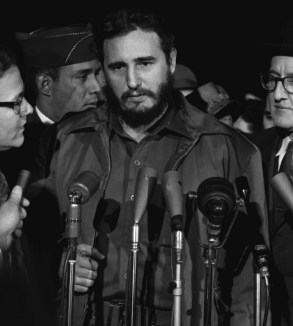 American satirist Mort Sahl once said, “If you maintain a consistent political position long enough, you’ll eventually be accused of treason.” Nothing demonstrates this more completely than the life and death of Fidel Castro. Once the darling of the political left, Fidel, dashing revolutionary, somehow, somewhere, turned into Castro, a particularly dickie brand of dictator, universally admonished. Obviously, our times they are a’changin’, but unlike other relics of the 1960s, Castro didn’t change with them. He might have been the last — and possibly the greatest — Cold War warrior, but here, in the 21st century there’s no room for Fidel because all we want to see is Castro. How the mighty have fallen.
 WD Fyfe