 Last week, I discovered a place where the Internet wasn’t alive. It still existed, though. After all, I was just outside Paris, not roaming the orangutan valleys of Borneo. However, when I looked around, I found the www dot world didn’t breathe, pulse or walk on two legs. It was just a machine. It was convenient and smart and autocorrected my spelling, but like the ancient rotisserie toaster in my breakfast-included hotel, it didn’t change my life. It just did as it was told. That’s not strictly true. I never figured out WiFi, for example, but that wasn’t the machine’s fault. I don’t speak technologese in any language. Regardless, it surprised me that within church bell distance of one of the most connected capitals on the planet, young people had unmasked the omnipotent Internet for what it is – a tool.
I love the internet. It’s the greatest thing to happen to humanity since Gutenberg decided that the big money was in Bibles. And like Gutenberg, the Internet has gone from changing history to shaping it — in just a couple of decades. Of course, most of the big-gun commentators point out that this is because we’re all connected blah, blah, blah. While that’s true, it’s not the only reason. In fact, a lot of this new-found connectivity has simply trivialized much of our communication. Texting, by its very nature, is not serious. Don’t believe me? Try double-thumbing your way through a complicated conversation sometime. It can’t be done! Personally, I prefer Graham Bell’s 19th century technology when I want to argue a point, if for no other reason than there are no passive aggressive LOLs or LMAOs to get in my way. Of course, as in poker, if you’re going to be serious, you need to see the other person’s eyes.
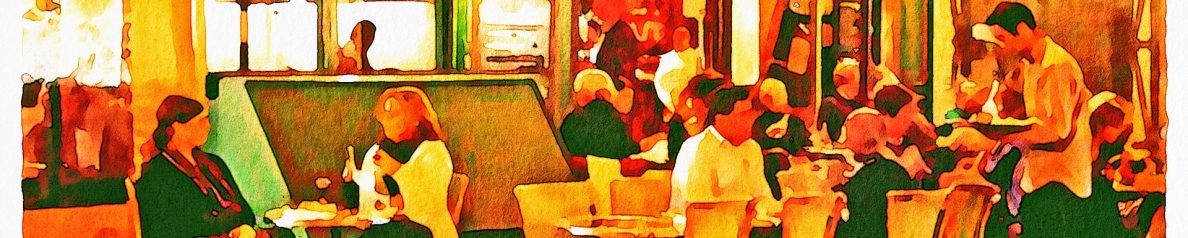
That’s what the French kids were doing in a couple of cafes just outside Paris. The national election was over and they were talking politics the way their grandparents did (just short of the other fellow’s nose) but with an extra kick. Every once in a while an animated face would drop back and, with a few finger strokes, reach into cyberspace and haul out a fact. The Smart Phones then became part of the argument presented like evidence in a court of law. “Hollande said this. Look! It’s right here!”
This is what the Internet really is: a democracy of information. It gives each of us the same opportunity to be just as smart as the rest of us — or the best of us. We are no longer ignorant savages. We have the world’s mightiest tool at our disposal: knowledge. It doesn’t matter whether we want to know how to tie a Windsor knot or build a flying buttress, the Internet can show us how. Those French students were going through encyclopedias of information at warp speed so they could wade back into the discussion like political fencers armed with sharpened epees. They were using the Internet for its primary purpose: a vast depository of the world’s knowledge – everything from Herodotus to Sam Huntington — delivered to the palms of their hands by a digital Prometheus.
But remember: Prometheus was punished for giving gifts to humans and fire unleashed can be destructive. For the most part, the Internet has been hijacked by social media — Facebook friends “Liking” everything under the sun and telling each other what they had for breakfast. Serious debate has been overshadowed by Angry Birds™ (a great game, I might add.) However, for a couple of days, I saw what the Internet was supposed to be: a really, really smart intuitive machine. Like a paintbrush or a chisel, capable of greatness in the right hand and practically useless without a hand to guide it.






 WD Fyfe