The Stanley Cup Playoffs: The Rites of Spring

Although it’s going unnoticed by most of the world, today is the start of the toughest sporting event on the planet: the annual Stanley Cup Playoffs.  Yes, I know: World Cup is the Big Kahuna; more people watch baseball; rugby is strength and stamina; and Aussie Rules Football is nothing short of legalized assault and battery.  But, big wow!   Kilo for kilo, the National Hockey League’s Stanley Cup is the hardest trophy on Earth to play for and the most difficult to win.  Tonight, sixteen ice hockey teams will start a two month marathon which is the most grueling tournament in professional sports.  Lord Stanley’s Cup is reserved for the mentally strong and the physically resilient; no others need apply.  If you can’t cut it, go home: this is a game for the brave.

The rules of the Stanley Cup Playoffs are simple: win 16 games – four out of seven against each opponent.  If you do that, the Cup is yours and, unlike most professional trophies, you can do what you want with it.  Most players take it back to their hometowns to show the parents and their old friends what they’ve been doing for the last couple of years.  That’s the thing about the Stanley Cup: it has an old time feel about it.  It’s small town puppies and lemonade, not big city glitz.  The teams might be located in New York and Los Angeles, Toronto and Montreal, but the players come from Pincourt, Grimsby, Livonia and Ornskoldsvik.  They are the boys of winter who learned the game after school.  They played on artificially frozen ponds, just like their grandfathers did on the real thing.  They understand the heritage of the game and the structure.  They know what it takes to win: straight-edged mental toughness that destroys your opponents’ will before he does that to you.  So every second night (or thereabouts) for the next two months, young men will lace up their skates and fly at each other in a series of full-contact ballets, choreographed at 35 MPH.
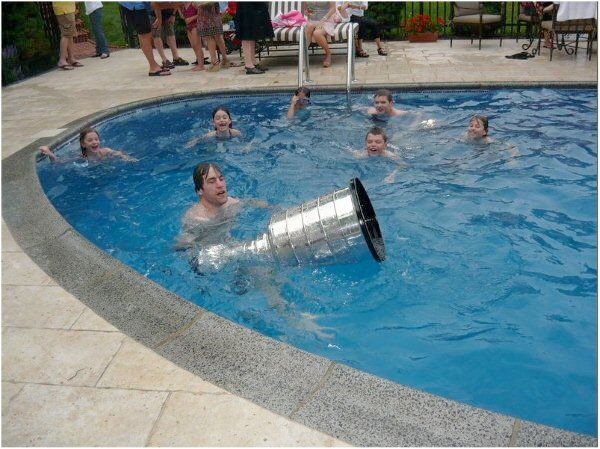
Directing a 3 inch rubber disc with a curved stick on glare ice takes the hands of Picasso.  Delivering and absorbing punishing body checks in full battle dress takes the physique of Baryshnikov.  Constantly remembering your place on the ice — at top speed — takes the concentration of Boris Spassky and Bobby Fischer combined.  But to do all these things, night after night, travelling back and forth across the continent can only be learned by the self-discipline of desire.  These boys want the Stanley Cup more than anything else in the world.  As children, they dreamed about it and practiced and skated alone with the puck until the stick they carried became an extension of their arm.  As adolescents, they lost teeth, forgot birthdays and missed the girlfriends they grew up with.  Now, as men, they are willing to tape up their injuries, stitch up the gashes, patch over the bruises and ignore the pain and nagging fatigue to take just one skated circle with the Cup in their hands.  Superstition has it that no hockey player may even touch the Cup until he wins it.

To the hockey tribes of North America, the game is more than bone-jarring collisions on YouTube, bare knuckle brawls and concussions.  It is chivalry on ice, played by contemporary knights, with no quarter asked or given.  It is brutal finesse; the meeting of Hermes the Swift and Thor, the Thunder God.  But the Stanley Cup Playoffs are not just a war of attrition, nor is the Stanley Cup a trophy given only to the strong.  In the end, when one team steps forward to touch the Cup for the first time, it will be their mental tenacity that prevails; the strength of mind that has always carried the warrior spirit forward.  It is that indomitable voice that says to each player night after arduous night — “Once more into the breach  … once more.”

I’ve never wanted anything that badly.

Happy Holidays?

One of the annoying things about living in the modern western world is that everybody complains so much.  There isn’t a day goes by without somebody having a nasty word to say about something.  And when it comes to high holidays like Christmas and Easter, the bellyaching reaches fever pitch.  Yesterday, sitting around the after dinner chocolate and ham, some incompetent wag (who shall remain nameless) came up with the oh-so-original: “Easter is crap!  How did we get from Christ on the Cross to bunnies and chocolate eggs?”  I suffered in silence for at least two seconds before I explained that it was a conspiracy by the Medieval Christian church to decrease the chicken population.  By convincing the peasants to collect, boil and colour eggs every spring, the priests kept the food supply at subsistence levels and thus kept the ignorant peasants in perpetual servitude.  Okay, I’m a dick, but I’m not sure she didn’t believe me.

In fact, the road from the crucifixion to the Easter Bunny was a simple case of marketing.  The early Christians were not as stupid as some people seem to think.  They knew they were the new kid on the block and it was going to be difficult to convince the heathen hordes of Europe to abandon their gods for this new guy.  After all, the pagan religions of the time were all about Mother Earth and fertility — which meant plenty of sex, wine and playing the lute (the 5th century equivalent of sex, drugs and rock and roll.)  Persuading people to give that up for abstinence, prayer and penury was a tough sell.  However, the Christians realized that the pagans had some pretty healthy spring festivals already available that celebrated the end of winter.  What they did was attach Christ’s resurrection and the renewal of the spirit to the established idea of the renewal of the earth.  From there, it was mere baby steps to preaching the gospel in terms that the local peasantry could understand.  In fact, the name “Easter” probably comes from the ancient Anglo-Saxon goddess Eastre.  She was the goddess of the dawn and fertility, and her symbols were the egg and the rabbit or hare.  The Christians just cashed in on her popularity and slowly squeezed her out of the picture.  Actually, by the time The Venerable Bede was writing about her in the 8th century, she was already ancient history.  Not bad for a bunch of religious fanatics without a marketing degree among them!

The early Christians’ sizing up local festivals and parachuting their man into them gives us a glimpse into why we have holidays in the first place.

Way back in the day — before weekends, paid vacations, stress leave and personal time — life, for the vast majority of people, consisted of toil.  People worked; that’s what they did.  Their lives depended on it.  In general, as soon as you could walk, you worked, and when you couldn’t walk anymore, you died.  It was a dismal existence.  Since most people grew their own food in those days, the only change to this trudge to the grave was the seasons.  The necessity of pleasing and pleading with the gods for fair weather and a good harvest gave rise to elaborate ceremonies.  These occasional attempts to invoke the gods were opportunities for celebration.  People took their noses away from the grindstone and their shoulders away from the wheel to party.  In the autumn, when the harvest was done, it was time to sample that year’s grape crop and eat everything that couldn’t be preserved.  In the spring, after planting the crop, fertility was everybody’s responsibility, so getting naked in the sunshine was what the gods intended.  These pagan rites were the perfect place for the early Christians to deposit their saints, their rituals and their religious holidays.

Non-religious holidays came much later.  Kings might grant a special feast day to celebrate a military victory or the birth of an heir, but it wasn’t until the Age of Reason that secular holidays became institutionalized.  Yet, even up until the early 20th century, there weren’t that many holidays.  Days like Labour Day and Thanksgiving are fairly recent additions.  However, since the 1950s we’ve gone nuts and now there are very few days left on the calendar which don’t have some significance.  We have Mother’s Day, Father’s Day, Secretary’s Day, Boss’s Day, Valentine’s Day, Groundhog Day and on and on and on.

Yet, in the land of plenty, where we can celebrate minor saints and jumped-up rodents, there is always somebody with a sour word about it.  Holidays are a modern invention, and given we have so much to celebrate, it would be nice if we could just shut up and enjoy them.

This Generation and the Light at the End of the Tunnel

We do not live in a sophisticated age.  It’s a shame, but it’s true.  Our intellectual prowess is centred on finding the E! News app for our Smart Phones.  Our curiosity is confined to Kim Kardashian’s matrimonial motivation.  Our music is repetitive; our films derivative and our artistic vision still focused on Paris Hilton’s bum (although we’re all getting a little jaded with that.)  In comparison to most of recorded history, our time is, like the Dark Ages, distinctly low-end.  This is no sin, by the way.  As just about everyone has cliched (about almost everything) in the last six months: “It is what it is.”  So I come not to bury our time, but to praise it.

A Mogul like luxury covers our brutish world.  It disguises the crude nature of life in the 21st century.  We believe, therefore, that living vertically — with running water — makes us culturally superior to those in history who didn’t.  However, as convenient as peeing inside on a cold winter night might be, it has nothing to do with our contribution to the continuity of the human experience.  Simply put, we’re barbarians with indoor plumbing.

Just look around.  Ours is an angry world, thinly veiled by repeated assurances of tolerance.  Our conversations are so laced with profanity they’re incomprehensible.  We constantly call each other names — off-handedly.  “Bitch” is an all-purpose descriptive, eagerly applied across the genders, and it’s the mildest of our nominals.  Anatomical insults are mandatory in any conversation, just to demonstrate our total disregard not only for the opposing opinion but also for anyone who espouses it.  In the same vein, we conduct our disagreements with loud not logic, shouting like Visigoths to show the passion of our principles.

Sexually, we behave like parochial tribesman, mistaking smut for sophistication.  We hang on every slyly exposed curve of the female body, giggling like villagers at everything from a skirt lifted on an unexpected breeze to heavy-handed wardrobe malfunctions.  To prove our sophomoric enlightenment, we’ve made female breasts de rigueur in visual entertainment (everything from commercials to sitcoms.)  Likewise, gratuitous nudity is a Cable TV staple and amateur porn a celebrity necessity.   We’ve turned sensual privacy into random exhibitionism, based on a smirking philosophy dedicated to underhanded titillation.  Sex is so overvalued in our society it’s no wonder young people are too confused to do it properly.

Meanwhile, we’ve undervalued education.  Scholars are labeled nerds or geeks or worse.  They have taken such a back seat to the beautiful among us that recently the number one career ambition for girls in North America was Reality TV star.  The Kardashians might be smart business women (which I think they are, BTW) but obviously that isn’t the role model message they’re providing.  It’s common knowledge that Bill Gates, Steve Jobs and Mark Zuckerberg all dropped out of school, a fact pointed to with pride by every never graduated student with visions of grandeur.

And what is our vision of grandeur?  Indolence!  Couch potato-ing, social networking and gaming are now the world’s fastest growing activities.  More people play Farmville™ than actually farm.  More people are creating urban utopias in Sim City’s™ many incarnations than are at work on real urban problems.  And more people are engaging in criminal activity in Grand Theft Auto™ than are employed in law enforcement.  Our collective energies are being harvested by computers at an alarming rate.

This will be our legacy to the continuum of civilization.  As we persist in our relentless pursuit of leisure, we will demand more and better machines to do it with.  And not just handheld gadgets to take pictures or play games, but machines that will keep us alive, drive for us, cut our toenails and deliver pizza.  This is no sci-fi dystopian nightmare but a genuine and optimistic glimpse of our future.

History shows that the insatiable craving for spices, treasure and slaves drove the Europeans out of the parochial ignorance of the Medieval Age.  Their exploration and exploitation of the world funded the flowering of the Renaissance.  So, too, will our insatiable need for amusement drive our technicians to digital places as yet unimagined.  The playthings they produce will fund future and wiser generations.  When history views us (and it will) our monuments won’t be pyramids and cathedrals erected to the glory of our gods.  They will be miniature screens and gigantic TVs, lost in the dusts of obsolescence.  And when history judges us (and it will) we won’t be guilty of squandering our resources on smutty celebrities.  We will be praised for driving a mechanical revolution with our laziness.

We might be dumb, inarticulate and rude, but we’ve gotten used to sitting on our ass; now, we demand it.