A Penny Saved is a Penny Lost

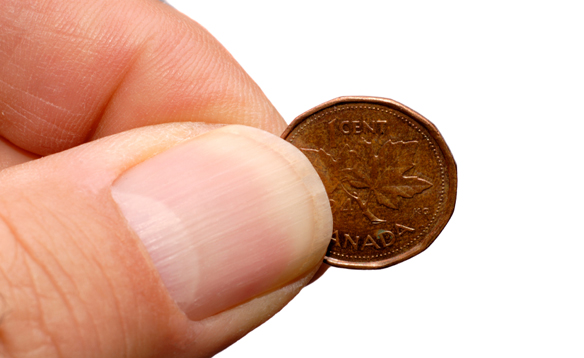
Last week, in a fit of uncontrollable common sense, the Canadian government decided to quit minting the penny.  According to the Finance Minister, it was costing Canadians 1.6 cents to produce the one cent coin.  A quick run to the calculator puts the annual loss at approximately eleven million dollars — which isn’t chump change, even to a national government.  So, as of sometime next autumn, Canadians will no longer get pennies from heaven, buy penny loafers or play the Beatles song “Penny Lane.”  They will have to give a nickel for your thoughts and keep their two cents’ worth to themselves.  Okay, I’ll stop now.  Actually that’s about the extent of the Canadian reaction to the penny’s demise.  Nobody cares.  After all, how worked up can you get when you have the world’s most uber-stable banking system and you call your national currency the Loonie?

Personally, I’ve always liked the penny.  Slowly accumulating in the jars of my youth, it was my ticket to Batman comics and small brown bags of candy.  That was back in the days when coins were currency, and paper dollars were reserved for birthday cards.  However, noble as it once was, the penny has become a pariah: a horrid little coin that nobody wants.  It adds weight but no value to our pockets; it cheapens the charitable donation and provides the most striking of insults to the restaurant tip.  It is money in name only; left unguarded in “Take a penny: leave a penny” retail counter dishes.

Of course, the penny itself doesn’t matter.  Nobody is going to miss it.  There will be no indignant parents tearing up over their child’s lost piggy bank experience nor angry university blowhorns demanding the government reinstate the penny for the poor.  The penny will fade out of time and memory, just like the groat and the farthing before it.

However, the larger question is not confined to pennies but to currency itself.  How deep is our commitment to money in its tangible form?  There are those who argue that our world has now transcended money, and cash actually causes more trouble than it’s worth.  As long as there are old guys like me around, those folks might be jumping the gun a bit.  However, even I have the feeling they’re right, and we’re less than a generation away from a cashless society.

These days, the only people who use cash on a regular basis are dinosaurs, drug dealers and the Salvation Army.  Obviously, the Sally Ann and the Los Zetas cartel do it out of necessity.  However, the rest of us, who don’t need to look like Tony Soprano every time it’s our turn to buy lunch, rely on dots of data emanating from our credit cards.  It’s quick: it’s easy, and, most importantly, it’s safe.  Meanwhile, back at the ranchero, paying our household bills online is becoming the norm.  Internet commerce will soon outstrip bricks and mortar shopping in cash flow, even though there’s no cash involved.  And only the Tech-gods know what kind of purchasing power our Smart phones are going to have by this time next year.   Folding money is losing its commercial dominance.  In fact, if you want some serious grins, go try booking a hotel room with cash or renting a car or even paying your phone bill.  Money still talks in the 21st century, but it’s getting a little hoarse.

The fact of the matter is it makes just as much sense to base our net worth on binary code as it does shiny metal or coloured paper.  Money, whether it’s gold ingots, sweaty twenties or American Express, is a question of faith.  It’s not the object itself; it’s its purchasing power.  We lost faith in the penny many years ago when it quit buying us things.  There are no more penny arcades, no penny candy and “penny ante” is an expression of derision.   That’s why the penny now lives in the fuzzy back corners of our office desk drawers (with the sprung paperclips and the bent pushpin) orphaned by the speed of a modern society which no longer has time to pinch its pennies.


Dogs are from Heaven; Cats are from Hell

As I’ve said many times, I’m totally pissed that I’m never going to be able to view my time as history.  You see, in the future, we’re going to know so much more about ourselves and our world that it’ll be as if somebody turned on the lights.  I’m not just talking about technology, either, or science.  I’m talking about real discoveries.  Things like why there are always at least three lines at the DMV but the one we want is always the longest.  Or why all the really cool people are always at another table at a wedding and we’re stuck with somebody’s deadbeat aunt.  Or how come we can never think of that witty retort until after the jerk with the attitude has left the building?  This is important information, and eventually, we’re going to know this stuff.

For example, we’re going to understand why cats hate us and dogs are the perfect pet.  I’ve got nothing against cats, BTW.  One of my favourite pets ever was a cat: Diega, who’s now in the witness protection program.  (It’s a long story for another time.)  But, let’s be honest: cats are adorable on Facebook, but try living with one.  Even dedicated cat people have some bloodcurdling tales to tell – mutilated mice in the bathtub during the in-law sleepover; slimy hairballs, coughed up on the boss’s cashmere lap; and deep childhood scars from “kitty has pins in her toes.”  Sound familiar?  Dog people never talk like that.  You never hear horror stories from a dog person.  And no complaints.  They never say, “I don’t know what I’m going to do.  Fluffy just won’t eat anything but imported French dog food.”  Dogs will eat anything.  They eat bones and crap that nobody else can even look at.  A dog’s motto is “Go to the bowl: good things happen.”  Meanwhile, a cat will turn up its nose at free range $25.00 per lb hand ground salmon.  Then, not an hour later, it will go out in the alley and kill a totally scabby, wantonly diseased sewer rat and drag it home as snacks for the whole family.

But that’s the difference between dogs and cats, isn’t it?  Dogs are straight-ahead, and cats are devious.  If a dog’s angry with you, he chews your shoes.  If a cat’s mad at you, you’re in trouble.  A cat will wait for two or three weeks — until the night before you have the presentation of your life happening at 8:00 a.m. sharp.  That’s the night — all night — that it’ll have outrageous screaming sex, right outside your bedroom window, show up five minutes before you have to leave and shed all over your perfect black dress.  That’s not cute; that’s malicious!

Personally, I think cats hate us because they missed the first 50,000 years on the domestication train.

Way back, at the dawn of evolution, when humans ran in packs, dogs did, too.  We must have encountered each other somewhere along the trail.  Humans probably thought, “Those guys aren’t very good to eat, and they’re really difficult to kill.  So let’s leave them alone unless we’re desperate.”  Dogs probably thought, “Those guys have puny little teeth, no fur, and they can’t hear or smell worth a damn.  There’s no way they’re gonna survive.  Let’s hang around until they can’t keep up with their pack, and eat ‘em.”  Over the course of hundreds of generations, the two species got used to each other.  Humans discovered that dogs were really good at finding food.  All hunters had to do was follow the pack to get to the good stuff.  Dogs, on the other hand, figured out that even though humans were pretty much useless, in close, they were kick-ass dangerous and could bring down the big boys like mastodons.  All a smart dog had to do was bark and snarl and keep the prey at bay until the humans got in there with their pointy sticks.  Then it was Happy Meals™ for everybody.  Plus humans had fire, which, thumbless, a dog could never master.  But fire, under control was just the ticket for a frosty canine on a cold winter night.  Meanwhile, as dogs crept closer to the fire, humans found that, after dark, with their superior smell and hearing, dogs were the perfect burglar alarm.  It made sense to let them cuddle up to the warmth if they wanted to.  Over the course of a couple of hundred more generations, humans and dogs became inseparable.  They lived together, hunted together, their kids played together and they all ate the same food.  So it was only natural dogs and humans became BFFs*.

Cats, Johnny-come-latelies to domestication, have never really gotten over the special relationship humans have with dogs.  They see it as an insult to their self-diagnosed superiority.  Remember, cats didn’t start hanging with humans until the Egyptians turned them into gods for killing rats.  That little theological faux pas went directly to the feline ego and has been stuck there ever since.  These days, cats still think they’re gods almighty, and being cats, they want the lion’s share of human attention.  When they don’t get it, they go looking for revenge.

Of course, this is only my theory — which I’m never going to be able to prove.  Unfortunately, I’m not going to be around when humans and dogs develop two-way communication and we humans can finally just ask dogs, “What the hell’s wrong with cats, anyway?

*(Yes, I know, way back when, humans ate dogs.  In some parts of the world they still do.  But we’re talking millions of people over thousands of years, and dogs are intelligent enough to overlook the occasional act of barbarism.)

In Praise of Higher Education

A couple of weeks ago, I got into a hopeless discussion (argument, for the uninitiated) with some young people (under 30) about education.  I haven’t taken a beating like that since Betty Jones (not her real name) and her 2nd grade boyfriend decided my lunch was more interesting than hers.  The problem was, in both cases, no amount of reason was going to be sufficient to change anybody’s mind.  Unreasonable people, with big boyfriends, have a way of winning discussions.  In the early part of the evening, I relied on Aristotlesque logic.  I laid out concise theses, which I supported with facts and observations, which in turn, naturally led to the only possible conclusion: mine.  Q.E.D!  Their response was “Crap!” (or a somewhat stronger version of said same.)  I spent the rest of the night — and at least two more bottles of wine — fighting for my verbal life against wave after wave of anecdotal evidence, non sequitur reminiscences, rhetorical questions and profanity.  The kids were clearly angry about the fuzzy end of the lollipop they had received at the hands of liberal education, but they couldn’t articulate it.  Therefore, even though I knew they were intelligent young people, they looked just about as dumb as they assured me they weren’t.

I’m not going to rework the discussion here.  That wouldn’t be fair.  But my position was “Stay in school you’re going to need it” and theirs was, the oft repeated, “Crap!” (or a somewhat stronger version of said same.)  This really surprised me, because my generation and every generation before mine has worshipped education.  Ever since Gideon outwitted the Midianites, it’s been seen as, not only the magic carpet of social mobility but the keys to the bank vault.  Even in the darkest of the Dark Ages, education was the one thing that gave ordinary peasants a leg up in society.  A millennium later, our contemporary world is so compartmentalized that, without a specialized education, you are almost certainly relegated to tier-two employment – Starbucks, et al.  Either that or you could luck-out and land a union-protected public service job (but you might want to buy lottery tickets on that one just to be on the safe side.)  Of course, there is intrinsic value in learning for its own sake.  Nobody denies that, but practically speaking (which is all I was doing the other night) it’s all about where the money is.

My young friends beg to differ, however.  They see education as a great wormhole that eats time, energy and student loans, then shoots them out the other end, no wiser, several years older and deeper in debt.  While admitting that post-secondary education is indeed a necessity, they also see it, for the most part, as a waste.  Their argument is, why should they spend four years and forty thousand dollars for information they already know or can find on the Internet?  To them, a liberal education is merely a thinly disguised tactic to keep them out of the job market for as long as possible, and a single university or college degree is a ticket to poverty.  The “piece of paper” as they call it, with disdain, is not essential preparation for future employment but an artificial barrier to their own advancement.   With it, the only guarantee is student debt.  There are not that many high-priced jobs going begging these days, and experienced expertise trumps recent graduation, every time.  Remember, these kids are making cappuccinos with a lot of underemployed PhDs.  However, without a diploma (of some sort) there is a serious top end to whatever employment they find.  Whether they’ve landed their perfect career/job or they’re just getting a pay check, without accreditation, they’re going to stay where they are for an awfully long time.  It’s a no-win/no-win situation, and they know it.

To be fair, the kids have a point.  However, they’re missing some essential ingredients.  First of all, the big bad world out there has never heard of them.  Education is the hello handshake that separates them from the herd.  To be brutally honest, to employers, a degree is just shorthand for “at least the guy hung in there for four years.”  Secondly, education, off its own bat, is useless.  It needs thought and practical application.  Getting a degree in Earth Science, Medieval Dance or the infamous Art History is indeed a ticket to poverty.  Our society is awash in people who found that out – the hard way.  The trick is fitting education to employment, even if it isn’t a perfect match.  Sometimes, the difference between doing what you like and making change at Chevron is flexibility and imagination.  Finally, and most importantly, only about half of post secondary education occurs in the classroom.  At this level, gathering information is nothing serious.  The kids are right; it’s all on the Internet.  The important stuff is learning the complex skills of analysis, organization, communication and time management, to name but a few.  The smartest person in the world is just a German Shepherd with a thumb if he can’t find his notes, doesn’t have the discipline for deadlines or can’t express his ideas effectively.  Anybody can Google “the capital of Poland,” but it’s post-secondary education that teaches us how to use that information.

It might have been the wine, but I wasn’t this articulate the other night.  Maybe it’s time for Round Two.  After all, I met Betty Jones years later, and we came to an understanding over a couple of churros and a bottle of Kahlua.