 In medieval Europe, there was a festival held every year in the run up to Christmas. It went by a number of different names and a number of different shapes, but essentially it was the same all over the continent. If I were an anthropologist, I would tell you that it was a mutation of the old Roman celebrations for the god Saturn, hijacked by the early Christian church. And that it was also tied to the even earlier local animistic rituals connected to the Winter Solstice. However, I’m not an anthropologist, so to me, the whole thing was just a drunken bash. The Medievals would get together just before the onset of real winter and party – mainly because they weren’t sure if they were going to make it ‘til spring. They’d eat and drink, gamble and chase women (or men, depending on which side of the bar wench you were on) until after the Solstice and the solemn occasion of Christmas. Then they’d hunker down and try to survive for another year.
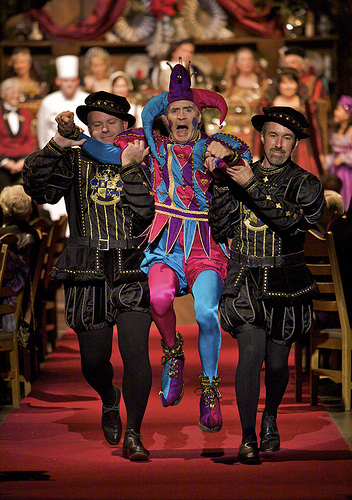
In England, this was called the Feast of Fools or Topsy-Turvy Time. For twelve days (probably the 12 days from our Christmas song) the natural order of society was suspended and turned upside down – the more ridiculous, the better. People wore their hats backwards; shepherds carried their sheep. Peasants stopped toiling and went to the bar; servants were served by their masters, barmaids were treated like ladies, and on and on. The whole thing culminated in a drunken ceremony on the steps of the handiest church or cathedral, where the unruly crowd grabbed the dumbest Dumb and Dumber oaf among them and crowned him the Lord of Misrule. He presided over a feast that ate and drank into the early morning. Over the centuries, these parties got wilder and wilder until they were finally banned, in 1512, by Henry VIII, a guy who knew how to party. (That just tells you how crazy it got.)
It has stuck me recently that we live in Topsy-Turvy times — except for us they’re all year round. The natural order of our world has been bent to the breaking point and little or nothing we do makes sense anymore. For example, our cities are spending tons of money every day, trying to accommodate the needs of the ubiquitous Occupiers: things like extra police, fire and paramedical personnel, sanitation facilities and the essentials of water and trash removal. These things cost money that our cities wouldn’t normally be spending. Yet who’s complaining about these extra expenses? Ordinary taxpayers! This is exactly ass-backwards. Let me explain.
 Normally, aside from walking on the streets or calling the city to complain about potholes, ordinary people don’t have much contact with their civic government. They go to work, come home, rake their leaves, lock their doors at night and shut up about it. Come election time, they vote (in ever decreasing numbers) and once a month, they pay their rent or their mortgage, and that’s about it. The majority of people in any city don’t even know what services, aside from garbage pickup and community centres, their cities offer. They don’t need to; they don’t use them.
On the other hand, in every city I know of, there’s a group of people (and it’s getting larger by the minute) who not only know what services are available but actually need them to survive. These folks, on the bottom end of our social order, are in dire straits. They need homeless shelters, drop-in centres, clinics, paramedics and way more police protection than the rest of us. Their very lives depend on the money the city passes around to the various and sundry agencies and institutions dedicated to helping them. If that money is being spent someplace else, it has a direct impact on their quality of life — such as it is. Thus, money spent on Port-a-Potties for political activists is literally being taken out of the mouths of the homeless.
It doesn’t make any sense for ordinary taxpayers to complain about the whack in the wallet the Occupiers are giving us. That tax money is allocated long before we ever write the cheques, on stuff we’re never going to see anyway. The city managers could just as easily take it down to the local casino and drop it on 14 Red at the roulette wheel, for all we know. For example, thousands of dollars in my city was spent to encourage children to grow wheat in their backyards. That didn’t impact my quality of life one bit. I didn’t get any wheat, but that’s okay: I wouldn’t know what to do with it in the first place. My point is the money’s gone, folks, and Occupiers or not your tax assessments are going to go up next year.
However, the people who should be bitching, loud and long, are the disadvantaged among us who have a long, cold winter ahead of them. The money the city is spending on aid and comfort to the Occupiers is all immediate costs. If nothing else, overtime has to be paid, and that’s real cash – dollars and cents. At some point, city services are going to suffer — just to make ends meet. After all, that annual tax increase isn’t going to come until late next year, which is a little late when the snow’s gonna fly in January. Personally, if I was digging in a dumpster behind KFC, trying to find breakfast, I’d be a little tight-jawed to see a $20.00-an-hour city worker getting time and a half for extra clean-up at the local protest. A couple of thousand dollars a day is big money when food and shelter are an occasional luxury.
So here’s the deal. The people who are going to take the biggest kick in the groin from the uber-extra city expenses are oddly silent on the subject — whereas they should be the ones howling, to claw back some of that money, as if their life depended on it (which, in fact, it does.) Meanwhile, the folks who really aren’t affected by what the city spends (because they have to pay for it, regardless) are roaring away like a lion with a thorn in its paw, just as if somebody at the other end was actually listening.
Me, I want a spot in the front row, when we finally get it over with and crown the Lord of Misrule.



 WD Fyfe