Eagerly Offended: Our Brave New World

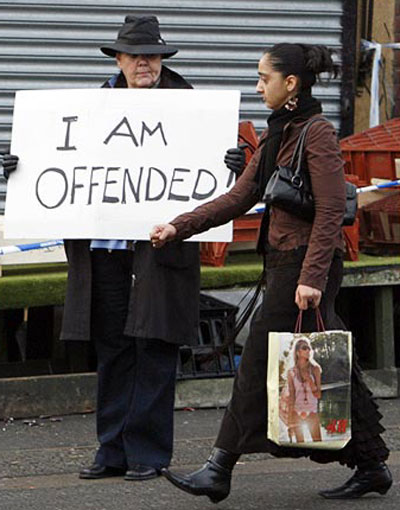
offendedI doubt that congratulations are in order, but as of this week, our world finally hit critical mass on the “I am offended” scale.  In less than a day and a half we went from a society that was merely easily offended — by pretty much anything — to one that is now eagerly offended by it.  Therefore, as of close of business, January 30th, 2013, we are currently self sustaining in the injured feelings department and will remain constantly offended by one thing or another for the rest of all time.  My, but we do live in a curious age!

The Malcolm Gladwell Tipping Point, that threw us into this abyss of indignation, came during this week’s hype-up to the Super Bowl.  No, it wasn’t Ray Lewis mouthing off about the devil.  Quite frankly nobody’s on his side (the devil’s that is, not Lewis’.)  Nor was it Taco Bell getting its ass kicked by a bunch of militant vegetarians.  They were the ones who were so offended by Taco Bell’s “attack ad” on healthy eating that they made the faux Mexican fast food chain withdraw its Super Bowl mega-mercial in abject shame.  (Frankly, I never realized vegetarians were an identifiable activist group.  I thought they were just people who didn’t eat meat.)   No, the straw that proverbially pushed us from “easily” to “eagerly” was an innocuous player interview from the three-ring media circus.

The radio interview of Frisco 49er cornerback Chris Culliver (BTW, I’m a Raven’s fan so I have no self interest in defending Mr. Culliver.) was probably cliché-ing along quite nicely when interviewer Artie Lange asked if there were any gay players on the 49ers.  Culliver’s murky, meandering answer amounted to assurances that he was a heterosexual, his team mates were heterosexuals and nobody in the 49ers’ locker room was interested in exploring any alternative sexual orientation for at least a decade.  The loud and proud crowd jumped on the guy faster that you can say leisure-class activist.  They hauled out their own battalion of clichés – homophobia, intolerance, discrimination etc. and made their usual demands – a personal apology, a corporate retraction and some force fed re-education for the offending member.  The 49ers’ organization reacted immediately, tremblingly obeyed, and all was right with the world again.

Unfortunately, as per usual, people were offended by the wrong thing.  It’s offended1beyond my comprehension why nobody was pissed off by the question itself.  Rhetorically speaking, why did Lange even ask it in the first place?  What the hell does homosexuality have to do with football?  I doubt very much if Raven’s Coach Harbaugh (John) called his players together and said, “Listen up!  My brother, over in San Fran, has got himself a couple of homosexuals on defence, so we’re going to overload the strong side on 3rd and long situations.”  Sexual orientation just isn’t part of a winning football strategy.  It would have made just about as much sense for Lange to ask how many Norwegians were on the team; more, actually, since Norway is not what you’d call an American football powerhouse (no offence, Norway.)  Yet, Artie got off scot free (no offence, Scotland, or Dred Scott or whoever — My God, there’s no end to it!)

My point is somebody is always going to be offended by something.  This is as natural as homosexuality itself.  However, bringing up contentious issues at every possible inappropriate opportunity is actively seeking to be offended.  There’s no second choice on this.  Lange didn’t ask the question because he genuinely thought the world needed to know the straight-to-gay ratio on the 49ers.  He askeoffended2d it to see if he would get a stir-the-pot response.  He did.  The usual suspects were shocked and appalled, and our society gasped in some kind of sicko socio-emotional masochistic satisfaction (no offence, masochists.)

It comes down to this: go ahead and be offended if that’s what makes you happy.  However, don’t go striding around as if you’ve just been confronted by the antiChrist.  As of a couple of days ago, it’s pretty obvious that getting offended in our society is something we’re doing on purpose, and it’s now just as institutionalized as the Super Bowl!
Apple: A Misguided Religion

Sometimes I think I’m the only person on this planet who’s fed up with Apple.  Yeah, yeah, yeah — I know!  They’re the uber coolest company of all time; they invented all the iCrap that nobody but your grandma uses anymore and oh (like I could ever forget) Stephen Jobs never wore a tie!  But for God sake’s, guys!  Get over yourselves!  You’re not a religion, no matter what your basement dwelling followers tell you.  In the real world, above ground, the only difference between Apple and every other Tom, Dick and Harry tech company is price.  Apple stuff is so wildly overpriced it’s a wonder anybody at the iStores, from manager to minion, can even look at themselves in a mirror in the morning.  Saying Apple is proud of their products is like saying Kim Kardashian is a media whore.  D’uh!

Normally, I leave Apple alone.  Way back in the day, I had a Mac — I loved it – but I grew up and outgrew my burning need to “share” odd photographs, soft core porn and my particular taste in music that week.  However, yesterday (believe me, the date doesn’t matter) Apple introduced yet another new iSomething and I wondered what it was.  Then, like a perpetual old fool, I took a gander.  Apparently, this most recent Galileo moment in electronic history is a new iPad, which looks so strikingly similar (inside and out) to the old iPad as to be the same machine.  In fact, aside from a memory tweak, it is the same machine.  Yet, despite this obvious sleight of hand, the reviewers were going onapple5 as if the da Vincis down at Cupertino, CA had just revolutionized computering in the 21st century.  According to them, this was the greatest human achievement since triple bypass surgeon — at merely twice the price.  Nor were they done!  After singing iPad 4’s (4.5? 5? 29?) praises until they got writer’s cramp, they went on for seven or eight more paragraphs in speculative hallelujahs about what Apple was going to come up with next.  It was like listening to Tom Cruise talk about L. Ron Hubbard.

I’m not very tech savvy, and I don’t want to go all Dennis Miller on the thing, but let’s stop for a minute and take a look at what we’re dealing with here.  Essentially, the iPad, in whatever number sequence Apple wants to give it, is an oversized, overpriced smart phone that doesn’t make telephone calls.  It’s as big as a turkey platter with more memory than any average human being can possibly use, a camera that can pick out nasal hair at 50 paces and solid walls of Benny and the Jets sound, if that’s what you’re into.  However, with a price tag that would bankrupt a Mexican drug lord, it doesn’t give you anymore battery life or connectivity than my $49.00 Samsung – which, BTW, fits in my back pocket.  iPads are so conspicuously large you can’t manipulate them with fewer than three hands.  Plus, even though they weigh less than lunch at Taco Bell, their side to side size dictates they don’t actually fit anywhere.  This sheer unbendable volume makes a mockery of their primary purpose – portability – and there are no other redeeming features, like a workable keyboard, to compensate for that.  In a reasonable world, iPads would be the new Betamax — with a commensurate consumer shelf life.  Unfortunately, we don’t live in a reasonable world.

apple3I’m not dissing Apple just for the hell of it.  I’m not a committed Android, Microsoft, Blackberry or anything else, user.  Honestly, I don’t know enough about what makes what work electronically even to have a choice.  However, I do know a con job when I see one.  For my money, when you have two items that look the same, act the same and were probably made in the same factory, but one costs more than three times as much as the other one…well…B. T. Barnum was definitely right.

It’s obvious; the real thing Apple is selling is “cool.”  So be it.  If you can sell the sizzle off a bad cut of meat, you’re a crooked jerk, but all the more power to you.  My problem is the boys down at the Apple clubhouse think they don’t put their pants on one leg at a time like the rest of us.  And every time I mention it, I get the Stephen Jobs/Johannes Gutenberg lecture.  I agree; the guy was a genius, but that doesn’t give him (or his post-mortem company) the arrogant right to gouge everybody.  But what really burns my bacon is that even though most people outside the Apple cabal realize it’s not the one true path to enlightenment nobody is willing to admit it – except, maybe, me.

Happy Birthday, Wikipedia!

wikiWhere does the time go?  I looked around the other day and discovered that Wikipedia was 12 years old.  I remember when it was a stumbling child.  People thought it was cute in those days: an amateur attempt at “all of us are smarter than one of us.”  Of course, real academics frowned on such antics: knowledge was their personal property, and one simply didn’t throw it around promiscuously.  However, even as their teachers scolded, tons of high school students — and more than a few undergrads — were salvaging their GPA with daring midnight raids on Wikipedia’s fact factory.  In the last decade those undergrads have grown up — and so has Wikipedia.  Today, both are shaping the society that a couple of years ago didn’t take either of them seriously.

Wikipedia is the latest attempt at gathering the world’s accumulated knowledge into one mighty force which, since knowledge is power, fears nothing.  The Egyptians tried it, a little over two millennia ago, with The Great Library at Alexandria.  It worked quite well for a couple of centuries, until one sultry night, in 48 BCE, it got in the way of Julius Caesar’s legions, and he burned it down.  Accumulated knowledge has always been at the mercy of fire and the ambitions of politicians.

From that time, despite what various apologists will tell you, it took us seventeen hundred years to try again.  In 1728, Ephraim Chambers, a printer in London, collected everything he and his friends knew to be true, and wrote it down.  The Chambers’ Cyclopaedia wasn’t the first of its kind, nor the best, but protected by the rule of British law and the guns of the newly minted Royal Navy, it not only survived, it grew.  Of course, not to be outdone by their nearest and dearest rivals, the French printed their own encyclopedia, Encyclopedie (Extremely long name) in 1751.  This, in turn, prompted the British to haul in the big boys; awiki1 couple of Scots named Colin Macfarquhar and Andrew Bell, who produced the Encyclopedia Britannica, in 1768.  For the next 250 years, even though there were 1,001 imitations, the Encyclopedia Britannica remained the Big Kahuna of “all ye know” in the world.  And its reputation as the “go-to” guy for “and all ye need to know” was such that the Nazis thought it worthy of incineration in the 1930s.  Had the Nazis spent more time reading books instead of burning them (thanks, Indiana Jones) the world’s knowledge may not have survived the mid 20th century.  Fortunately it did — and after World War II, Britannica (or something like it) migrated to every library and suburban school in the English-speaking world.  It was the greatest mass distribution of knowledge since Gutenberg and a serious blow to a lot of post-war know-it-alls.  Encyclopedias were everywhere, but they still weren’t necessarily everybody’s.  The world’s knowledge was still controlled by an exclusive club.

If you’re of an age, you remember the Encarta discs from the 1990s.  They made every computer in the world a fountain of knowledge, not only readily available, but portable.  Suddenly, everybody from nuclear physicists to primary school children could carry the world’s repository of information in their backpacks — and frequently did.  From there, it was only a few short digital steps to Jimmy and Larry and the final democratization of the accumulated wisdom of the world.

wiki2Jimmy Wales and Larry Sanger launched Wikipedia in January, 2001. It offered the world’s knowledge to the world, without restriction or restraint.  It was information “of the people, by the people, for the people.”  Twelve years later, the sum total of human experience is now available to anyone with a telephone.  Information is no longer the exclusive province of the few – jealously guarded and subject to attack.  Literally billions of people carry it with them, at school, on the bus and where they work.  It cannot be burned, stolen or hidden away.  It is the best defence against the next Adolf Hitler who comes along with a bunch of marching torches and a “better” idea.  The age of the flammable page is over.

Happy Birthday, Wikipedia!  You’ve come a long way, baby!