“Only” – An Unsung Hero!

unsung hero

“Only” is the hardest-working little word in the English language.  It does stuff that other words just dream about.  It modifies nouns, it modifies verbs, it connects phrases and, depending on where you place it, it can change the entire meaning of any sentence.  “Only” has so much talent; I’m sure all the other words are jealous.  But does anybody sing the praises of “only?”  Do you ever hear, “Good job, ‘only?’ or “Thanks, ‘only!’ You really spiced up my sentence?”  Nope!  Never happens!  The truth is, nobody thinks about “only.”  It just hangs out in the dictionary with all the other words (who don’t do half as much work, BTW) waiting for some writer who’s searching for subtletyThat’s when “only” jumps into the literary fray, without hesitation or fanfare, and gets the job done.  And what a job!  Here are just a few examples of what “only” can do.

It can kick-start an argument

“You phone me when you want to sleep with me.”
A legitimate statement, invitation or dismissal.
“You only phone me when you want to sleep with me.”
Suddenly, somebody’s a jerk and the war’s on.

It can convey emotion.

“He lost his friend when his dog ran away.”
Aww, that’s too bad.
“He lost his only friend when his dog ran away.”
OMG!  That’s s-o-o-o-o sad!

It can turn an ordinary evening into something special.

“She was wearing an apron when he came home.”
“She was only wearing an apron when he came home.”

Pair “only” with “if” and you get a ton of regret.

“If I’d kissed her, she wouldn’t have married Malcolm.”
“If only I’d kissed her, she wouldn’t have married Malcolm.”

Lawyers love “only” because it can mitigate the circumstances.

“She robbed the bank.”
“She only robbed the bank.”

But it can also assign blame.

“When the fire started, he tried to save himself.”
What a quick-thinking individual!
“When the fire started, he only tried to save himself.”
Selfish bastard!

Or it can turn a good deed into a reprimand

“She cleaned out the closet before she sat down and watched TV.”
Very responsible.
“She only cleaned out the closet before she sat down and watched TV.”
Lazy snot!

Or it can change the meaning entirely.  And this is where “only” really flexes its muscles.  Take a look at this single simple sentence.

“She told him that she loved him.”

Now, sit back and see how “only” changes the meaning — seven different times.

Only she told him that she loved him.
She only told him that she loved him.
She told only him that she loved him.
She told him only that she loved him.
She told him that only she loved him.
She told him that she only loved him.
She told him that she loved only him.

I think it’s time we all take a moment out of our busy lives, pour a glass and drink a toast to “only,” the unsung hero of syntax and semantics.

“Here’s to you, ‘only!’  Keep up the good work!”

A Few Definitions

definitions

English is a wonderful language.  It works like a river, flowing along, constantly changing and always finding its own level.  Words appear and disappear.  Definitions change.  Meanings mutate.  And, yet, we all kinda understand each other.  To that end, here are a few definitions that might not appear in any dictionary, but I’m sure you’ll recognize them, all the same.

Tomorrow – A place where all human activity and productivity is stored.

Calories – Nasty little creatures who live in your closet and eat the sizes off your clothes.

Avoidance Behaviour – The somewhat boring stuff we do when we have more important boring stuff to do.

Internet – An essential tool of avoidance behaviour.

Pockets – Those things that fashion designers have been denying women for centuries.

Leftovers – Food that lives in the refrigerator for a while– before you throw it out.

Selfies – Photographs of people who have no friends.

Full-length Mirror – A rather useful item when you have clothes on that turns remarkably evil when you’re naked.

Shower – A place to hold imaginary arguments and sing songs that were popular when you were a teenager.

Bae – A stupid, made-up, millennial word that doesn’t mean anything.

Wikipedia – The arbitrator of all arguments.

Exercise – Sometimes pronounced “extra fries,” depending on your self-esteem that day.

Man Bun – A one-size-fits-all way to look ridiculous.

Junk Food – Stuff that everybody eats but nobody admits it.

4 In The Morning – An elusive place where the truth lives.

Family – People who know too much about you to be your friends.

Lottery Tickets – A tax on people who can’t do math.

YouTube – Moving pictures that eat time.

And my favourite:

Vegans – People who announce the menu when nobody’s even thinking about food.

International Women’s Day (2019)

Parker Hellman

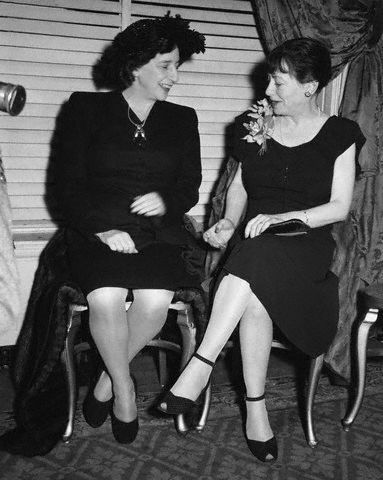
Lillian Hellman and Dorothy Parker

In the same week as International Women’s Day, a BBC headline read “Kylie Jenner becomes world’s youngest billionaire.”  Wow! What are the chances?  And the Beeb, notorious for tagging everyone as a member of some social/political group, didn’t even mention she was a woman.  Now, that, girls and boys, is gender equality.

Actually, I not the least bit shocked to discover that Kylie Jenner is rich enough to buy a small country in Africa and turn it into a tanning salon for herself and her friends.  After all, she’s been on the social media circuit since Paris Hilton was hot, and that was a number of years ago.  (Ms. Hilton’s “leaked” sex tape was 2001.)  Anyway, with more media coverage that an Ebola outbreak, it was almost impossible for Kylie not to get stinkin’ rich.  And I, for one, say, “Good on ya!”  I’ve never been opposed to people using their bodies to make a living; after all, professional athletes do it every day.  Nor am I against self-promotion, although I am wary of such people.  What I do wonder, however, especially on a day like today, is what history’s serious women would think about the antics of contemporary females like Kylie Jenner — self-proclaimed feminists who whore their privacy for trending fame and ungodly gain.  What, for example, would Lillian Hellman have to say, or Martha Gellhorn or the tongue that launched a thousand quips, Dorothy Parker?

For those of you who don’t live on this planet, Kylie Jenner is the latest member of the Kardashian celebrity factory to cash in – big time! – on P.T. Barnum’s maxim “There’s a sucker born every minute”– and Lillian, Martha and Dorothy are her cultural great-grandmothers (from the 1930s) who cut the path for her to do it.

Oddly enough, on International Women’s Day, the last thing this world needs is yet another lesson in feminism.  In fact, there is a significant portion of the population who think people like me (old, heterosexual white men) should just shut up and lay low for 24 hours.  They may have a point; after all, I am a self-confessed relic of a different age.  However, I think we need to stop the gender train for a moment, let everyone take three deep ones and get some historical perspective.

Way back in the day, the women who first strolled through the Men Only door in the media arts were just as young, just as wild and just as controversial as any trending personality we have today.  Make no mistake: Hellman, Parker, Gellhorn and the rest drank and partied to excess.  They smoked Virginia tobacco and Mexican marijuana.  They listened to cool jazz and Cab Calloway’s hot jive.  They had sex with who they wanted; when they wanted.  They married, divorced and frequently took lovers.  They broke rules.  They danced in the streets.  They were young and they acted like it.  However, they were also serious women.  They had something to say and they said it.  Hellman’s The Children’s Hour (1934) dealt with lesbianism before most of America even knew it existed.  Meanwhile, the outspoken Parker was eventually blacklisted for her sharp and uncompromising political views.  At the same time, women like Martha Gellhorn and Margaret Bourke-White were making their bones as legitimate foreign correspondents.  Gelllhorn covered the Spanish Civil War for Collier’s and Bourke-White went to the Soviet Union for Fortune Magazine.  (She was the first Western journalist allowed in, by the way.)  Others, like photojournalist Dorothea Lange, were picturing the Great Depression and painters like Frida Kahlo were painting it.  When these women spoke, people stopped and listened.

Today, a lot of people are going to stop and listen to Kylie Jenner.  They’re going to watch her on TV and follow her on social media.  At twenty-two, her claim to fame is … uh … I don’t know what it is!  However, she and her cohorts are smart business people.  They know what sells, and they’ve packaged themselves as the product.  This is not a sin.

However, on International Women’s Day, I wonder what the women from the 30s would make of what female role models have become.