Technology Is Not To Be Trusted

pdaNot so many years ago, I had a PDA (I still don’t know what that stands for) from Palm.  I loved that little thing.  I carried it with me like a religious icon.  It held all my worldly knowledge and then some.  It was the beginning of the end of my memory because it told me what the phone numbers were, when the birthdays were, where I was supposed to go, what I was supposed to do and even what I’d been thinking two weeks before.  It saved my pictures and played music.  I even typed out a couple of short stories on its tiny screen.  It still holds most of my accumulated life, sitting in a dark closet, silent and forlorn, replaced by a telephone that’s smarter than I am.  My PDA (I called it Oscar) was my first foray into techno-living, and it taught me a valuable lesson: information technology is not to be trusted.

Way back in the day, when Hammurabi wanted to tell his people that goat stealing was a no-no for civilized Babylonians, he made a law.  Then, in order to get the word out, he found a guy with a hammer and chisel and etched that law into stone.  It was a permanent record.  In fact, if you happen to be hanging out at The Louvre and just happen to understand ancient Akkadian cuneiform, you can still read all about it and a whole lot more — in the original text.  Three thousand seven hundred and some odd years later, Hammurabi can reach through history and talk to us in the 21st century.  Cool, huh?  This is information technology in its simplest and most durable form – and it’s universal.  For example, we know that “The Drunks of Menkaure” helped build the Pyramids in Egypt because they carved their name on a rock.  Likewise, we have Sanskrit texts from India, the famous Mayan calendar from Mesoamerica and literally tons of other information from all over the world.  It’s not exactly an Information Super Highway, but we have enough stuff to get a pretty good vibe about what was going on before Herodotus turned history into a paying proposition.  The only problem with “cut into stone” technology is you have to be standing right beside it in order to use it.  It might be permanent, but it sure as hell isn’t portable.

However, our ancestors were an ingenious lot, and after several centuries of trial and error, they came up with a portable semi-permanent product called paper.  Paper and all the information we inscribed on it served our civilization well until the 1980s when Bill Gates and Stephen Jobs killed it dead as Disco.  Jobs, Gates and the boys turned information into electricity, and we’ve been expanding on that ever since.  And therein lies the problem.

Today, I carry all I know and all I need to know in the palm of my hand – including a translation of Hammurabi if I want it.  pda1Unfortunately, without the machine to read it, I have nothing.  Not only that but if my good friends at Google decide to kill the thing (I honestly don’t know what it is) they call Android, I’m totally screwed.  Under some circumstances, I wouldn’t even be able to find my way home.  After all, it’s not like I carry maps anymore – or an address book, or an appointment calendar or even a pen.  But it doesn’t have to actually get that drastic.  For all intents and purposes, most of my (and a lot of other people’s) existence gets put on hold every time the techno somebodies change their minds.  For example, when the Palm operating system went out of business, so did I — for a while.  The information was there (somewhere) but I couldn’t see it.  It was like trying to fit my vinyl recording of Sgt. Pepper into my CD player.  (Yes, I still have both.)

Of course, these days, information isn’t even really “there” anymore.  There is no tangible place (like my old Palm) that has my sisters’ phone numbers or my doctor’s appointment or my nephew’s wedding pictures.  All these things do exist but in such specific formats that one techno-twitch either way and they disappear.  They haven’t been destroyed; it’s just that nobody can see them.  I might have all my information backed up on an SD card or Flash Drive, but without a corresponding slot to put it in or a protocol that recognizes it, my information becomes a lump of factory formed plastic.  And what happens to Grandma’s birthday party if the Cloud goes away?

Don’t get me wrong.  I’m not a 21st century Luddite, but I keep a handwritten address book and my photo albums right beside Oscar the PDA because, these days, information might be portable but it sure as hell isn’t permanent.
 

Happy Birthday, Wikipedia!

wikiWhere does the time go?  I looked around the other day and discovered that Wikipedia was 12 years old.  I remember when it was a stumbling child.  People thought it was cute in those days: an amateur attempt at “all of us are smarter than one of us.”  Of course, real academics frowned on such antics: knowledge was their personal property, and one simply didn’t throw it around promiscuously.  However, even as their teachers scolded, tons of high school students — and more than a few undergrads — were salvaging their GPA with daring midnight raids on Wikipedia’s fact factory.  In the last decade those undergrads have grown up — and so has Wikipedia.  Today, both are shaping the society that a couple of years ago didn’t take either of them seriously.

Wikipedia is the latest attempt at gathering the world’s accumulated knowledge into one mighty force which, since knowledge is power, fears nothing.  The Egyptians tried it, a little over two millennia ago, with The Great Library at Alexandria.  It worked quite well for a couple of centuries, until one sultry night, in 48 BCE, it got in the way of Julius Caesar’s legions, and he burned it down.  Accumulated knowledge has always been at the mercy of fire and the ambitions of politicians.

From that time, despite what various apologists will tell you, it took us seventeen hundred years to try again.  In 1728, Ephraim Chambers, a printer in London, collected everything he and his friends knew to be true, and wrote it down.  The Chambers’ Cyclopaedia wasn’t the first of its kind, nor the best, but protected by the rule of British law and the guns of the newly minted Royal Navy, it not only survived, it grew.  Of course, not to be outdone by their nearest and dearest rivals, the French printed their own encyclopedia, Encyclopedie (Extremely long name) in 1751.  This, in turn, prompted the British to haul in the big boys; awiki1 couple of Scots named Colin Macfarquhar and Andrew Bell, who produced the Encyclopedia Britannica, in 1768.  For the next 250 years, even though there were 1,001 imitations, the Encyclopedia Britannica remained the Big Kahuna of “all ye know” in the world.  And its reputation as the “go-to” guy for “and all ye need to know” was such that the Nazis thought it worthy of incineration in the 1930s.  Had the Nazis spent more time reading books instead of burning them (thanks, Indiana Jones) the world’s knowledge may not have survived the mid 20th century.  Fortunately it did — and after World War II, Britannica (or something like it) migrated to every library and suburban school in the English-speaking world.  It was the greatest mass distribution of knowledge since Gutenberg and a serious blow to a lot of post-war know-it-alls.  Encyclopedias were everywhere, but they still weren’t necessarily everybody’s.  The world’s knowledge was still controlled by an exclusive club.

If you’re of an age, you remember the Encarta discs from the 1990s.  They made every computer in the world a fountain of knowledge, not only readily available, but portable.  Suddenly, everybody from nuclear physicists to primary school children could carry the world’s repository of information in their backpacks — and frequently did.  From there, it was only a few short digital steps to Jimmy and Larry and the final democratization of the accumulated wisdom of the world.

wiki2Jimmy Wales and Larry Sanger launched Wikipedia in January, 2001. It offered the world’s knowledge to the world, without restriction or restraint.  It was information “of the people, by the people, for the people.”  Twelve years later, the sum total of human experience is now available to anyone with a telephone.  Information is no longer the exclusive province of the few – jealously guarded and subject to attack.  Literally billions of people carry it with them, at school, on the bus and where they work.  It cannot be burned, stolen or hidden away.  It is the best defence against the next Adolf Hitler who comes along with a bunch of marching torches and a “better” idea.  The age of the flammable page is over.

Happy Birthday, Wikipedia!  You’ve come a long way, baby!

If You Don’t Understand Our World, Blame Gutenberg!

If you live long enough, you find yourself out of the loop.  You lose touch with your own society.  You don’t understand the language anymore, fashions look scandalous, music is noise, young people are stupid and technology is a battle, not a convenience.  This is why, for the most part, old people are grumpy.  They simply don’t understand the world they live in.  This is the natural order of things, and we all do it.  It’s been going on since Zeus replaced Horus as the god of choice along the Nile.  In essence, we remain brand loyal to the years that made sense to us and we never leave them, regardless of what the rest of the world is doing.  So we fondly remember the 60s or the 20s (or whenever we thought we were cool) and naturally wonder, loud and long what the hell happened to that time.

However, in recent history, this generational disconnection has become more than just a side effect of the trudge to the grave; it’s now happening to young people.  Thirty-year-olds are looking back at the 80s like it was a Golden Age.  Forty-year-olds are wrapping themselves in fashions clearly unsuitable for a widening waistline, and if you’re creeping up on fifty — forget it – you just might as well have been born during Prohibition.  The problem is we live in an age when the layers of knowledge are getting thinner and thinner, and if you miss one, you can never catch up.  Here’s how it works.

For the thousand years or so between the fall of the Roman Empire and the Renaissance, nothing much changed in our world.  Certainly, there were scientific and social advances during that time, but progress was slow.  To your average peasant, one century looked pretty much like the last one: a bit more plague, a little less heretic burning, but no decided differences.  People were born, lived and died in a world dominated by the church, impending famine and war.  Generations of people worked the land, built cathedrals and occasionally bashed each other over the head — for a millennium — with the tools and weapons their ancestors used.  Innovation, when it came, travelled slowly and new ideas were not readily accepted.  The layers of knowledge were thick.

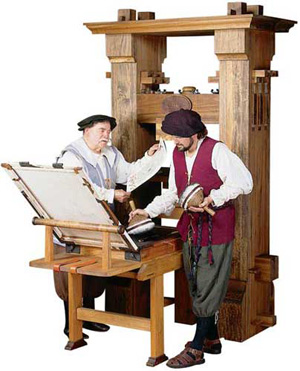
This all changed when a German named Gutenberg built a printing press sometime around 1436.  Suddenly, ideas didn’t have to travel by word of mouth anymore (getting totally screwed up along the way.)  They could be written down and printed in large numbers.  So, if Wolfgang, a Bavarian smart guy, figured out a better way to grind wheat that knowledge was both easily assessable and, more importantly, widely distributed (with no embellishments.)  With this rapid exchange of information, the
layers of knowledge got remarkably thinner.  By the time Pope Urban VIII was threatening to cut off Galileo’s protruding parts for saying the Earth revolved around the sun — not the other way around — in 1633, there was no stopping it.  Galileo may have recanted his discoveries to save his appendages, but his book remained out there for anybody to read.

Thus it was that invention no longer had to rely on the genius of one person to initiate change, nor the local gossipmonger to spread the word about it.  Books changed all that; ideas became permanently available.  Philosophers and scientists could build on each others’ knowledge just by reading each others’ books.  And each innovation was also written about, in turn, thus spawning dozens of refinements that continued the cycle.  The world of ideas expanded exponentially.  The layers of our society’s knowledge became thinner and thinner.

Skip forward two centuries and these days the layers of knowledge are so thin they don’t last more than a couple of years.  Some are added to our world and expanded upon before people are even acquainted with them.  For example, for 99% of history, people looked at a map if they wanted to know where they were going.  In the late 1990s, the GPS system revolutionized that.  However, before anybody could really cash in on a stand-alone GPS device, it became an accessory (App?) on our Smart phones.  The same thing is now happening with digital cameras and MP3 players.  These devices were born, lived and died in less time than it takes an average person to get a PhD in Sociology.

There is no longer a generation gap in our society.  There is only an information gap.  As the world spins ever faster all around us, we long for the security blanket of the objects we’re familiar with – whether they’re electronic devices or social interaction.  Nobody fully understands the world we live in (not that anybody ever did) but in the 21st century, more and more of us are falling further and further behind.  People are downloading information at such a furious rate they can no longer process it properly.  (For example, that last sentence wouldn’t have made sense a couple of generations ago.)   The result is we look with nostalgia on what we remember as a simpler time.  So the next time you see some kid with droopy drawers, talking to what is clearly a teenage prostitute, in a language akin to gibberish, blame it on Gutenberg: he started it all.