
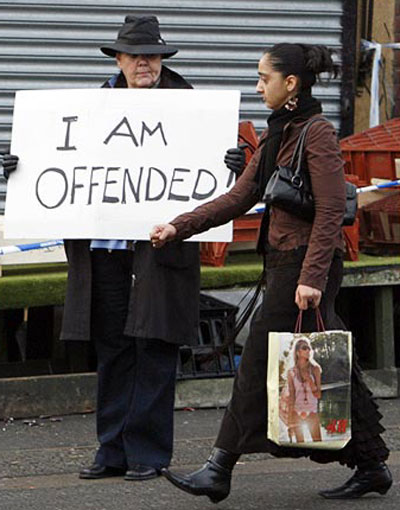
Eagerly Offended: Our Brave New World

offendedI doubt that congratulations are in order, but as of this week, our world finally hit critical mass on the “I am offended” scale.  In less than a day and a half we went from a society that was merely easily offended — by pretty much anything — to one that is now eagerly offended by it.  Therefore, as of close of business, January 30th, 2013, we are currently self sustaining in the injured feelings department and will remain constantly offended by one thing or another for the rest of all time.  My, but we do live in a curious age!

The Malcolm Gladwell Tipping Point, that threw us into this abyss of indignation, came during this week’s hype-up to the Super Bowl.  No, it wasn’t Ray Lewis mouthing off about the devil.  Quite frankly nobody’s on his side (the devil’s that is, not Lewis’.)  Nor was it Taco Bell getting its ass kicked by a bunch of militant vegetarians.  They were the ones who were so offended by Taco Bell’s “attack ad” on healthy eating that they made the faux Mexican fast food chain withdraw its Super Bowl mega-mercial in abject shame.  (Frankly, I never realized vegetarians were an identifiable activist group.  I thought they were just people who didn’t eat meat.)   No, the straw that proverbially pushed us from “easily” to “eagerly” was an innocuous player interview from the three-ring media circus.

The radio interview of Frisco 49er cornerback Chris Culliver (BTW, I’m a Raven’s fan so I have no self interest in defending Mr. Culliver.) was probably cliché-ing along quite nicely when interviewer Artie Lange asked if there were any gay players on the 49ers.  Culliver’s murky, meandering answer amounted to assurances that he was a heterosexual, his team mates were heterosexuals and nobody in the 49ers’ locker room was interested in exploring any alternative sexual orientation for at least a decade.  The loud and proud crowd jumped on the guy faster that you can say leisure-class activist.  They hauled out their own battalion of clichés – homophobia, intolerance, discrimination etc. and made their usual demands – a personal apology, a corporate retraction and some force fed re-education for the offending member.  The 49ers’ organization reacted immediately, tremblingly obeyed, and all was right with the world again.

Unfortunately, as per usual, people were offended by the wrong thing.  It’s offended1beyond my comprehension why nobody was pissed off by the question itself.  Rhetorically speaking, why did Lange even ask it in the first place?  What the hell does homosexuality have to do with football?  I doubt very much if Raven’s Coach Harbaugh (John) called his players together and said, “Listen up!  My brother, over in San Fran, has got himself a couple of homosexuals on defence, so we’re going to overload the strong side on 3rd and long situations.”  Sexual orientation just isn’t part of a winning football strategy.  It would have made just about as much sense for Lange to ask how many Norwegians were on the team; more, actually, since Norway is not what you’d call an American football powerhouse (no offence, Norway.)  Yet, Artie got off scot free (no offence, Scotland, or Dred Scott or whoever — My God, there’s no end to it!)

My point is somebody is always going to be offended by something.  This is as natural as homosexuality itself.  However, bringing up contentious issues at every possible inappropriate opportunity is actively seeking to be offended.  There’s no second choice on this.  Lange didn’t ask the question because he genuinely thought the world needed to know the straight-to-gay ratio on the 49ers.  He askeoffended2d it to see if he would get a stir-the-pot response.  He did.  The usual suspects were shocked and appalled, and our society gasped in some kind of sicko socio-emotional masochistic satisfaction (no offence, masochists.)

It comes down to this: go ahead and be offended if that’s what makes you happy.  However, don’t go striding around as if you’ve just been confronted by the antiChrist.  As of a couple of days ago, it’s pretty obvious that getting offended in our society is something we’re doing on purpose, and it’s now just as institutionalized as the Super Bowl!

Dare I Defend Cliches?

Normally, I’d be the first guy to applaud the death of a cliché.  As everybody within earshot knows, I’ve spent the last two decades praying that the “shocked and appalled” crowd would pack their “imagine my surprise” bag and hit the road.  However, imagine my surprise, the other night when I witnessed the sudden and painful death of “schizophrenia.”  It was a minor incident that left me shocked and appalled.  What happened was, on election night, Tom (Brokaw) and Brian (Williams) were controlling their euphoria and discussing what had just happened to the Republican Party.  It was all fun and games until Brokaw forgot it was 2012 and said something like “Voting patterns are suffering from a kind of political schizophrenia right now.”  The words were hardly out of his mouth when his eyes widened and his hand visibly twitched towards his earpiece.  Obviously, the director up in the sound booth had set off the Politically Correct alarm.  Immediately, Tom started bobbin’ and weavin’ as if he were Muhammad Ali about to tuck into Smokin’ Joe Frazier.  In less than two sentences, we learned that schizophrenia was a debilitating disease, not to be taken lightly, and that the Republicans were a deeply divided party.  Off camera, I imagine the producer was pulling his (or her) hair out as the offended Tweets started coming in, Williams exhaled a mighty sigh of relief it wasn’t he who went off the reservation (“Oops, I didn’t think that!”) and the unpaid squad of interns over at the snack table were laughing their asses off.  Such is the minefield of modern reporting.

As we all learned from Miss Allen, our collective grade school grammar teacher, clichés are bad.  If you use clichés, the rotation of the Earth will be altered and Satan will rise from Hades with his hideous minions to wage unholy war on puppies and kittens.  Just one “round as a barrel” or a thoughtless “white as snow,” and you’ll never get a good job and probably end your days a scabby crack whore, lost and alone.  Even though I know in my heart Miss Allen was right, now that the PC crew have joined the fray, my enthusiasm for the war on clichés has diminished — noticeably.  It’s no secret that the Politically Correct have been up to no good ever since they raised their mindless heads, way back in the 70s.  To say the least, I’m on the horns of a dilemma.  Perhaps clichés are actually our friends, stalwarts who have stood by us through thick and thin, ready, willing and able to quickly communicate complex information with a minimal use of words.  For example, who among us doesn’t know something that is “funny as hell?”

OMG! I may have stumbled through the Politically Correct barrier and now stand friendless in the barren wastes of independent thought.  Hell is, after all, a major component of Judeo-Christian tradition – the particularly nasty bit at the end, actually.  Logically, therefore, it follows (since “humourous Christian” is definitely an oxymoron) that I may have offended some Christians by suggesting that Hell , the ultimate punishment for disobeying God’s law, is in some way comical.  Fortunately, since Christians are pretty much the Rodney Dangerfield of the 21st century, I don’t have to apologize.  However, way more serious than that, I may have offended a myriad of other groups with more powerful friends.  There is a cornucopia of religions out there (Wiccans, Shamanists, the folks who worship Tinker Toys) who do not acknowledge the existence of Hell, and they may be offended that I had the audacity to suggest there is such a place – funny or otherwise.  Besides, there are the Buddhists, Hindus, Zoroastrians and the ever-offended Moslems, who might be offended that my subconscious concept of eternal fire and brimstone is Eurocentric in nature and, therefore, suggests that their Hell is not equally as funny.  And what about the Atheists or the Existentialists or the Secularists?  I may have inadvertently offended three-quarters of the people on this planet!  Hell might actually be the most offensive word in the English language!  In order to satisfy the Politically Correct Fascistas, we may have to cut Hell completely out of our vocabulary!

Hell no!  Not on my watch!

Hell is a perfectly good word, and I shall defend it until they pry the keyboard from my cold, stiff fingers.  However, I am also a caring, sharing man of the 21st century, not insensitive to the sensitivities of others.  I have a compromise.  Why don’t we tap into our proud tradition and just call it the H-word?  It could join the L-word, the R-word, the mildly confusing Other F-word and the wildly popular F-bomb in our pantheon of words we no longer say out loud.  Everyone will still know what we’re talking about, but nobody will actually hear the word.  For example, it could be “hot as the H-word, out there.” Or “If I’m ever chased by zombies, I going to run like the H-word.”  It’s a brilliant and workable solution.

Unfortunately, I’ve run out of time to deal with my cliché situation.  Isn’t it fascinating that politically correct always diverts our attention from the immediate problem at hand?

George Custer Is Not Politically Correct!

Today is the 136th anniversary of the Battle of the Little Big Horn; alternatively called Custer’s Last Stand or the Battle of Greasy Grass (depending on which side of the bowstring you’re on.)  Just in case you were raised by wolves, the Little Big Horn is a river in Montana.  In June 1876, it was the home of several thousand pissed-off Native Americans (Sioux, Cheyenne and Arapaho) who were fed up with being pushed around.  On June 25th, General George Custer showed up — with five companies of the 7th Cavalry — to do some major pushing.  It wasn’t the best time to pick a fight; by the end of the day, George and all his soldiers were dead.

The Little Big Horn is a pivotal event in US history.  It almost exactly bisects the timeline of the American expansion west of the Mississippi.  (Mythology aside, the Old West, as it’s called, lasted barely thirty years.)  It also marked a change in the American attitude towards the indigenous populations of the West.  After Custer, the US military was turned loose to settle some scores.  By 1890, the frontier was officially closed, and America, the modern nation, was moving on to bigger and better things.

I realize that writing about Custer and the Little Big Horn is like running with Politically Correct buffalo.  Like buffalo, the politically correct are short-sighted and ill-tempered.  Chances are good that I’m going to get either trampled or gored.  However, I think I speak for all of us when I say Custer is one of the villains of history.  He wasn’t always that way.  For more than half of the last 136 years, he was a hero.  His picture was admired on literally thousands of walls across America, courtesy of Anheuser-Busch’s famous but woefully inaccurate painting of Custer’s Last Stand.  It’s only in my lifetime that the painting was taken down and Custer grew fangs and started spitting green saliva.  That’s the nature of interpretive history, though.  As Mort Sahl once said, “If you keep a consistent political position, you’ll eventually get tried for treason.”  That’s kinda what happened to Custer.  When the political winds began to change, he was too dead to change with them.  You see, history doesn’t change; historians do.

In the last 50 years, Custer has been called everything but nice.  He has been portrayed as a megalomaniac; a glory hound, building his political career on the bodies of dead Cheyenne babies; a walking insane asylum; and everything in between – including a nepotist and an unfaithful husband.  It’s now universally accepted that hell itself couldn’t hold half his nastiness.  He is the poster boy for America’s racist, money-grubbing theft of the continent it now occupies.  Unfortunately, these charges could be directed against any 19th century American who took Horace Greeley’s (John Soule’s, actually) advice to “Go West, young man.”  (The insane asylum crack, however, is just Hollywood’s way of making amends for Errol Flynn’s They Died with Their Boots On.)  Actually, calling Custer a racist is redundant; they all were, including his boss President Ulysses S. Grant — the guy who led the charge when his boss, at the time, Abraham Lincoln, wanted to free the slaves.

I’m not trying to start an “I Love Custer” club, but regurgitating, history half digested, in order to support a moral judgement is how we lose sight of our historical legacy.  In fact, representing Custer as a man with character flaws large enough to drive a stagecoach through is actually postulating that it’s no wonder he got everybody killed at Little Big Horn; the guy was a mess.  This is the soft prejudice that usually accompanies politically correct.  In the end it’s always about us, and everybody else is just a reflection.  The last thing these nouveau historians are willing to admit is that a brilliant military leader named George Custer got out generalled by a guy who didn’t wear pants.

The truth is Custer wasn’t drunk, crazy or incompetent, nor was he morally bankrupt and he didn’t torture kittens on his day off.  He was just a man of his times.  On June 25th, 1876, he planned a classic enveloping maneuver to trap the Sioux and was beaten when Crazy Horse out manoeuvred and outfought him.  Like it or not, Custer was good at what he did.  It just so happened that Crazy Horse was better.  There’s nothing wrong with that.  There don’t have to be mitigating circumstances or moral turpitude to explain the Sioux victory.  The truth is General Custer (like Captain Fetterman* ten years before him) ran into a 19th century military genius named Crazy Horse, who used his limited resources, the terrain and his opponent’s arrogance to win overwhelming victories.  It’s that simple.

Contemporary historians would lead us to believe that, after the Civil War, swarms of snarling swindlers headed west, armed with Winchester rifles and the single evil purpose of destroying everything in their path.  The robbed, raped and pillaged their way to the Pacific because the indigenous peoples were too pastorally ignorant to stop them or even figure out what was going on.  This makes for good reading in sophomore textbooks, but in actual fact, it’s nothing more than another Anheuser-Busch painting with an academic bibliography.

When we bother to look, history tells us that in the second half of the 19th century, two nations — the United States and the Lakota Sioux — fought it out for supremacy on the northern plains.  Both were a dynamic people.  The outcome was never in doubt: the United States had overwhelming advantages, yet the Lakota Sioux and their allies managed to keep them at bay for a generation.  In the middle of that conflict, on a sunny day in June, the United States 7th cavalry went looking for a fight and got their ass kicked.  That’s what happened 136 years ago; I don’t care how you paint the picture.


*Captain William Fetterman may or may not have boasted, “Give me eighty men and I’ll ride through the whole Sioux nation,” but when he did get a crack at it, he got less than 500 yards.  On December 21st, 1866, Fetterman, 79 soldiers and two curious civilians marched out of Fort Phil Kearny to relieve a work party that was under attack.  Taunted by Crazy Horse and a few of his Oglala buddies, they crossed Lodge Trail Ridge and walked into an elaborate ambush.  He and his entire command were killed.