(Sorry for the title. I know it’s cheap but I couldn’t resist.)
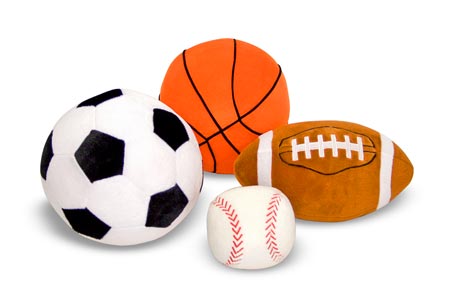 For the 6,994,000,000 or so people in the world who are blissfully unaware that Toronto, Canada is the centre of the universe, a public school there, one Earl Beatty Junior and Senior, has banned balls. You can read about it here. This has caused some controversy and an immediate reaction from conservative parents in the district. At a time when there is increasing pressure from activist groups to derail progressive policies, we need to set the record straight with a few facts.
First of all, the school did not ban all balls. They merely directed parents to be aware that all “hard” balls (up to and including but not limited to) footballs, soccer balls, baseballs, basketballs, volleyballs and probably bowling balls would be confiscated if students brought them to school. Balls made out of sponge, or nerf material would still be perfectly acceptable and students would be encouraged to enjoy them during supervised recreation.
Secondly, although an outright ban on balls might seem heavy-headed, the school’s reaction was the direct result of a ball-related injury which required hospitalization. Luckily, it was a parent coming to pick up her child who was injured, not a student. However, in light of this single event, the school immediately took a proactive approach to prevent any innocent child from getting a noggin floggin’ in the future.
Thirdly, we need to remember that a ball in the hands (or feet) of a child can lead to a potentially dangerous situation. They may kick or throw it! Young people have not yet developed the cognitive, judgemental or motor skills to properly handle a ball. Make no mistake: without the proper skills, balls are missiles, capable of causing great harm – a quick review of America’s Funniest Home Videos is documented proof of this.
 Fourthly, overwhelming medical evidence proves a direct link between the use of balls by children and injury. A study conducted by the American Academy of Pediatrics in 1994 (this is real, by the way) found that between 2 and 8% of all children who play Little League Baseball suffer some kind of injury. Although there are no hard statistics to show the severity of these injuries, or whether or not they occurred as an immediate result of contact with a ball, they all happened in a ball environment. We cannot dismiss these findings as natural or “part of growing up.” It’s obvious that if these children had not been playing Little League Baseball, they would not have come to grievous bodily harm.
Let’s be clear: the banning of balls at Earl Beatty Junior and Senior is a progressive step which could lead to a number of positive outcomes. It’s a known fact that children left unattended with a ball will attempt to play a game. Group games, as we know, are detrimental to a child’s emotional growth. They create “winners” and “losers” a concept which can irreparably damage a child’s self esteem. It is far better to engage young people in activities that focus on individual skill development and provide positive reinforcement than rank their performance on an artificial scale.
Furthermore, we know that most games played with a ball in North America are Eurocentric (soccer, baseball, basketball etc.) forced on the rest of the world during the colonial and neocolonial periods. By eliminating the symbol of oppression, the ball, we allow our children to experience the true diversity of our society at the most primal level — play. Our children are free to explore, without being constrained by a narrow European model. In our changing society, stressing our diversity is very important.
In a much wider sense, the Earl Beatty ban on balls — if viewed in an open, unbiased manner — could result in a district-wide ban, or even a city-wide ban. This would encourage our entire nation to open a dialogue on the role of balls in our society. Perhaps, this could eventually lead to a national “hard” ball registry. We could then control the indiscriminate use of balls and limit their impact to those who would play with them responsibly.
The future is bright, my friends. We can change our world and make it a safer place for our children.
 However, there are some in our society who don’t want change. They wish to turn the clock back to a darker time when balls created fear in the youngest and most vulnerable among us. Against those people, we must stand firm. We must send a strong message that hope is better than fear. We must tell them that when any child is put at risk, that is not acceptable. When it is within our power to spare any child needless pain and suffering, we are morally obligated to do it. Children are our future. They are our most precious natural resource.




 WD Fyfe